
Smart Perimeter Monitoring Delivers 80%+ Safety Accuracy in Doha (Qatar) Metro Projects
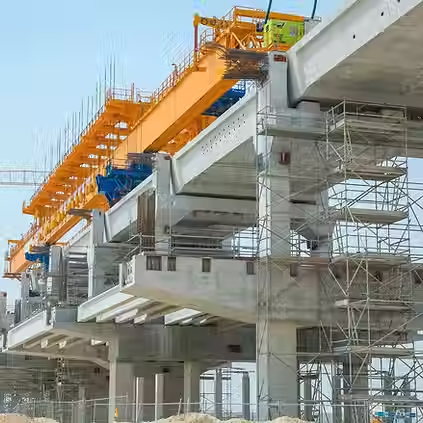
A transit-oriented development linked to the Doha Metro extension faced major safety risks as dense commuter flows intersected with active high-rise construction works. Pedestrians often attempted to cross into restricted areas, while crane lifts and vertical operations increased accident potential. These incidents posed threats to both workers and thousands of metro passengers daily. To address this, one of the vendors deployed viAct AI-powered perimeter intrusion module ensuring round-the-clock perimeter monitoring, real-time intrusion alerts, and proactive risk prevention across the site.

70% Decrease in Manual Patrolling Needs,
freeing supervisors for high-value tasks.

3x Faster Emergency Response Time
enabled by instant AI-triggered notifications.

Zero Major Public Safety Breaches
recorded across the construction–commuter interface.
Project Overview
The Doha Metro extension is a large-scale transit-oriented development connecting high-density urban areas with metro corridors. Alongside commuter infrastructure, the project integrates commercial spaces and high-rise developments, demanding seamless coordination between ongoing construction and uninterrupted passenger movement. Ensuring public safety at this interface became a critical priority for stakeholders.
Story Snapshot
High commuter density and repeated restricted-zone intrusions created recurring safety risks at the construction metro interface. With viAct AI-powered perimeter instruction detection, the project achieved a 40% reduction in near-miss incidents, ensured 24/7 automated oversight across 5 active sites, and delivered safer commuter–construction interaction with zero major public safety breaches.

Industry:
Infrastructure

Location:
Doha, Qatar

Use Case:
Perimeter Intrusion
The Challenge
Protecting Commuter Safety Alongside Metro Construction Project
During the Doha Metro extension, thousands of commuters passed daily alongside active construction zones. Despite barricades and safety signage, pedestrians frequently attempted to cross into restricted areas, creating recurring risks of accidents near heavy equipment and moving vehicles.
Manual patrolling alone was not enough. Supervisors could not maintain constant oversight across multiple access points, and intrusions were often noticed only after pedestrians had already entered hazardous areas. This reactive model left gaps in public safety enforcement, increasing the potential for near misses and unsafe commuter–construction interactions.
To overcome this, project stakeholders required a digital solution capable of 24/7 real-time perimeter monitoring, instant intrusion alerts, and proactive intervention ensuring that public safety was never compromised during metro expansion.

“In such high-footfall transit zones, even one breach into restricted areas could have severe consequences. With viAct AI, every intrusion is captured in real time, enabling swift action and securing the commuter–construction interface.”

Safety Supervisor,
Doha Metro Extension Project, Qatar
The Solution
AI-Powered Perimeter Intrusion for Metro Construction Safety
To address recurring safety breaches, one of the vendors implemented viAct AI-powered Perimeter Intrusion Monitoring along key sections of the Doha (Qatar) Metro extension. Existing site cameras were enhanced with AI modules, enabling continuous observation of restricted entry points and pedestrian interfaces without requiring additional manpower.
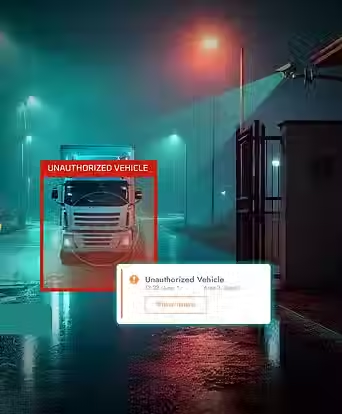
When an intrusion was detected, the system triggered onsite alarms and sent real-time alerts to supervisors. These alarms provided an immediate deterrent, notifying intruders directly and prompting them to step back before entering deeper into hazardous zones. Automated logs further helped supervisors identify patterns, such as specific times or locations where intrusions were more common. Both workers and commuters benefited from faster intervention and safer movement across high-traffic transit areas, while construction progress continued without major disruptions.
“Earlier, we often found intruders already inside restricted zones. Now alarms warn them instantly, and we can act before risks escalate,” said the Safety Supervisor, Doha Metro Extension Project.
“The AI system gave us confidence that safety risks around commuter areas were controlled without slowing down construction progress,” added the Project Director of the Metro Expansion Project.
Consistent Perimeter Protection Beyond Manual Patrolling
Traditional safety measures relied heavily on manual patrols, which often left blind spots and inconsistent coverage across large construction zones. Supervisors could not be everywhere at once, and intrusions were sometimes detected only after pedestrians had already entered restricted areas.
The Perimeter Intrusion Detection module filled these gaps by providing continuous, scenario-based monitoring of all critical entry points. The system tracked multiple zones simultaneously, triggering real-time alerts and onsite alarms the moment unauthorized access was attempted. By reducing dependence on manual patrols and eliminating lapses in human oversight, the solution ensured more consistent protection of active worksites. This proactive, always-on monitoring strengthened public safety at commuter interfaces, minimized near-miss incidents, and created a unified layer of assurance across the entire project footprint.

Mitigating Surveillance Blind Spots in Perimeter Safety
Beyond reducing manual patrolling, viAct perimeter instruction monitoring addressed blind spots caused by poor lighting, physical obstructions, or limited camera angles. Real-time detection ensured that intrusions were flagged instantly, even in areas that human guards or conventional CCTV might overlook. Automated event logs created in the viAct dashboard provided complete visibility, while dashboards enabled supervisors to track safety coverage across multiple access points.
“This continuous oversight closed the gaps we previously struggled with at night or in obstructed areas. Intrusions are now caught the moment they happen, giving us consistent protection and greater confidence in public safety.”, Project Director, Doha Metro Extension Project

The Impact
Strengthening Public Safety and Operational Confidence with AI-Powered Monitoring
The deployment perimeter intrusion module went beyond preventing immediate accidents. By ensuring continuous oversight of commuter–construction interfaces, the project established a stronger culture of safety and discipline across the entire workforce. Automated detection and onsite alarms reduced repeat intrusions, enhanced commuter awareness, and enabled supervisors to redirect their focus to higher-value safety planning instead of routine patrolling.
In the longer term, the system provided consistent assurance that public safety could be safeguarded alongside rapid metro expansion. This reliability strengthened stakeholder confidence, supported smoother project delivery, and set a benchmark for how AI-driven safety systems can be scaled across future infrastructure developments in high-density urban areas. Ultimately, viAct helped shift site safety from reactive enforcement to proactive protection, embedding trust, efficiency, and resilience into the metro extension project.
“With AI continuously monitoring perimeters, safety is no longer left to chance. Commuters are protected, our teams are empowered, and the project progresses with greater confidence.”
Safety Officer,
Doha Metro Extension (Qatar)