
AI Guide to EHS in Logistics and Supply Chain Operations
Discover how Artificial Intelligence is transforming Environment, Health, and Safety (EHS) across modern logistics and supply chain operations. Explore AI-powered Computer Vision, Video Analytics, Edge AI, IIoT, Digital Twins, smart wearables, LiDAR, and Generative AI to identify risks, improve worker safety, strengthen compliance, enhance operational efficiency, and build a more proactive and resilient supply chain.
Augest 10, 2026

Hugo Cheuk
COO
In this guide
Understanding Logistics & Supply Chain EHS
Environment, Health, and Safety (EHS) has become a critical part of modern logistics operations, helping organizations manage risks across diverse facilities and interconnected processes. From warehouse operations and loading docks to transport yards and cargo terminals, every stage of the supply chain presents unique safety and environmental considerations that require a proactive and coordinated approach.
What is EHS in Logistics and Supply Chain Operations?
EHS in logistics and supply chain operations refers to the policies, processes, and technologies used to protect people, assets, and the environment throughout the movement, storage, and distribution of goods. It focuses on identifying workplace hazards, preventing accidents, ensuring regulatory compliance, and promoting sustainable operations.
Logistics EHS covers the entire supply chain ecosystem, including warehouses, distribution centers, fulfillment centers, loading docks, transport yards, airport cargo terminals, and seaport facilities. Each environment presents unique risks, from forklift collisions and manual handling injuries to fire hazards and vehicle interactions.
As logistics operations become more complex, organizations are adopting AI-powered technologies such as Computer Vision, AI Video Analytics, Edge AI, and IIoT to monitor operations in real time, detect unsafe conditions, and improve compliance. These technologies help businesses shift from reactive incident management to proactive risk prevention while improving operational efficiency.
Why is EHS Critical Across the Logistics and Supply Chain Ecosystem?
Logistics operations involve the constant movement of people, vehicles, equipment, and goods across multiple facilities. A single safety incident can disrupt warehouse operations, delay deliveries, damage inventory, and affect the entire supply chain.
Effective EHS protects employees, reduces operational downtime, supports regulatory compliance, and strengthens business continuity. It also helps organizations improve productivity, reduce costs associated with workplace incidents, and achieve Environmental, Social, and Governance (ESG) objectives.
With AI-enabled monitoring and predictive analytics, businesses can identify risks earlier, respond faster, and create safer, more resilient logistics operations.
Which Operational Environments Are Covered Under Logistics EHS?

Logistics EHS applies to every facility involved in the movement, storage, and distribution of goods. This includes:
-
Warehouses
-
Distribution Centers
-
Fulfillment Centers
-
Cross-Docking Facilities
-
Loading Docks
-
Truck Yards and Logistics Parks
-
Cold Storage Facilities
-
Airport Cargo Terminals
-
Seaport Container Terminals
-
Rail Freight Terminals
-
Last-Mile Delivery Hubs
Each environment presents different operational, environmental, and workplace safety risks. A unified EHS strategy helps organizations maintain consistent safety standards, improve visibility, and reduce risks across the entire logistics network.
How Is Logistics EHS Different from Warehouse-Only Safety?
Warehouse safety focuses on protecting workers, equipment, and inventory within a warehouse through measures such as forklift safety, material handling, fire prevention, and housekeeping.
Logistics EHS takes a broader approach by managing health, safety, and environmental risks across the entire supply chain. It includes warehouses as well as distribution centers, transport yards, loading docks, airport cargo terminals, seaports, rail freight facilities, and delivery networks.
By combining AI, Computer Vision, IIoT, and real-time monitoring, logistics EHS provides centralized visibility across multiple facilities, helping organizations improve safety, maintain compliance, and ensure uninterrupted supply chain operations.
Common EHS Challenges in Logistics
Unlike static work environments, logistics operations are constantly changing. Fluctuating workloads, seasonal demand, third-party contractors, automated equipment, and time-sensitive deliveries create dynamic conditions that can increase operational risks if not managed effectively.
What are the biggest EHS challenges in modern logistics operations?
Modern logistics operations are more interconnected and fast-paced than ever before. Warehouses, distribution centers, transport hubs, and cargo terminals must handle increasing shipment volumes, tighter delivery schedules, and growing customer expectations while maintaining safe working environments. This operational intensity introduces a wide range of EHS challenges, including vehicle traffic, material handling, hazardous substances, ergonomic risks, and emergency preparedness.
Additionally, the rise of automation, temporary workforces, third-party logistics (3PL) providers, and multi-site operations has made it more difficult to maintain consistent safety standards across the supply chain. Organizations must not only protect employees but also ensure regulatory compliance, minimize environmental impacts, and maintain business continuity. Successfully managing these interconnected challenges requires a proactive EHS strategy that balances operational efficiency with worker safety and environmental responsibility.
Why do incidents continue despite existing safety procedures?
Most logistics companies have safety policies, training programs, and standard operating procedures in place. Yet incidents continue because logistics environments are constantly changing. A loading dock that was clear five minutes ago may become congested with trucks, forklifts, pallets, and workers. During peak hours, employees often work under tight deadlines, increasing the likelihood of missed safety checks, rushed decisions, or temporary shortcuts to keep operations moving. In large facilities, supervisors cannot be everywhere at once. Unsafe behaviors, blocked walkways, improper PPE use, equipment faults, or vehicle–pedestrian conflicts can easily go unnoticed until an incident or near miss occurs. As logistics operations become faster and more complex, relying solely on periodic inspections and manual supervision is no longer enough to identify and address risks in real time.
What factors make logistics operations high-risk environments?
Logistics operations involve the continuous movement of goods, people, and heavy equipment across multiple interconnected facilities. Unlike controlled manufacturing processes, logistics environments are constantly changing, with vehicles arriving and departing, inventory shifting, and workers performing diverse tasks throughout the day. This dynamic nature increases the likelihood of unexpected hazards and operational disruptions. Several factors contribute to these elevated risks, including high traffic volumes, shared workspaces between pedestrians and vehicles, manual material handling, heavy lifting, loading dock activities, and the operation of forklifts, conveyors, and automated equipment. Seasonal demand spikes, contractor activities, and around-the-clock operations further increase workplace complexity. As logistics networks continue to expand, organizations must effectively manage these evolving risks while maintaining productivity and compliance across multiple operational environments.
How do human, vehicle, and equipment interactions increase safety risks?
Safe logistics operations depend on the seamless coordination of workers, industrial vehicles, and material handling equipment. Forklifts, trucks, pallet jacks, automated guided vehicles (AGVs), cranes, and conveyor systems frequently operate within the same spaces as employees, creating numerous interaction points where accidents can occur. Poor visibility, blind spots, reversing vehicles, distracted workers, and congested work areas significantly increase the risk of collisions, struck-by incidents, and near misses. As facilities adopt greater levels of automation, managing safe interactions between people and machines becomes even more important. Effective traffic management, clearly defined pedestrian routes, equipment maintenance, and continuous monitoring are essential for reducing risks and creating safer working environments throughout logistics operations.
Why is manual safety monitoring no longer sufficient?
Traditional safety management relies on routine inspections, CCTV monitoring, checklists, and supervisor observations. While these remain essential, they cannot provide continuous oversight in fast-moving logistics environments. Hazards such as unsafe behaviors, PPE violations, blocked exits, equipment faults, or unauthorized access can develop between inspections and go unnoticed. As logistics operations become larger and more dynamic, organizations need continuous visibility to identify risks early and respond before incidents occur.
Connecting Logistics Operations with Supply Chain Safety
Logistics and supply chain are often used interchangeably, but they represent different aspects of the same operational ecosystem. Logistics focuses on the planning, movement, storage, and distribution of goods, while the supply chain encompasses the broader network of organizations, processes, and resources involved in delivering products from origin to end customer. Because these functions are closely interconnected, decisions made within logistics operations can influence the efficiency, reliability, and resilience of the entire supply chain.
Understanding this relationship is essential for developing effective EHS strategies. This section explores how logistics activities interact with the wider supply chain and why organizations should view EHS as a shared responsibility across connected operations rather than as isolated safety initiatives.
How do logistics activities create safety risks throughout the supply chain?
Logistics activities form the operational backbone of the supply chain, connecting procurement, warehousing, transportation, distribution, and final delivery. As goods move through each stage, they are handled by people, vehicles, and equipment across multiple facilities. Delays, equipment failures, unsafe handling practices, vehicle incidents, or operational errors at any point can disrupt the flow of goods and create safety risks that extend beyond a single location. Managing these risks is essential to maintaining supply chain continuity, protecting workers, and ensuring efficient operations.
Why is a unified EHS strategy important across logistics and supply chain operations?
Logistics and supply chain operations involve multiple facilities, teams, contractors, and transportation networks, making consistent safety management a significant challenge. A unified EHS strategy establishes common safety standards, risk management practices, and compliance procedures across all operational environments. This improves visibility, reduces safety gaps between facilities, strengthens emergency response, and helps organizations maintain operational continuity while ensuring worker safety and regulatory compliance throughout the supply chain.
AI for Logistics and Supply Chain EHS
Artificial Intelligence (AI) is transforming how logistics and supply chain organizations manage Environment, Health, and Safety (EHS). Instead of relying solely on manual inspections and reactive incident reporting, AI enables continuous monitoring, real-time risk detection, predictive insights, and data-driven decision-making across interconnected logistics operations. From warehouses and distribution centers to transport yards, ports, and cargo terminals, AI helps organizations create safer, more efficient, and resilient supply chains.
What is AI-powered EHS for Logistics and Supply Chain?
AI-powered Environment, Health, and Safety (EHS) combines Artificial Intelligence with digital technologies to continuously monitor, analyze, and improve safety across logistics and supply chain operations. Unlike traditional EHS programs that rely on manual inspections, incident reports, and periodic audits, AI provides real-time visibility into workplace conditions, helping organizations detect hazards, automate compliance, and respond faster to emerging risks.
By leveraging technologies such as Computer Vision, AI Video Analytics, Edge AI, Industrial IoT (IIoT), and Digital Twins, AI-powered EHS enables organizations to proactively manage safety across warehouses, distribution centers, loading docks, transport yards, airport cargo terminals, and seaport facilities. This shift from reactive to predictive safety helps reduce workplace incidents while improving operational resilience and compliance.
How does AI improve workplace safety across logistics operations?
AI improves workplace safety by continuously monitoring logistics activities and identifying unsafe conditions that may be missed during manual inspections. Instead of relying solely on human supervision, AI analyzes live video feeds and sensor data to detect hazards in real time and immediately notify relevant personnel.
For example, AI can:
-
Detect workers not wearing required PPE.
-
Monitor forklift–pedestrian interactions to prevent collisions.
-
Identify unsafe loading dock activities.
-
Detect fire, smoke, or hazardous material leaks.
-
Recognize blocked emergency exits and evacuation routes.
-
Monitor unauthorized access to restricted areas.
-
Identify improper material stacking that may lead to falling objects.
By providing instant alerts, AI helps organizations respond quickly, reduce workplace incidents, and create safer working environments across logistics facilities.
How does AI detect risks before accidents occur?
Rather than reacting after an incident, AI continuously analyzes workplace activities to identify patterns that indicate potential risks. Using machine learning and computer vision, AI recognizes unsafe behaviors, equipment anomalies, and operational trends that could lead to accidents if left unaddressed.
For instance, AI can detect repeated near misses between forklifts and pedestrians, identify congestion around loading docks, recognize unsafe vehicle speeds, or monitor recurring PPE violations in specific work zones. Over time, these insights reveal high-risk areas and recurring safety issues, enabling organizations to implement corrective actions before incidents occur. This predictive approach helps reduce accidents, improve risk management, and strengthen overall supply chain resilience.
Which AI technologies are transforming Logistics & Supply Chain EHS?
Modern logistics EHS is powered by multiple AI technologies working together to provide comprehensive safety and operational visibility. Computer Vision and AI Video Analytics analyze CCTV footage to detect unsafe behaviors and hazards in real time. Edge AI processes data locally for faster response times, while Industrial IoT (IIoT) connects cameras, sensors, and equipment to deliver continuous operational insights.
Other technologies such as Digital Twins simulate logistics environments to evaluate risks, LiDAR improves object detection and spatial awareness in complex facilities, Smart Wearables monitor worker safety, and Autonomous Inspection using drones enhances monitoring of large or hard-to-reach areas. Generative AI and AI Agents further support EHS teams by summarizing incidents, generating reports, and providing actionable recommendations for decision-making.
How does AI support both safety and operational efficiency?
Safety and operational efficiency are closely connected. When workplaces are safer, disruptions decrease, equipment operates more reliably, and employees can perform their tasks more efficiently. AI helps organizations achieve both by providing continuous visibility into operations and enabling faster, data-driven decision-making.
For example, detecting forklift congestion can reduce collision risks while improving traffic flow. Monitoring loading dock operations helps prevent unsafe practices and minimizes loading delays. Predictive maintenance reduces equipment failures, improving both worker safety and asset availability. Automated compliance monitoring also reduces the time spent on manual inspections and reporting.
By reducing incidents, minimizing downtime, optimizing workflows, and improving resource utilization, AI transforms EHS from a compliance function into a strategic driver of operational excellence across the logistics and supply chain
AI Applications Across Logistics Operations
Artificial Intelligence (AI) is reshaping the logistics and supply chain industry by enabling organizations to manage increasingly complex operations with greater intelligence, speed, and precision. As logistics networks continue to expand, businesses require smarter solutions that can improve visibility, strengthen safety, optimize workflows, and support informed decision-making across interconnected operations.
Today, AI is being applied across a wide range of logistics processes to automate monitoring, analyze operational data, identify potential risks, and enhance overall performance.
How does AI improve warehouse and distribution center safety?

Warehouses and distribution centers are among the busiest environments in the logistics and supply chain ecosystem, where workers, forklifts, conveyors, storage systems, and inventory operate simultaneously. AI improves safety by continuously monitoring these activities through Computer Vision, AI Video Analytics, and Edge AI, enabling organizations to detect hazards in real time rather than relying solely on manual inspections.
AI can identify unsafe forklift operations, pedestrian-vehicle interactions, improper material stacking, blocked emergency exits, restricted area violations, and slip or fall hazards. It also helps optimize warehouse traffic flow, monitor storage conditions, and identify operational bottlenecks that may increase safety risks. By providing instant alerts and actionable insights, AI enables faster corrective actions, reducing workplace incidents while improving warehouse productivity, inventory movement, and overall operational efficiency.
How does AI enhance loading dock, yard, and fleet safety?
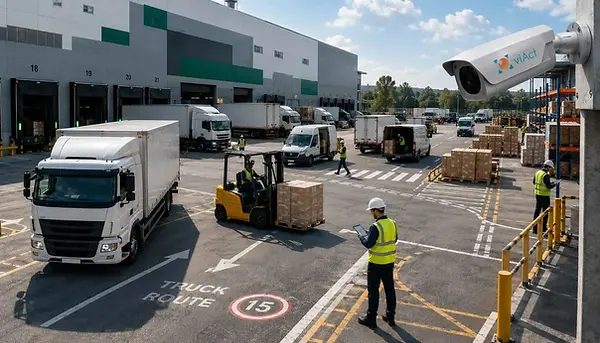
Loading docks, transport yards, and fleet operations are high-risk areas where heavy vehicles, equipment, and personnel interact continuously. AI enhances safety by monitoring vehicle movements, loading and unloading activities, trailer positioning, and pedestrian zones in real time. Using Computer Vision, AI Video Analytics, and Intelligent Traffic Monitoring, AI identifies unsafe reversing, speeding, unauthorized vehicle movements, unsafe loading practices, and potential collision risks before incidents occur.
AI also improves fleet safety by monitoring driver behavior, vehicle occupancy, parking compliance, and designated traffic routes across logistics facilities. Real-time alerts allow supervisors to respond quickly to unsafe situations, reducing vehicle-related incidents and improving traffic coordination. Beyond safety, these insights help optimize vehicle flow, minimize congestion, reduce loading delays, and improve overall logistics efficiency.
How does AI monitor worker behavior and PPE compliance?
Maintaining safe worker behavior is essential for reducing workplace incidents across logistics operations. AI continuously analyzes workplace activities to detect unsafe behaviors and verify compliance with established safety procedures. Using Computer Vision and AI Video Analytics, AI can identify whether workers are wearing mandatory Personal Protective Equipment (PPE) such as helmets, safety vests, gloves, goggles, or safety shoes before entering designated work zones.
Beyond PPE detection, AI can recognize unsafe actions such as entering restricted areas, standing beneath suspended loads, unsafe manual handling practices, distracted behavior, or failure to follow designated pedestrian routes. Instead of replacing safety supervisors, AI acts as an additional layer of continuous monitoring, providing real-time notifications that enable immediate intervention. This helps organizations strengthen safety culture, improve regulatory compliance, and reduce the likelihood of human-related incidents.
How does AI improve emergency response and incident management?
Rapid response is critical during workplace emergencies, where even a short delay can increase risks to people, assets, and operations. AI improves emergency response by continuously monitoring logistics facilities for incidents such as fires, smoke, chemical leaks, equipment failures, unauthorized access, and worker distress. Once a hazard is detected, AI automatically generates real-time alerts, allowing safety teams to respond immediately.
AI also supports incident management by capturing event data, recording timelines, identifying contributing factors, and generating automated reports for investigation and compliance purposes. During emergency evacuations, AI can monitor evacuation routes, identify blocked exits, and track occupancy levels to improve situational awareness. By reducing response times and providing accurate operational insights, AI helps organizations minimize disruption, protect workers, and improve overall emergency preparedness.
How does AI support environmental monitoring and regulatory compliance?
Environmental compliance has become an essential part of modern logistics and supply chain operations. AI helps organizations monitor environmental conditions and regulatory requirements by analyzing data from cameras, sensors, and connected devices in real time. It can detect smoke, fire, hazardous material leaks, improper waste disposal, spill events, and environmental hazards that may affect worker safety or regulatory compliance.
AI also automates routine compliance activities by monitoring PPE usage, restricted area access, housekeeping standards, emergency equipment availability, and safety procedures across multiple facilities. Automated reporting, digital audit trails, and centralized dashboards simplify inspections and support compliance with standards such as ISO 45001, ISO 14001, and local occupational safety regulations. This enables organizations to reduce compliance risks while strengthening both EHS performance and sustainability initiatives.
Core Technologies Behind AI-Powered Logistics EHS
Modern logistics and supply chain operations generate vast amounts of safety and operational data across people, equipment, facilities, and connected systems. AI-powered EHS brings these data sources together to create greater visibility and support faster, more informed safety decisions. This section explores the key technologies that enable this connected approach, from intelligent video monitoring and real-time edge processing to IoT, spatial intelligence, wearables, autonomous inspection, and Generative AI. Together, these technologies form the foundation for a more connected, proactive, and data-driven approach to EHS across logistics operations.
How does Computer Vision improve logistics safety?
The rapid advancement of Artificial Intelligence (AI) has transformed how logistics and supply chain organizations approach Environment, Health, and Safety (EHS). Rather than relying on a single technology, modern AI-powered EHS solutions combine multiple intelligent systems that work together to monitor operations, analyze data, identify risks, and support faster decision-making. These technologies create a connected digital ecosystem that provides greater visibility across logistics operations, enabling organizations to strengthen workplace safety, improve compliance, enhance operational efficiency, and build more resilient supply chains. Understanding these core technologies is essential for organizations looking to accelerate their digital transformation and unlock the full potential of AI-driven EHS.
What role does AI Video Analytics play in EHS management?
Computer Vision enables logistics organizations to transform conventional CCTV cameras into intelligent monitoring systems that continuously observe workplace activities without requiring constant human supervision. Instead of simply recording footage, Computer Vision identifies people, vehicles, equipment, and workplace conditions in real time, allowing organizations to detect unsafe behaviors before they escalate into incidents.
Across logistics operations, Computer Vision can monitor forklift–pedestrian interactions, unsafe material handling, restricted area access, loading dock activities, improper pallet stacking, and emergency exits. It also supports automated PPE verification, vehicle movement analysis, and hazard detection across warehouses, distribution centers, transport yards, airport cargo terminals, and seaports. By providing continuous operational visibility, Computer Vision helps organizations reduce workplace risks, improve compliance, and make faster safety decisions.
How do Edge AI, IIoT, and Digital Twins work together?
AI Video Analytics enhances EHS management by automatically analyzing live CCTV footage to detect safety risks, operational deviations, and compliance violations in real time. Rather than relying on manual CCTV monitoring, the system continuously identifies unsafe conditions and immediately alerts supervisors, enabling faster response and corrective action.
AI-powered safety monitoring has reported up to 90% fewer safety breaches, 80% fewer workplace incidents, and 95% AI detection accuracy, enabling faster intervention and stronger compliance.
For logistics operations, AI Video Analytics can detect PPE violations, unsafe forklift movements, near misses, unauthorized access, loading dock hazards, warehouse congestion, and unsafe cargo handling, providing EHS teams with actionable insights that improve workplace safety and operational performance.
How do LiDAR, smart wearables, and autonomous inspection enhance worker protection?
LiDAR, smart wearables, and autonomous inspection technologies complement AI-powered monitoring by improving situational awareness in complex logistics environments. LiDAR accurately measures distance and movement, helping detect obstacles, monitor vehicle proximity, and improve navigation in busy operational areas. Smart wearables monitor worker location, movement, and emergency conditions, enabling faster response during incidents while supporting lone-worker protection. Autonomous inspection using drones or robotic systems allows organizations to inspect high-risk or difficult-to-access areas without exposing personnel to unnecessary hazards.
Together, these technologies provide an additional layer of protection by improving hazard detection, reducing manual inspections, and strengthening workplace safety across warehouses, transport yards, cargo terminals, and other logistics facilities.
How do Generative AI and AI Agents support EHS teams?
Generative AI and AI Agents help EHS teams move beyond manual reporting by transforming operational data into actionable insights. Instead of searching through hours of CCTV footage or multiple safety reports, EHS professionals can use AI Agents to retrieve incident information, summarize safety trends, investigate near misses, and generate compliance reports through natural language interactions.
AI Agent allows users to query logistics incidents, retrieve relevant camera footage, identify safety risks, and support faster operational decision-making across warehouses and supply chain facilities. By reducing administrative workload and accelerating access to critical information, Generative AI enables EHS teams to spend more time preventing risks, improving compliance, and enhancing overall operational performance.
Compliance and ESG in Logistics
As logistics and supply chain operations expand across multiple facilities and jurisdictions, maintaining regulatory compliance and achieving sustainability goals have become strategic priorities. Organizations must comply with occupational safety, environmental, and operational regulations while also demonstrating responsible business practices through ESG initiatives. AI-powered EHS solutions help streamline compliance, improve reporting accuracy, strengthen audit readiness, and provide the real-time visibility needed to support safer and more sustainable logistics operations.
Which EHS regulations apply to logistics and supply chain operations?
Logistics organizations operate under a wide range of occupational safety, environmental, and industry-specific regulations designed to protect workers, assets, and the environment. While requirements vary by country, globally recognized standards such as ISO 45001 for Occupational Health and Safety Management Systems and ISO 14001 for Environmental Management Systems provide a strong framework for managing EHS risks. Many organizations must also comply with national workplace safety regulations, hazardous material handling requirements, fire safety codes, and transportation regulations. For multinational logistics providers, maintaining consistent compliance across warehouses, distribution centers, transport fleets, ports, and cargo terminals can be challenging. A standardized EHS framework helps organizations improve governance, reduce operational risks, and ensure compliance throughout the supply chain.
How can AI simplify regulatory compliance and reporting?
Regulatory compliance often involves routine inspections, incident reporting, documentation, and evidence collection—processes that are traditionally manual and time-consuming. AI simplifies these activities by continuously monitoring workplace conditions, automatically detecting compliance violations, and generating digital records that support regulatory reporting. Using Computer Vision, AI Video Analytics, and Edge AI, organizations can automatically identify PPE violations, unauthorized access, blocked emergency exits, unsafe equipment operation, and housekeeping issues. AI also creates time-stamped alerts, incident logs, and digital audit trails, reducing administrative effort while improving reporting accuracy. By automating compliance monitoring, organizations can spend less time on paperwork and more time improving workplace safety.
How does AI support ESG and sustainability initiatives?
Environmental, Social, and Governance (ESG) performance has become a key business priority for logistics organizations seeking to improve operational resilience and meet stakeholder expectations. AI supports ESG by providing measurable insights into workplace safety, environmental performance, and operational efficiency. AI can monitor environmental conditions, detect smoke, fire, hazardous material leaks, improper waste handling, and excessive emissions while helping organizations reduce energy consumption through smarter operational monitoring. At the same time, AI strengthens the social pillar of ESG by improving worker safety, reducing workplace incidents, and promoting a proactive safety culture. The ability to collect reliable operational data also enhances Governance, enabling more transparent reporting and better-informed decision-making.
How can AI improve audit readiness and documentation?
Preparing for EHS audits often requires significant time to collect inspection records, incident reports, training logs, and compliance documentation from multiple facilities. AI centralizes this information by automatically capturing operational data, maintaining digital records, and organizing evidence in real time. Instead of manually reviewing CCTV footage or paper-based reports, organizations can quickly access incident timelines, safety observations, compliance records, and historical trends through centralized dashboards. Automated documentation not only simplifies internal and external audits but also improves data accuracy, traceability, and accountability. This enables organizations to demonstrate compliance more efficiently while supporting continuous improvement across logistics and supply chain operations.
Building a Proactive Safety Culture
Traditional safety programs often rely on reacting to incidents after they occur. Modern logistics organizations are adopting a proactive approach by combining AI, connected devices, and operational intelligence to identify risks before they escalate. Rather than functioning as standalone technologies, AI solutions work together to create an integrated safety ecosystem that continuously monitors operations, delivers real-time insights, and supports informed decision-making across the logistics and supply chain.
How can organizations move from reactive to proactive safety management?
Traditional safety management focuses on responding to incidents after they occur through investigations, corrective actions, and compliance reporting. A proactive approach shifts the focus to identifying hazards before they lead to accidents. By combining continuous monitoring, predictive risk analysis, and real-time operational insights, organizations can detect emerging risks early, prioritize preventive actions, and strengthen workplace safety. This shift enables logistics and supply chain organizations to reduce incidents, improve operational resilience, and foster a culture where prevention becomes part of everyday decision-making rather than a response to failure.

How does AI encourage safer worker behavior?
AI helps build a stronger safety culture by providing continuous visibility into workplace activities and reinforcing safe behaviors through real-time feedback. Instead of relying solely on periodic supervision or post-incident investigations, AI identifies unsafe practices as they occur and enables immediate intervention. Over time, behavioral trends, recurring safety violations, and near-miss patterns help organizations deliver targeted training, improve workforce awareness, and encourage greater accountability. By supporting workers with timely insights rather than replacing human oversight, AI promotes long-term behavioral change and strengthens safety culture across logistics operations.
Which KPIs should organizations monitor to measure EHS performance?
AI-powered dashboards consolidate these metrics into real-time insights, enabling safety teams to monitor trends, benchmark performance, and make faster, data-driven decisions across multiple logistics facilities. Organizations should track a combination of leading and lagging EHS indicators to understand current safety performance and identify risks before they result in incidents. Key logistics and supply chain EHS KPIs include:
-
Total Recordable Incident Rate (TRIR): Measures the number of recordable workplace injuries and illnesses relative to hours worked.
-
Lost-Time Injury Frequency Rate (LTIFR): Measures how frequently workplace injuries result in employees being unable to work.
-
Near-Miss Frequency: Tracks incidents that could have caused injury, damage, or disruption but did not.
-
PPE Compliance Rate: Measures how consistently workers use the required personal protective equipment correctly.
-
Unsafe Behavior Detection Rate: Tracks the frequency of observed unsafe actions or safety violations.
-
Safety Inspection Completion Rate: Measures how consistently scheduled safety inspections are completed on time.
-
Corrective Action Closure Rate: Measures the percentage of identified safety issues that are resolved within the required timeframe.
-
Emergency Response Time: Measures how quickly safety teams respond after an incident or hazard is detected.
-
Incident Frequency Rate: Tracks how often workplace safety incidents occur over a defined period or number of working hours.
-
DART Rate: Measures cases involving days away from work, restricted work, or job transfer due to workplace injuries or illnesses.
-
Employee Safety Training Completion Rate: Measures the percentage of employees who complete required EHS training.
-
Equipment-Related Incident Rate: Tracks incidents involving forklifts, vehicles, machinery, or other operational equipment.
-
Workplace Hazard Detection Rate: Measures how frequently potential hazards are identified through inspections, monitoring, or AI-powered detection.
-
Safety Observation Rate: Tracks the number of documented safety observations made by workers, supervisors, or monitoring systems.
-
Regulatory Non-Compliance Rate: Measures the frequency of identified violations or failures to meet applicable EHS requirements.
.webp)
How can safety data drive continuous improvement?
Safety data becomes valuable when it is transformed into actionable insights. AI-powered EHS platforms combine information from Computer Vision, AI Video Analytics, Edge AI, Industrial IoT (IIoT), smart wearables, environmental sensors, and connected equipment to create a unified view of workplace safety. By analyzing historical incidents, near misses, behavioral trends, equipment performance, and operational data, organizations can identify recurring risks, evaluate the effectiveness of safety initiatives, and continuously refine their processes. This integrated intelligence supports informed decision-making, strengthens operational resilience, and enables a proactive safety culture that evolves with changing logistics and supply chain operations.
Implementing AI Across Logistics Operations (Case Studies)
Real-world AI deployments show how logistics organizations can move from manual safety monitoring to continuous, intelligent EHS management. The following case studies highlight practical applications and measurable outcomes across logistics operations.
What can logistics organizations learn from real-world AI deployments?
Real-world deployments show that AI-powered EHS can address safety gaps that are difficult to manage through manual supervision alone. For example, at a distribution center in the Netherlands, forklift and dock-worker near misses were occurring more frequently than traditional incident records indicated. AI-powered monitoring helped identify proximity risks in real time, enabling teams to intervene before situations escalated. Similarly, at a warehouse in Singapore, AI automatically detected loading and unloading violations across dock bays, helping improve compliance monitoring during time-sensitive operations.
These examples highlight an important implementation principle: AI delivers the greatest value when it is connected to real operational challenges. Rather than replacing existing safety systems, organizations can use AI to extend visibility, identify risks that may otherwise go unnoticed, and provide EHS teams with actionable insights to support faster and more informed decisions
How can AI deployment deliver measurable safety and operational outcomes?
The impact of AI can extend beyond incident detection when safety data is connected with operational decision-making. Reports mention 75% reduction in forklift near misses across high-traffic warehouse zones and a 50% increase in picking-floor productivity across more than 100 warehouse facilities. Its logistics platform also reports a 55% increase in throughput, a 30% reduction in operational costs, and 60% faster incident prevention across warehouses, seaports, airports, and distribution centers. These outcomes illustrate how AI-powered EHS can create a link between safety and operational performance. By detecting risks earlier, reducing disruptions, and providing continuous visibility, AI can help logistics organizations improve both worker protection and the efficiency of their supply chain operations. This is much better for the guide because the section becomes evidence-led: instead of explaining how to implement AI in generic terms, it shows what implementation looks like in real logistics environments and what measurable outcomes can result.
How end-to-end AI-powered EHS across logistics and supply chain operations work in real world?
AI provides Multiple layers of safety intelligence into a single ecosystem, combining Computer Vision, AI Video Analytics, Edge AI, IIoT, smart wearables, LiDAR, drones, and AI Agents. Its logistics platform, viHUB, brings these data sources together to monitor, detect, and prevent safety risks in real time. Existing CCTV feeds can be transformed into intelligent monitoring systems, while IoT devices and wearables add worker- and equipment-level visibility. Edge devices enable on-site processing for faster alerts, while the EHS AI Agent supports incident reporting, compliance documentation, and safety analysis.
This connected approach allows EHS teams to move from isolated monitoring tools toward a proactive safety ecosystem, where safety events, operational data, and corrective actions can be viewed through a unified platform.
Why viAct for Logistics & Supply Chain EHS?

viAct brings AI-powered safety and operational intelligence together to help organizations identify risks, strengthen compliance, and make faster, data-driven decisions. Its technology ecosystem combines Computer Vision, AI Video Analytics, Edge AI, IIoT, Digital Twins, LiDAR, smart wearables, autonomous inspection, and Generative AI to support safer and more efficient logistics operations. The following section explores how viAct brings these capabilities together, where they can be applied, and the measurable outcomes they can deliver.
Which logistics environments and safety challenges can viAct address?
viAct's logistics and supply chain solutions are designed for diverse operational environments, including warehouses, distribution centers, seaports, airports, and other high-traffic logistics operations. The platform can address risks involving workers, vehicles, equipment, restricted areas, material movement, and operational safety.
Its Computer Vision and AI Video Analytics capabilities can monitor scenarios such as PPE compliance, worker–equipment proximity, unsafe behavior, restricted-zone breaches, forklift risks, fire and smoke, and housekeeping hazards. Additional technologies extend monitoring beyond conventional cameras: LiDAR provides spatial awareness, wearables support worker-level monitoring, and drones enable inspection of difficult-to-access areas.
This makes the platform suitable for organizations managing multiple logistics environments, rather than limiting EHS monitoring to a single warehouse or facility.
What measurable safety and operational outcomes can organizations achieve with viAct?
viAct reports measurable impact across logistics deployments, with its official Logistics & Supply Chain page reporting a 55% increase in throughput, 30% reduction in operational costs, and 60% faster incident prevention across warehouses, seaports, airports, and distribution centers. The company also reports more than $2 million in annual operational savings across warehouse, port, and distribution operations during FY24–25.
At the safety level, viAct's forklift safety solution reports a 75% reduction in collisions between forklifts, AGVs, and pedestrians, while its Computer Vision and Edge AI capabilities provide real-time alerts for unsafe proximity, blind spots, and risky movements.
These outcomes demonstrate how AI-powered EHS can connect worker protection with operational performance—reducing safety risks while helping logistics organizations improve throughput, minimize disruption, and operate more efficiently.