
5 Ways Computer Vision Can Mitigate Offshore Surveillance Blind Spots


“Quick AI-Powered Insights on the Topic— Freshly Updated!”
|
A rig floor at night, a drillship hundreds of miles from the nearest signal, a deck rolling under a rough sea- these are environments where a supervisor's line of sight was never designed to reach everywhere at once. Add in intermittent satellite bandwidth, and even the footage that does get captured often isn't reviewed until well after the moment that mattered has passed.
According to a research article published in the International Journal of Research and Innovation in Applied Science (IJRIAS), human error contributes to 75% to 96% of marine incidents, not because crews are careless, but because manual observation simply cannot keep pace with how fast conditions change on an active rig or vessel deck.
This is where Vision AI systems are changing the equation for offshore surveillance blind spots — not by adding more eyes, but by making the eyes that already exist (existing CCTV, on-vessel cameras) capable of watching everything, continuously, without needing a stable signal to do it.
In this blog, we discuss five specific ways this shows up in practice, aligned to how an AI-powered offshore vessel monitoring solution is actually deployed today.
What Are Offshore Surveillance Blind Spots?
An offshore surveillance blind spot is any point where a hazard can develop without being seen, recorded, or acted on in time — and offshore, that happens for three distinct reasons rather than one.
The first is physical: equipment, deck layout, and the sheer geometry of a rig floor or vessel mean no single camera or watchstander has a clear line of sight to every red zone, mooring line, or confined space at once.
The second is human: a crew can be attentive and still miss a fast-developing risk simply because their attention is finite and the vessel isn't small.
The third, and the one that makes offshore genuinely different from most industrial settings, is connectivity. Traditional AI CCTV and cloud-based monitoring depend on a stable signal to process footage and send alerts, and offshore, that signal is often the first thing to go.
Put together, these three gaps mean that "we have cameras" and "we have coverage" are not the same claim on a vessel or drillship. Solving for offshore surveillance blind spots means solving for all three at once.
Why Traditional Offshore Surveillance Struggles to Eliminate Blind Spots
Most vessels and rigs aren't short on cameras. The gap is in what happens after the camera captures something.
Traditional surveillance setups were built around a simple assumption: a person watches the feed, or reviews it later, and decides what matters. That assumption breaks down fast offshore.
Meanwhile, cloud-dependent AI CCTV systems that work well on land often fail offshore for a more basic reason: when the satellite link drops, so does the system's ability to process anything in real time. Footage keeps recording, but nobody — human or machine — is actually watching it until the vessel reconnects, by which point the moment that mattered is long gone.
Layer on rough-sea conditions, where deck activity shifts by the minute, and where crew are also monitoring their own footing, and the result is a monitoring model that's technically "on" but practically blind for long stretches of every voyage.
This is the specific failure mode AI Computer Vision was built to solve.
Factors | Traditional Offshore Surveillance | AI Computer Vision |
Detection timing | Reviewed after the fact, once footage is checked | Detected in real time, as it happens |
Connectivity dependency | Cloud-based systems stop processing when signal drops | Edge AI keeps processing on-vessel, signal or not |
Coverage during shift changes | Gaps when supervisors rotate or attention shifts | Continuous, uninterrupted monitoring across every shift |
Rough-sea and dynamic conditions | Harder to track consistently amid vessel motion | Tracks proximity and movement risk continuously regardless of conditions |
Response speed | Delayed by manual review and shore round-trips | Near-instant on-vessel alerts, no cloud round-trip required |
Data usage offshore | Streams or stores raw footage, costly over satellite bandwidth | Syncs only critical alerts, conserving bandwidth |
Review after an incident | Manual footage search, time-consuming | Full-resolution footage indexed and searchable once reconnected |
5 Use Cases of AI Computer Vision in Offshore Surveillance
Each of the blind-spot categories above needs a different kind of fix. Here are five ways AI Vision Cameras and Vision AI systems are closing them on active vessels and drillships today.

The most offshore-specific blind spot is a lost satellite link. The moment connectivity drops, cloud-dependent monitoring tools stop functioning, which historically meant losing visibility for hours at a time. Edge AI devices like viMOV solve this by processing camera feeds directly on the vessel, so hazard detection continues uninterrupted with zero dependence on internet or satellite signal.
Only critical alerts are synced to shore once connectivity returns, avoiding the cost and delay of streaming raw footage over limited bandwidth, while full-resolution footage stays available for deeper review once the vessel reconnects.
In short: losing signal no longer means losing sight of what's happening on deck.

Rig floors are dense with equipment, and that density creates natural blind spots for any single fixed camera or supervisor. AI Computer Vision tracks worker position relative to active machinery such as the rotary table, iron roughneck, and top drive, flagging entry into red zones the instant it happens, regardless of where a supervisor happens to be looking.
The same detection layer extends to the monkey board and V-door during pipe tripping, where fall and struck-by risk concentrate in a physically awkward space to monitor manually.
The result is continuous coverage of the exact zones where equipment geometry has always made human observation unreliable.

Some of the highest-consequence offshore risks sit at boundaries. For example, the edge of the moon pool, a restricted gangway, a helideck entry point. AI Vision Cameras detect unauthorized or unsecured presence at these access points in real time, distinguishing routine crew movement from a genuine boundary breach, whether that's an unsecured position near open water or unauthorized boarding at a restricted access point.
Because these zones carry outsized consequences for a single missed detection, continuous automated monitoring closes a gap that periodic checks were never built to cover.

Conditions on an offshore deck change by the minute with rough seas, active anchor handling, and machinery in motion. Static monitoring schedules struggle to keep pace. Vision AI tracks worker presence within mooring and anchor cable snap-back zones while lines are under tension, alerting before a wire failure can cause injury, and extends the same proximity logic to winches and deck machinery to flag crushing and entanglement risk.
During rough-sea states specifically, motion tracking flags unsafe footing as the vessel rolls and pitches — a risk that shifts constantly and is easy for a fixed watch rotation to miss.
This is blind-spot coverage built for conditions that don't hold still.
The final blind spot isn't about missing a hazard in the moment — it's about how slowly a crew can act once something does go wrong, and how much gets missed in review afterwards. AI CCTV trained on flame and smoke signatures scans engine rooms and open decks for early fire indicators, while cross-checking ignition-risk activity near flammable storage against active hot work permits before work begins.
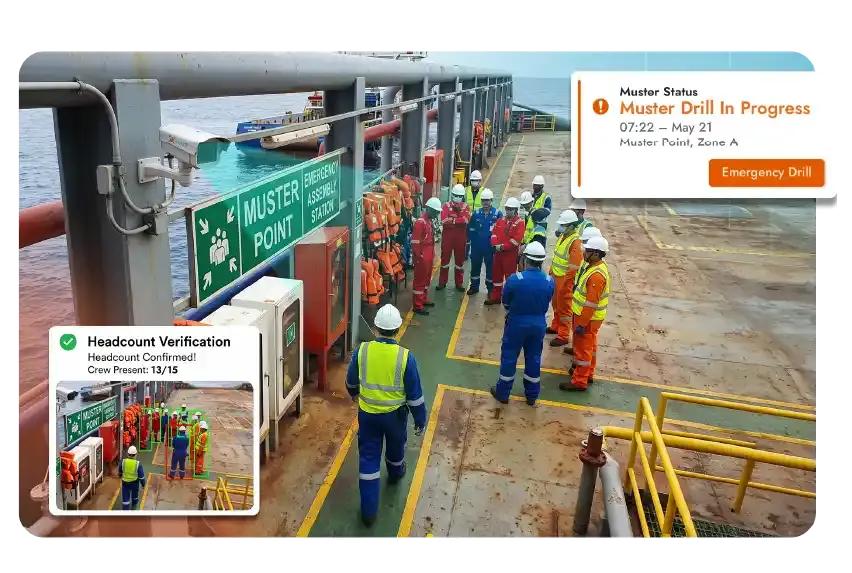
During emergencies and drills, automated muster verification confirms crew headcounts at designated points, removing the margin for manual counting error when it matters most. And because full-resolution footage remains available once connectivity returns, safety teams can review post-voyage footage to surface near-miss patterns and trends that a real-time alert alone wouldn't catch.
Put together, this closes the loop from first detection through to what the crew learns after the fact.
The Impact of Closing Offshore Surveillance Blind Spots with AI Vision Cameras
The value of closing these blind spots shows up in measurable operational terms, not just safer optics. Vessels and drillships running continuous AI-powered rig floor and deck monitoring have recorded an 85% reduction in red zone and line-of-fire violations, alongside 90% faster hazard detection across decks and confined spaces — even with zero internet connectivity at the time of detection.
On-vessel Edge AI processing has also driven 2x faster incident response, since alerts no longer wait for a round trip to a shore-based server over a strained satellite link.
An offshore oil & gas operator running multiple production and drilling rigs across Abu Dhabi faced the same red zone blind spot described earlier in this piece — manual spotters simply couldn't maintain visibility across crane decks and drill floors during simultaneous operations, and unsafe entries were routinely caught only after the fact, once they'd already forced a drilling stoppage.
As the operator's HSE Superintendent put it, spotters admitted the blind spots were unavoidable. Existing rig cameras were trained on viAct AI Computer Vision for offshore safety within 7 days, requiring no additional hardware. Red zone violations dropped by more than 80%, the rig recorded a 10x improvement in its safety score, and over 1,500 operational hours were recovered annually from fewer stoppages, feeding into a 50% gain in annual productivity.
These aren't isolated gains. Closing surveillance blind spots isn't just a safety upgrade in that context; it's becoming a baseline operational expectation, much like continuous monitoring has already become standard on high-risk industrial sites onshore.
How to Implement AI Computer Vision for Offshore Safety
Adopting AI Computer Vision offshore doesn't require replacing what's already on the vessel; it requires layering intelligence onto it, in the right order.

Conclusion: Key Takeaways
Offshore surveillance blind spots come from three distinct sources — physical obstruction, human attention limits, and connectivity loss — and closing them requires addressing all three, not just adding more cameras.
Edge processing keeps detection running even when satellite or internet connectivity drops, which is the single most offshore-specific gap traditional AI CCTV fails to close.
AI Computer Vision covers physically obstructed, hard-to-reach zones — the rig floor's red zones, the monkey board, the V-door — where equipment geometry has always limited manual observation.
Boundary and access risks, like moon pool and restricted-zone breaches, get continuous coverage instead of periodic checks, closing gaps at exactly the points where consequence is highest.
Vision AI adapts to dynamic, fast-changing deck conditions — anchor handling, rough seas, machinery in motion — rather than relying on a static watch schedule.
Measurable impact is already proven: up to 85% fewer red zone violations, 90% faster hazard detection, and 2x faster incident response in real offshore deployments.
Implementation works best as a phased rollout — audit, prioritize, integrate, pilot — layered onto existing vessel infrastructure rather than replacing it.
As offshore operations push further from shore and further from reliable signal, the vessels that see everything, not just when connectivity allows it, but all the time, will be the ones that stay ahead of the next incident instead of reviewing it after the fact.

Quick FAQs
1. What are offshore surveillance blind spots?
They're zones or moments where a hazard can develop without being seen or acted on — caused by physical obstruction (equipment, deck layout), human attention limits, or lost connectivity that disables cloud-dependent monitoring.
2. How does AI Computer Vision work without internet connectivity offshore?
Edge AI devices like viMOV process camera feeds directly on the vessel rather than relying on cloud processing, so hazard detection continues even when satellite or internet connectivity is completely lost.
3. Can AI Computer Vision integrate with existing vessel CCTV and safety systems?
Yes. Most offshore AI Vision Camera systems are designed to layer onto existing CCTV, permit-to-work systems, and muster protocols without requiring a rebuild of current infrastructure.
4. What offshore zones benefit most from AI Vision Cameras?
The rig floor's red zones (rotary table, iron roughneck, top drive), the monkey board and V-door, the moon pool, anchor and mooring snap-back zones, and muster points all see the clearest impact.
5. How long does it take to deploy AI Computer Vision on a vessel or drillship?
Deployment timelines vary by vessel size and scope, but because most systems integrate with existing CCTV rather than requiring new hardware throughout, pilot programs can often begin within 24 hours.
Read More:


Enjoyed reading this content and learning something new today. I liked the straightforward setup of the CPS Test. A short session is enough to produce a score, and taking another round lets users see how their clicking result compares with the earlier one.
It is such a great tower defense strategy that Pokepath TD offers! What I love about it is the way every stage makes me ponder where to set my Pokémon and what kind of Pokémon should deal with the approaching enemies.
Deploying computer vision models to eliminate surveillance blind spots on offshore oil rigs and maritime facilities is a game-changing operational upgrade, especially where extreme weather, marine glare, and complex steel structures limit traditional CCTV coverage. Automated visual tracking for PPE compliance, slip hazard detection, and unauthorized perimeter access significantly reduces human monitoring fatigue while creating real-time alert systems that prevent severe industrial accidents. Outside of industrial computer vision frameworks and edge-computing safety networks, I also spend time analyzing how different cloud systems, responsive web interfaces, and high-traffic mobile platforms like https://melbets-apk.net/ handle low-latency data streams and seamless cross-device optimization under challenging network conditions. Thank you for putting together such a clear, technically sound overview of computer vision applications in high-risk maritime…
I like how much pressure there is during the final seconds of Basketball Bros. Even when I have the lead, I still have to stay focused until the timer reaches zero.