
AI for Mining Industry: 10 Applications for Safety & Operations

Updated: Oct 7

“Quick AI-Powered Insights on the Topic— Freshly Updated!”
|
In 2025, U.S. mine fatalities jumped 27% to 33 deaths — even as the industry's overall injury rate fell to an all-time low of 1.74 per 200,000 hours worked, according to the Mine Safety and Health Administration (MSHA). That contradiction is the story of modern mining safety in one statistic: routine risk is finally coming down, but the highest-consequence hazards are proving far harder to close out.
Mining remains one of the most economically vital and physically hazardous industries on earth. The world's largest mining companies generate hundreds of billions of dollars in annual revenue, and dozens of national economies depend on mineral exports, employment, and tax revenue from the sector. That scale is exactly why the gap between "safer on average" and "still deadly at the extremes" matters — and why AI for mining industry safety has moved from a pilot-stage curiosity to a standard part of how leading operators run open-pit, underground, and surface sites.
This blog covers what AI for the mining industry actually means, why operators are adopting it now, how it works and how a mining company should decide where to start.
What Is AI for the Mining Industry?
AI for the mining industry is the use of computer vision, IoT sensors, wearables, and edge-processing hardware to detect hazards, track workers, and monitor equipment in real time across mining sites, replacing periodic manual inspection with continuous, automated risk detection. Rather than a single tool, it functions as a connected safety and operations layer sitting on top of a mine's existing infrastructure, covering open-pit, underground, and surface environments alike.
Rather than one single technology, it's best understood as a layered system.
Why Is AI Becoming Important for Mining Safety & Operations?
Mining sites present a specific combination of risk factors that make continuous, automated monitoring valuable in a way few other industries share. Open-pit layouts shift daily as haul routes change; underground tunnels and shafts put workers out of camera range entirely; and heavy mobile equipment operates in close proximity to people across all of it.
Static safety rules including a fixed exclusion zone, a scheduled inspection walk, struggle to keep pace with conditions that can change hour to hour, exactly the challenge one Chile-based mining operator described in the case study below.
Three pressures are converging to push AI for mining industry adoption from experimental to standard practice:
Hazard complexity outpaces manual supervision: A supervisor walking a blast zone or checking a confined-space entry log can miss what a continuously monitoring system catches automatically, the kind of gap that shows up in near-miss data long before it shows up in a fatality report.
The highest-consequence risks are concentrated and identifiable: Powered haulage, falls from height, confined-space incidents, and gas exposure account for a disproportionate share of serious mining injuries and fatalities, which means targeted AI deployment against those specific hazards delivers outsized safety return relative to broad, generic monitoring.
Regulatory and insurance pressure is rising alongside production targets: Operators are being asked to do both, increase output and demonstrably improve safety outcomes at the same time, and manual processes alone increasingly can't deliver both.
At a mining operation in Chile, viAct AI platform was used to create dynamic safety zones around haul trucks, mobile equipment and shifting work fronts. Using the company-provided standardized baseline of 100 verified proximity-risk events, the reported 70% reduction corresponded to approximately 30 events after deployment. The site also reported 65% fewer zone intrusions and 55% faster incident response after implementing dynamic safety zoning.
The system continuously monitored worker and equipment movement around haul roads, loading areas and active machinery, with safety boundaries adapting as operating conditions changed. Detected breaches were logged with time-stamped visual evidence and alerts were sent to supervisors, providing a consistent basis for tracking changes in exposure and response performance.
How Does AI Work in Mining Environments?

Because mining sites combine open-pit terrain, underground tunnels, and constantly moving heavy equipment, AI for the mining industry has to work across a wider range of physical conditions than most other industrial deployments. The mechanism, at its core, follows a consistent loop regardless of which hazard it's watching for:
Capture. Existing CCTV, drones, gas leak detectors, or wearable devices (smart helmets and smart watches) feed live data — video, location, gas readings, proximity, into the system, hardware-agnostic enough to plug into cameras a site already has installed.
Detect. AI modules trained on real mining incidents (not generic datasets) scan that data for defined risk scenarios: a worker entering a blast exclusion zone, a haul truck approaching a pedestrian, a gas reading crossing a safety threshold.
Alert. The moment a risk is detected, the system triggers a multi-channel alert — on-site speaker, SMS, WhatsApp, or email — routed to the supervisor or worker who needs to act on it immediately.
Escalate & log. Where cameras can't reach — underground shafts, remote surface zones, confined spaces —edge devices like viMOV carry the same detection logic, processing data locally so alerts still fire without relying on constant connectivity, while every incident is logged centrally for audit and trend analysis.
This is also where an EHS AI agent layer for mining adds a further step: rather than a supervisor manually pulling footage and compiling an incident report after something happens, the agent can retrieve the relevant footage, analyze what occurred, and guide the response, turning a process that used to take a site visit into one that starts the moment an alert fires.
With that mechanism in place, the next question is where it actually gets applied across a mining operation.
10 Applications of AI for Mining Industry
Mapped against the hazards that most commonly cause mining injuries and fatalities, these ten applications represent where AI for the mining industry is delivering measurable results on active sites today.

Powered haulage remains the single leading cause of mining fatalities with 13 of the 33 U.S. mining deaths in 2025 alone, per MSHA. AI-powered vehicle control systems detect worker-vehicle proximity, blind-spot risks, and speeding in real time across haul roads and loading zones, which is where viAct deployments have driven an 80% reduction in haul truck collisions.

Unauthorized entry into active blast zones is one of mining's highest-consequence risks, and static barricades don't adapt as blasting schedules shift. AI-powered zone monitoring digitally enforces exclusion boundaries and flags unauthorized entry the moment it happens, contributing to a 75% reduction in blast zone violations across deployed sites.

Falling rock and wall instability are persistent underground and open-pit threats, especially where manual visual inspection can't catch gradual slope movement. LiDAR-based 3D sensing using viLID continuously monitors slope stability and wall movement, catching instability that manual checks would miss, including in low visibility, dust, or nighttime conditions.

Underground communication and visibility gaps mean a worker can go unaccounted for far longer than is safe. Wearable-based tracking powered through edge processing monitors worker location, movement, and activity across tunnels and shafts continuously, so a missed check-in triggers an immediate location lookup rather than a delayed search.

Confined-space incidents like falling rock, fires and asphyxiation account for a disproportionate share of fatal underground injuries. AI monitoring tracks entry, exit, and in-space conditions automatically, removing the dependence on someone remembering to check a confined-space log manually.

Explosive storage and handling areas require strict, continuously enforced access control. AI-powered area control detects tailgating, unauthorized access, and permit violations at these high-risk zones, logging every breach with visual evidence for audit and accountability.

Hard hats, safety glasses, respiratory protection, and hearing protection are baseline requirements across every mining role, but manual PPE checks are inherently spot-checks, not continuous coverage. AI-powered cameras detect missing or improper PPE automatically and in real time, closing the gap between policy and what's actually happening on-site.

Gas exposure is one of underground mining's most acute health risks, and it's invisible without instrumentation. Environmental sensors with IoT powered gas leak detection systems continuously track worker gas exposure levels across underground environments, which is how viAct deployments have cut underground gas exposure incidents by 65% across more than 500,000 square feet of underground mining environments.

Common unsafe acts like running, climbing, improper access or risky positioning contribute meaningfully to incident rates without necessarily triggering a single dramatic failure. AI-powered behavioural monitoring flags these patterns early, enabling supervisor intervention before an unsafe habit compounds into an actual incident.
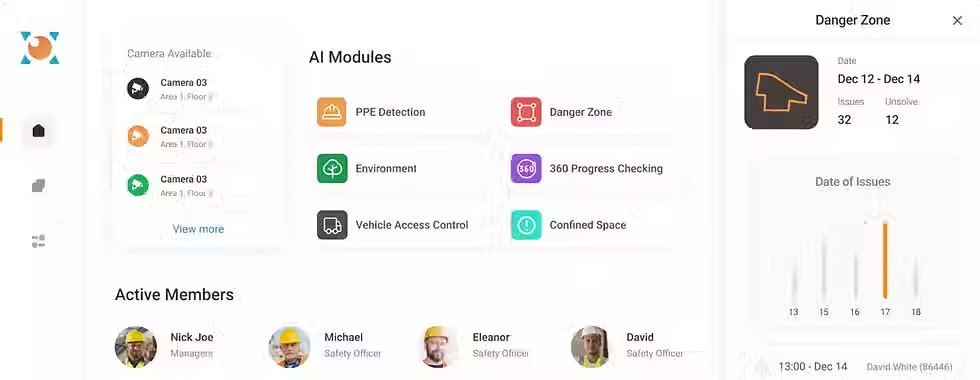
With ten different hazard categories being monitored across one site, the value collapses if that data lives in ten different places. A centralized dashboard like viHUB pulls detection, alerts, and incident logs from every module including vehicle control, gas exposure, PPE or zone breaches into one view, giving safety teams a single source of truth instead of a fragmented one.
Taken together, these ten applications facilitated in a Mining AI Safety Solution cover the full span of mining risk which raises the practical next question of where a mining company should actually start.
How Should Mining Companies Choose the Right AI Applications?
Not every mining site needs all ten applications on day one, and choosing where to start matters more than trying to deploy everything at once. The table below lays out the decision factors that separate a deployment that scales from one that stalls as a single-site pilot:
Decision Factor | What to Check | Why It Matters |
Highest-consequence risk | Is powered haulage, blast zone intrusion, or another specific hazard your dominant incident cause? | Deployment should start against your biggest risk, not your easiest rollout |
Where the blind spots are | Does the site rely mainly on camera coverage, or does it have significant underground/remote zones? | Open-pit sites with strong camera coverage get the fastest value from vehicle control and blast zone monitoring; underground operations need wearables and edge devices carrying the load instead. |
Existing infrastructure | Is there CCTV already installed, and is it RTSP-compatible? | A hardware-agnostic platform that plugs into existing cameras avoids a costly hardware overhaul and gets a pilot running faster than a rip-and-replace approach. |
Pilot scope | Can the rollout start on one site or one risk category rather than sitewide? | Proving the model on a contained scope first builds internal confidence and surfaces integration issues before a full-scale rollout multiplies them. |
Coverage gaps from day one | Does the plan account for both what cameras can see and what they can't? | Sites getting the most value run computer vision alongside wearables and edge devices, not vision alone |
Choosing correctly against this table is what determines whether an AI deployment becomes a genuine operational program or stalls out as a single-site pilot.
Conclusion: Key Takeaways
Mining fatalities rose 27% in the U.S. in 2025 even as the industry's overall injury rate hit an all-time low — a sign that routine risk is improving while high-consequence hazards like powered haulage remain stubbornly persistent.
AI for the mining industry works as a layered system — computer vision, wearables, edge devices, LiDAR, drones, and an EHS AI agent — built specifically to cover both what cameras can see and what they can't.
The ten applications covered here, from haul truck collision prevention to underground gas monitoring, map directly onto the hazards that cause the most serious mining injuries and fatalities.
Real deployments are already delivering measurable results: 75% fewer blast zone violations, 65% less underground gas exposure, and 80% fewer haul truck collisions across live mining sites.
The Chile case study shows this isn't theoretical — dynamic safety zoning cut proximity risks by 70% and sped up incident response by 55% in one of mining's most operationally volatile environments.
Choosing where to start matters as much as the technology itself: the operators seeing the strongest results are targeting their highest-consequence risk first, not their easiest deployment.
As mining operations keep expanding into more remote, more complex, and more tightly regulated terrain, the gap between sites running real-time AI monitoring and those still relying on periodic manual inspection is only going to widen — and closing it early is what will separate the operators reducing serious incidents from the ones still reading about them in next year's fatality report.

Quick FAQs
1. What is AI for the mining industry?
AI for the mining industry refers to computer vision, IoT sensors, wearables, and edge-processing hardware working together to detect hazards, track workers, and monitor equipment in real time — replacing periodic manual inspection with continuous, automated risk detection across open-pit and underground sites.
2. How does AI improve safety in mining operations?
AI improves mining safety by continuously monitoring for specific known hazards — worker-vehicle proximity, blast zone intrusion, gas exposure, missing PPE — and triggering instant alerts the moment a risk is detected, rather than relying on periodic manual inspection that can miss risks between checks.
3. What is the biggest cause of mining fatalities that AI addresses?
Powered haulage — collisions and proximity incidents involving haul trucks and other mobile equipment — is the leading cause of U.S. mining fatalities, accounting for 13 of 33 deaths in 2025 according to MSHA. AI-powered vehicle control and proximity detection directly target this hazard.
4. Can AI work in underground mines where there's no camera coverage?
Yes. Underground and remote areas without camera coverage rely on IoT wearables (smart watches, helmets) and edge devices that process data locally, tracking worker location, movement, and gas exposure independent of camera placement or constant connectivity.
5. How quickly can a mining company deploy AI safety monitoring?
Because many AI mining safety platforms are hardware-agnostic and integrate with existing CCTV via RTSP, deployment doesn't require a hardware overhaul — sites can typically pilot on a single high-risk area, such as a blast zone or haul road, and expand from there once results are proven.
Read more:


