
Construction Automation in Singapore: Applications, Benefits & Implementation


“Quick AI-Powered Insights on the Topic— Freshly Updated!”
|
Construction automation is changing how contractors in Singapore manage workplace safety, monitor construction progress and carry out daily site activities. Technologies such as artificial intelligence (AI), computer vision and IoT sensors help reduce manual work and provide better visibility into construction operations.
According to Singapore's Building and Construction Authority (BCA), construction demand is projected to reach S$47–53 billion in 2026, following S$50.5 billion in preliminary demand during 2025. This project pipeline increases the importance of efficient resource planning, site monitoring and construction automation.
This guide explains the main applications, technologies, benefits and implementation of AI construction automation in Singapore.
What Is AI Construction Automation?
AI construction automation refers to the use of AI and connected technologies to automate selected construction activities, including safety monitoring, equipment tracking, progress reporting and site inspections. It helps contractors reduce repetitive work, identify risks earlier and make decisions using real-time site information.
For example, computer vision can analyse existing CCTV footage to detect unsafe activities, while IoT sensors can monitor equipment and environmental conditions. These technologies support construction teams by automating observations and reporting, rather than replacing the need for site supervision.
Construction automation can be divided into three main areas:
Safety automation: Detecting workplace hazards, PPE violations and unsafe activities.
Operational automation: Monitoring equipment, construction activities and site progress.
Administrative automation: Collecting site records, generating reports and organising project information.
What Construction Activities Can Be Automated Using AI?
A construction AI safety solution helps contractors manage repetitive site activities, inspections, reporting and operational monitoring with less manual effort. Instead of treating each activity separately, an automated system collects site information, identifies relevant changes and shares findings with the responsible teams.
The main construction activities that can be automated include:
1. Routine Site Monitoring and Inspections
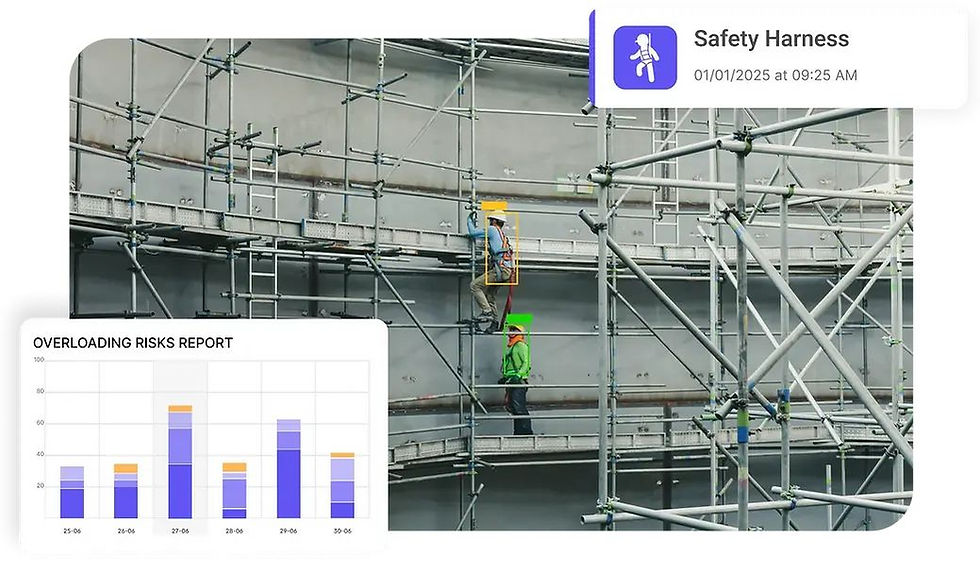
Construction sites require regular checks to identify unsafe conditions, worksite changes and operational issues. AI systems can continuously monitor selected areas, identify predefined conditions and record events that require attention.
This reduces the need for staff to manually review every observation while allowing site supervisors to focus on issues that require investigation.
2. Construction Progress Documentation

Project teams regularly collect information about completed work, ongoing activities and pending tasks. Construction automation can help organise site observations, update digital progress records and highlight changes requiring review.
Project managers can then compare these records with planned activities to understand whether work is progressing as expected.
3. Equipment and Resource Monitoring

Contractors need to monitor machinery usage, equipment availability and the movement of resources across different work areas. Automated AI systems can collect operational information and identify patterns such as prolonged equipment inactivity or repeated interruptions.
These findings help managers review resource allocation and identify where operational adjustments may be necessary.
4. Safety Inspections and Incident Reporting

Safety teams spend considerable time recording observations, reviewing incidents and preparing inspection reports. AI automation can capture predefined safety events, maintain time-stamped records and organise information for investigation.
This supports more consistent documentation and helps supervisors follow up on recurring safety concerns.
5. Site Reporting and Coordination

Construction projects involve regular communication between contractors, engineers, supervisors and project managers. Automated vision based systems can consolidate monitoring information into centralised dashboards and generate routine reports.
This reduces repeated data collection and makes relevant project information easier to access across teams.
What AI Technologies Are Used in Singapore Construction Automation?
Construction automation uses different technologies depending on the activity being monitored or automated. Computer vision, IoT sensors, edge devices, LiDAR, drones and AI agents are among the technologies used to support construction site operations.
Computer vision uses AI to analyse images and video footage from construction site cameras. It can identify predefined conditions such as PPE violations, fall risks, restricted-zone intrusions and worker–equipment proximity. It is particularly useful for continuous monitoring because compatible existing CCTV cameras can be used without replacing the entire surveillance infrastructure.
IoT & Smart Wearables
IoT sensors and smart wearables collect information about workers, equipment and environmental conditions. Smart helmets, watches and connected sensors can support monitoring of worker location, movement, selected fatigue indicators and environmental exposure. These technologies are useful where camera coverage is limited or where additional sensor information is needed.
Edge devices process AI data directly at the construction site rather than sending all information to a remote cloud server. This allows safety alerts to be generated with lower latency and can support operations where internet connectivity is unreliable. For example, an edge AI device can process camera footage locally and alert supervisors when a worker enters a designated danger zone.
LiDAR
LiDAR uses laser-based sensing to measure distances and create three-dimensional information about the surrounding environment. In construction, it can support spatial monitoring, distance measurement and worker–equipment proximity detection. LiDAR can complement camera-based monitoring in areas where accurate distance information is important.
AI-powered Drones
Drones capture aerial images and video footage of construction sites. They can assist with progress monitoring, site surveys and visual inspections of elevated or difficult-to-access areas. Drone inspections can reduce the need for personnel to access certain locations solely to collect visual records.
AI Agents
An AI Agent for construction helps safety teams organise monitoring information, review detected incidents and prepare reports. It can also support the identification of recurring safety concerns across different work areas and projects.
These technologies can be combined within an integrated AI solution to connect site cameras, sensors and safety records.
How Does Construction Automation Improve Construction Productivity and Progress Tracking?
Construction productivity monitoring measures how much work is completed relative to the labour and time used. BCA defines site productivity as constructed floor area divided by site worker man-days.
Construction automation helps contractors monitor ongoing activities, compare actual progress with project schedules and identify work areas that require attention. It provides updated site information that project managers can use to assess whether construction activities are progressing as planned.
The process involves four key activities:
Activity tracking: Records ongoing and completed construction activities across designated work areas.
Schedule comparison: Compares recorded site progress with planned construction milestones to identify deviations.
Delay identification: Highlights work areas with limited progress or repeated interruptions for further investigation.
Progress verification: Uses time-stamped site records and BIM models to compare completed construction work with planned project milestones.
More than 7,000 working hours were saved by a leading Singapore construction company during FY2024–FY2025, following the deployment of viAct AI monitoring across high-rise and infrastructure projects. The system helped identify recurring equipment-related interruptions, unsafe worker–machinery interactions and hazards in high-risk work areas, supporting better site coordination, fewer operational disruptions and more efficient use of working hours.
How Can Construction Automation Support Safety Monitoring in Singapore?
Construction automation supports workplace safety by continuously monitoring selected high-risk activities and alerting safety teams when predefined hazards are detected. It can help contractors identify unsafe conditions between scheduled inspections and maintain digital records for follow-up action.
According to MOM's Workplace Safety and Health Report 2025, Singapore's construction sector recorded 26.3 fatal and major injuries per 100,000 workers, compared with 31.0 in 2024. Small-scale construction works accounted for more than 60% of fatal and major injuries in the sector, highlighting the need for consistent safety oversight.
Common AI Construction Safety Applications
Application | What AI monitors |
Open edges, missing guardrails and visible fall-protection risks | |
Worker proximity to lifting zones and suspended loads | |
Unsafe proximity between workers and moving machinery | |
Missing helmets, safety vests and other visible PPE | |
Selected unsafe access and visible scaffolding conditions | |
Workers entering designated high-risk areas |
What Are the Benefits of AI Construction Automation?
AI construction automation helps contractors improve safety oversight, reduce repetitive work, strengthen site coordination and minimise avoidable operational interruptions. Its benefits depend on the construction activities being automated and how effectively project teams use the information.

Improved Safety Performance
Consistent monitoring and corrective-action records can help contractors identify recurring risks and assess the effectiveness of safety measures.
A 50% reduction in Total Recordable Incident Rate (TRIR), covering more than 32,000 workers across 400+ construction sites was reported from viAct deployments during FY2024–FY2025. These company-reported results illustrate the potential contribution of AI-assisted monitoring to construction safety performance.
Reduced Administrative Work
Automated observations and digital records reduce the time spent watching CCTV footage, collecting inspection information and preparing routine reports.
Better Resource Utilisation
Access to site activity and equipment information helps project managers identify delays, review resource allocation and improve daily work planning.
Reduced Operational Costs
Earlier hazard identification and improved site coordination can help reduce incident-related interruptions, repeated inspections and avoidable administrative work.
The financial impact varies depending on site size, technology coverage and implementation costs.
How Can Contractors Implement AI Automation on Construction Sites?
Contractors can implement AI construction automation by identifying a specific site requirement, reviewing existing infrastructure and testing suitable technologies before wider deployment.
Step 1: Identify the priority activity. Determine whether the main requirement is safety monitoring, progress tracking, equipment monitoring or automated reporting.
Step 2: Review existing infrastructure. Check CCTV coverage, network connectivity, available sensors and existing project management systems.
Step 3: Select suitable technologies. Choose computer vision, IoT sensors, edge devices, LiDAR, drones or other systems based on the site requirement.
Step 4: Conduct a pilot deployment. Test the selected technology in one work area and assess its performance under actual site conditions.
Step 5: Measure the results. Compare relevant indicators such as verified safety events, reporting hours, incident response time and equipment downtime against the pre-deployment baseline.
Step 6: Expand the deployment. Train responsible personnel, establish procedures for reviewing alerts and extend the system to additional areas where appropriate.
Contractors should also consider data protection, system maintenance, false alerts and changing site conditions before expanding automation.
Conclusion: Key Takeaways
AI construction automation supports safety monitoring, progress tracking, equipment management and automated reporting.
Computer vision, IoT & Smart Wearables, Edge Devices, LiDAR, Drones and EHS AI Agents support different construction requirements.
AI monitoring can help contractors identify risks earlier and maintain more consistent site records.
Contractors should begin with a specific operational problem, test the technology and measure results before expanding deployment.
Construction automation in Singapore helps contractors improve workplace safety, reduce manual work and monitor project activities more efficiently.

Quick FAQs
1. What Is AI Construction Automation in Singapore?
AI construction automation uses artificial intelligence, cameras, sensors and connected systems to automate selected construction activities. Common applications include safety monitoring, equipment tracking, progress monitoring and reporting.
2. Can It Work With Existing CCTV Cameras?
Yes. AI video analytics can work with compatible existing IP cameras that support RTSP video streaming. A minimum resolution of 1080p at 25 fps is a recommended technical baseline, although camera placement, lighting and visibility also affect detection performance. Contractors should confirm camera compatibility before deployment.
3. What Deployment Options Are Available: On-Premises, Cloud or Hybrid?
Construction automation systems like viAct can support cloud, on-premises, edge or hybrid deployment, depending on the provider. Cloud deployment supports centralised monitoring, while on-premises and edge processing allow data to be processed locally. Contractors in Singapore should evaluate connectivity, data security, storage location and latency before selecting a deployment model.
4. Can the Construction Automation Systems Integrate With BIM and Existing Project Management Systems?
Yes, where compatible integration interfaces are available. AI construction automation can connect with Building Information Modelling (BIM), video management systems and project management platforms through supported APIs or data integrations. This can help contractors combine site observations with project schedules, inspection records and construction progress information.
5. How Much Does AI Construction Automation Cost in Singapore?
The cost of AI construction automation depends on the number of cameras, AI modules, deployment model, hardware requirements and system integrations. Pricing may involve software subscriptions, licences and implementation costs. Contractors should request a site-specific quotation covering initial deployment, maintenance and ongoing support.
Read more:


