
Process Hazard Analysis Software: Using AI Video Analytics for Workplace Safety

Updated: May 8, 2025

Workplace hazards are an unfortunate reality across industries, putting lives at risk and causing costly disruptions. Detecting these hazards before they escalate into full-blown incidents is essential to safeguard workers and minimize operational losses.
Every year over 2.78 million workers die either due to work-related injuries or occupational diseases. It is accompanied by over 374 million non-fatal work-related injuries.
Workplace hazards have the potential to cause minimal impacts such as a bruise or a cut to a loss of life. To ensure workplace safety, a round the clock surveillance by EHS teams are required to stop different hazards such as –
Chemical Hazards
Electrical Hazards
Biological Hazards
Ergonomic Hazards
Traditional methods like Process Hazard Analysis (PHA) and Hazard and Operability Studies (HAZOP) have played pivotal roles in identifying and mitigating risks, but with the advent of AI video analytics, hazard detection using these methods has become faster, more precise, and more proactive.
Process Hazard Analysis Software: A Modern Approach to PHA and HAZOP
Process Hazard Analysis (PHA) and Hazard and Operability (HAZOP) Studies are established methodologies used to assess potential hazards in industrial processes. These techniques involve systematic reviews of processes and equipment to identify risks and determine safety measures.
PHA is a thorough examination of industrial processes to assess risks that can cause dangerous events.
HAZOP is used to identify potential operational hazards, such as equipment malfunctions or human errors, that could disrupt processes.
While these methods were effective earlier, they were largely manual, time-consuming, and relied heavily on human judgment. That’s where AI-driven solutions like viAct’s AI video analytics come in to revolutionize the process.
viAct’s AI Video Analytics integration into Process Hazard Analysis Software
viAct’s AI Video Analytics integrates cutting-edge computer vision, Generative AI, and machine learning to enhance the accuracy and speed of hazard detection.
By using AI for workplace safety, monitoring workplace activities in real-time enables the EHS monitoring software to quickly identify risks, non-compliance, and unsafe behavior, alerting EHS teams before incidents occur.
Below, we explore the role of viAct's AI video analytics across several high-risk industries.
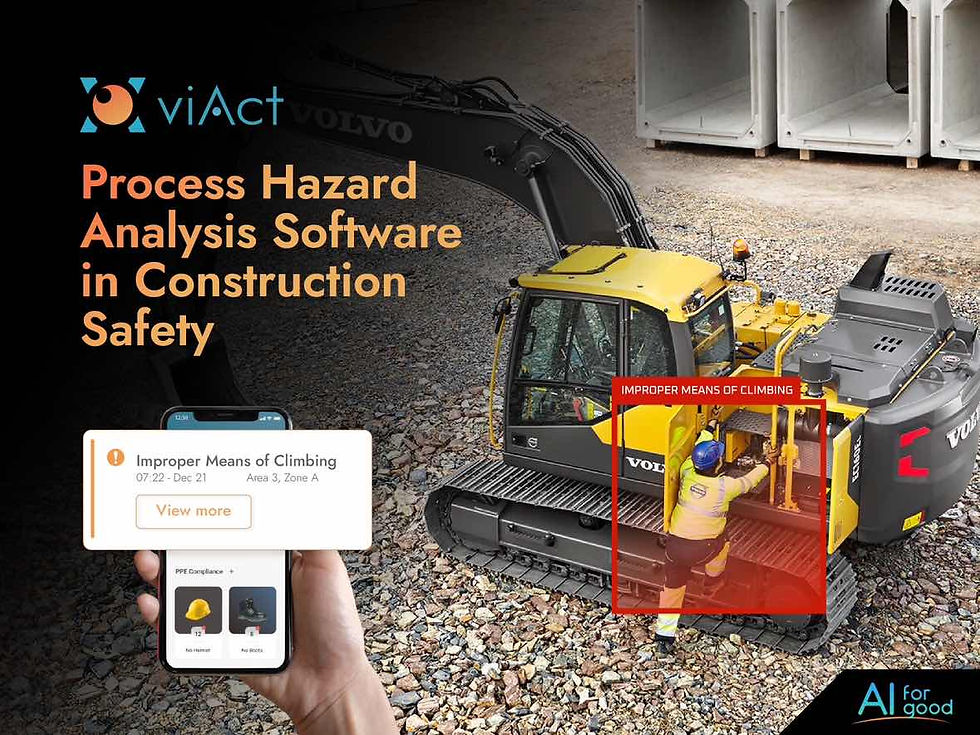
In construction, workers often face structural failures, equipment malfunctions, and accidents involving heavy machinery. Falls from height are one of the leading causes of fatal accidents, with OSHA estimating that falls account for 34% of all construction-related deaths.
OSHA urges that construction safety be focused from a fall hazard perspective. The EHS managers must ensure that they provide training and manage the worksites with the safe use of construction equipment to minimize accidents.
AI video analytics used in the Process Hazard Analysis Software continuously monitors construction sites especially against the highest risk hazard – fall from height. It engages in identifying risks such as workers not wearing proper PPE, scaffolding instability, and unsafe proximity to moving machinery.
Imagine a construction site where the worker is engaged in the task of steel framework assembly. The worker responsible for erecting and bolting together steel beams and girders to form the skeletal framework of the building has removed his helmet.
The AI-powered EHS monitoring software detects it instantly and sends an instant alert to the safety teams. As a result, there is instant intervention which leads to the prevention of an accident before it occurs.
2. Process Hazard Analysis Software for Manufacturing Safety

Manufacturing environments are fraught with risks from machinery malfunctions, electrical hazards, and chemical exposure such as -
Conveyor belt misfunctioning due to wear and tear
Overheating of machines
Improper lockout/tagouts
Fire Explosions
Electrocution due to short circuit or faulty wiring
viAct’s AI video analytics uses computer vision for manufacturing safety to monitor the machines in real-time, detecting abnormal vibrations, overheating, or improper usage. Any anomaly detection that could indicate impending mechanical failure or other dangers is immediately reported and fixed.
Ergonomic assessments through Process Hazard Analysis Software enable the EHS teams to monitor the workers based on their posture analysis. As long-term occupational diseases such as back pain, joint pain, sprains, etc. emerge from working in the same position, the use of AI video analytics for a periodic REBA and RULA ergonomic assessment makes a significant difference in this hazard prevention.
One of the most common sight son a factory floor is a forklift operation in constant motion. A worker who is not supposed to enter a danger zone designated alongside the forklifting path makes unauthorized access.
The process hazard analysis software instantly notifies the safety teams, preventing a potential collision. AI-powered EHS monitoring provision in a highly mobile form called viMAC, when attached to a forklift or any other mobile plant in a manufacturing facility can cover a vertical stretch of 6M and horizontal coverage of 5M.
In complex scenarios inside a factory floor, this attachment of a GPS-based camera helps to avoid blind spots and ensures the optimum use of AI for workplace safety.
3. AI-Powered Hazardous Area Access Control in Oil & Gas

The oil & gas industry is notorious for its high-risk environments, especially on drilling rigs where workers are frequently exposed to volatile materials and heavy machinery. Risks such as gas leaks, fires, and explosions are common, particularly in designated "red zones" – areas around active drilling or heavy equipment where access is highly restricted due to heightened danger.
Managing worker access to these hazardous zones is critical to preventing accidents.
viAct’s AI-powered video analytics for red zone monitoring is specifically designed to monitor worker movements in real-time, ensuring that only authorized personnel enter dangerous red zones. The system continuously tracks environmental parameters such as gas levels, smoke detection, and worker proximity to hazardous areas, providing instant alerts when predefined safety thresholds are breached.
Consider at an offshore drilling rig, Process Hazard Analysis Software detects abnormal gas levels in a processing unit. The system automatically triggers an evacuation protocol and alerts on-site EHS teams, engineers, and workers minimizing the risk of an explosion.
Moreover, Generative AI solution helps to curate a personalized safety briefing targeting every worker at different positions about their role in the evacuation process. This helps the EHS managers to focus on making the process faster rather than explaining to every individual worker about their safety instructions.
4. Managing Environmental Hazards in Mining Operations

Mining operations face dangers such as landslides, equipment collapses, and exposure to harmful dust or gases. The confined spaces and elongated hours of work in them make the exposure to toxic substances underneath a workplace safety concern.
viAct’s AI video analytics system monitors mining activities in real-time, detecting early signs of equipment instability or geotechnical shifts, and alerting the team to prevent catastrophic events like cave-ins.
The EHS teams use predictive risk assessment using Process Hazard Analysis Software where automated forecasts based on historical data are provided before the beginning of any confined space activity. The reports are accessed through the centralized management platform that helps EHS managers supervise even when being off mining sites.
Say in an open-pit mine, viAct’s AI notices a shift in the slope of a rock face, indicating a potential landslide. The system instantly notifies the safety teams, who halt operations and evacuate workers from the danger zone.
The integration of AI video analytics through Process Hazard Analysis Software for workplace safety is revolutionizing the way safety teams operate across high-risk industries. viAct’s AI video analytics not only enhances hazard detection but also empowers safety managers to take swift, data-driven actions, minimizing risks in real-time.
From construction sites to oil refineries, viAct is transforming workplace safety, making it smarter, faster, and more proactive using advanced methods of PHA and HAZOP and providing –
Scenario-based Analysis
Predictive Risk Assessment
Customized Management of PHA
Automated Audit Trails
Compliance with Process Safety Management (PSM) Guidelines
As industries continue to embrace AI for workplace safety, the future of hazard analysis will undoubtedly see a shift—where hazards are identified and addressed before they can cause harm.
Want to see how viAct’s AI Video Analytics is applied in the
Process Hazard Analysis Software?
Read More


This is a truly valuable and well-explained post! I enjoyed how you shared the key information in such a clear and engaging way. The practical insights make the content even more useful and meaningful for readers. Great work, and I’m looking forward to your next post! find out the trends shaping the future
I really enjoyed reading this thoughtful and informative post! You’ve done a great job of making the topic simple, interesting, and easy to understand. The useful ideas and practical takeaways add real value. Thank you for sharing, and I can’t wait to read more from you! grading calculator for teachers
I really enjoyed reading this article, especially the way it explains how Process Hazard Analysis Software and AI video analytics can help identify workplace risks before they turn into serious incidents. The focus on prevention is particularly useful because safety is often about noticing small warning signs early rather than waiting for an accident to happen. Interestingly, the same idea of prevention and early attention can also be applied to healthcare, where different people need different types of care depending on their age and circumstances.
This connects well with areas such as obstetrics, gynaecology, and pediatrics. For example, pregnancy requires regular monitoring because the health needs of both the mother and baby can change throughout the pregnancy. Obstetrics focuses on…
The article “Process Hazard Analysis Software: Using AI Video Analytics for Workplace Safety” is a useful topic because it highlights how technology can help identify workplace risks and improve safety before incidents become serious problems. Interestingly, the same idea of planning ahead can also be applied to construction. Just as safety analysis looks at possible risks before they occur, building planning requires understanding how a space will be used before choosing its materials, layout, doors, and installation methods.
This connects naturally with controlled environments such as Clean Rooms for DS Group in Greater Noida. Clean rooms are not simply ordinary rooms with cleaner surfaces. Their design needs to consider factors such as insulation, cleanliness, controlled conditions, maintenance, and the movement…
The article on Process Hazard Analysis Software and AI video analytics offers an interesting perspective on how technology can help organizations identify risks and create safer working environments. It also highlights an important idea: different workplaces have different requirements, and understanding those requirements is essential when planning a safe and functional environment. Interestingly, the same principle applies to construction. Just as safety systems need to match the activities taking place in a workplace, a building needs to be planned according to how it will be used.
This connects naturally to the question of how construction choices can vary from one project to another. A structure intended for storage may have very different requirements from a school, gym, marriage hall, or…