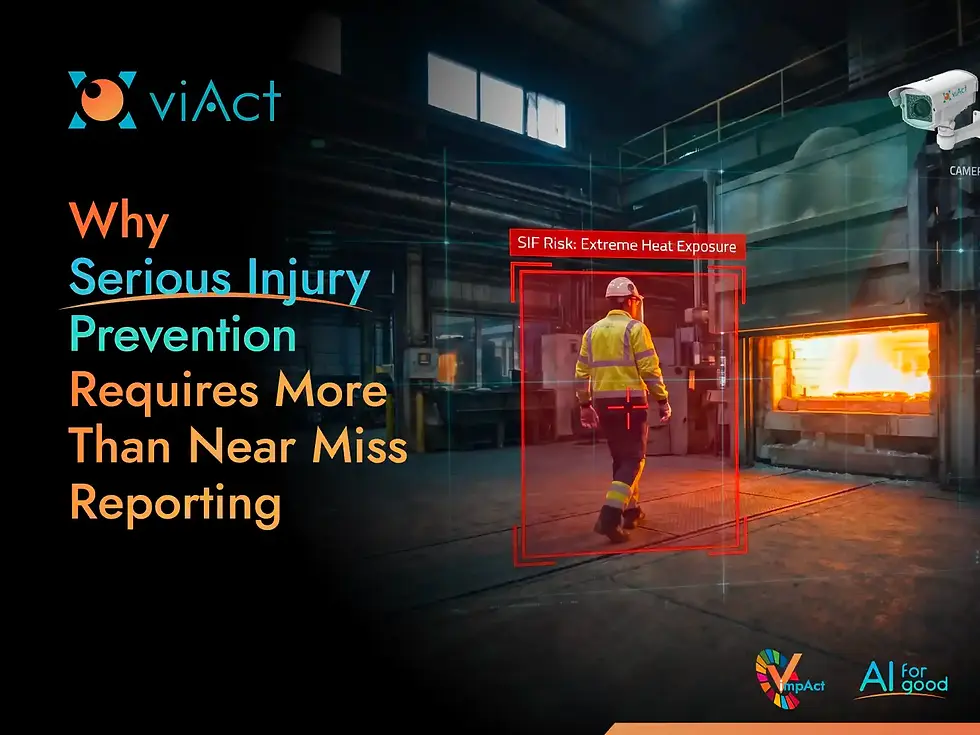
Why Serious Injury Prevention Requires More Than Near Miss Reporting

“Quick AI-Powered Insights on the Topic— Freshly Updated!”
|
Every 104 minutes, a worker dies from a work-related injury in the high-risk sector. In 2024, that totalled 5,070 fatal work injuries — a rate of 3.3 fatalities per 100,000 full-time workers, according to the U.S. Bureau of Labor Statistics. When we add to that an estimated 2.5 million non-fatal injuries and illnesses mentioned in the latest 2026 report by BLS, the picture is clear - workplace safety systems are not working as well as most EHS teams believe.
Here is the uncomfortable truth at the centre of this problem.
Most safety programs are built around near-miss reporting, a system that depends on workers choosing to report events that did not cause harm, after those events have already occurred.
Near-miss reporting is not useless, but it is incomplete. And for the category of events that result in life-altering injuries or fatalities, what the safety industry calls Serious Injuries or Fatalities (SIF) events, incomplete is not good enough.
What is Serious Injury and Fatality (SIF) Prevention?
Serious Injury and Fatality (SIF) Prevention is a targeted safety management approach focused specifically on identifying, assessing, and eliminating workplace hazards that carry the potential for life-altering injuries or death. It is not a replacement for a general safety management system, but it is a high-consequence lens applied on top of one.
The distinction between a general incident and an SIF-potential event is critical. As the National Safety Council puts it: “both a paper cut and a near miss involving a forklift may be logged as an ‘incident’ — but only one could be fatal”.
Treating them with the same urgency is how SIF risks get buried in noise.
SIF vs. pSIF: What’s the difference?
A pSIF (Potential SIF) is a near miss or lower-severity incident that could have resulted in a serious injury or fatality if one or two conditions had been different — timing, angle of impact, PPE use, or proximity. Not every near miss is a pSIF, but every pSIF is a near miss. The classification matters because pSIFs demand a fundamentally different and more urgent investigation response.
Table 1: SIF vs. pSIF: Key Differences
The table below explains the differences between a general near miss, a potential Serious Injury and Fatality (pSIF), and a Serious Injury and Fatality (SIF) event, helping safety teams determine the appropriate investigation priority.
Event type | Definition | Investigation urgency | SIF relevance |
General near miss | Unplanned event without injury, low consequence if it had occurred | Standard CAPA | Low |
pSIF (Potential SIF) | Near miss where one or two different factors would have caused a SIF | SIF-level investigation | Critical |
SIF event | Incident resulting in a life-altering injury or fatality | Immediate — full root cause | Fatal/life-altering |
Why near miss reporting is not enough for serious injury prevention
Near-miss reporting became the backbone of modern safety programs for a logical reason: if you capture enough precursors, you should be able to prevent harm before it happens. The Heinrich Triangle, with the idea that reducing minor incidents reduces major ones proportionally, shaped decades of EHS strategy.
The problem is that the relationship between minor incident rates and SIF rates does not hold at the high end of consequence. The systems designed to prevent slips, trips, and cuts are not the same systems needed to prevent a fatal fall, a confined space asphyxiation, or a struck-by fatality.
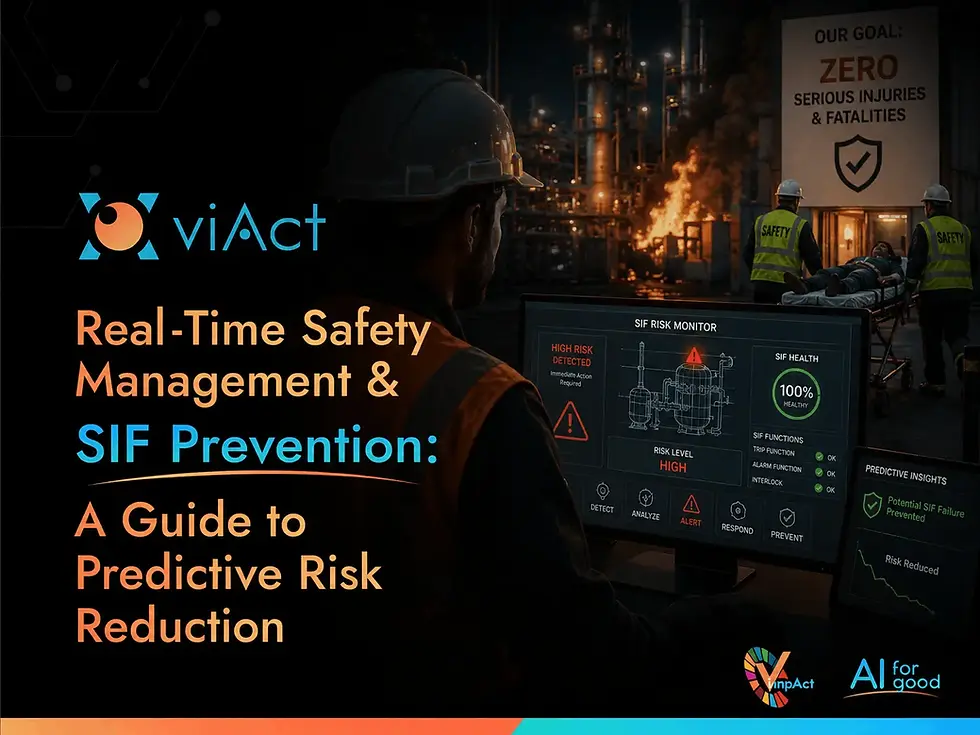
Read more: Real-Time Safety Management & SIF Prevention
The underreporting problem for near-misses
Near-miss systems are only as reliable as what workers choose to report. The Safe Work Australia Annual Report 2024-25 suggests that around 40-50% of serious injuries go unreported, and this figure is higher for events with SIF potential, where workers fear blame, retaliation, or disciplinary action. In the US, the AFL-CIO estimates the true toll of work-related injuries and illnesses may be 5.2 to 7.8 million annually in private industry, far above officially reported figures.
Even when reporting happens, it frequently misses the conditions that matter most. A near-miss report describes what occurred. It rarely captures the critical control failure, for example, the missing guardrail, the bypassed interlock, or the LOTO procedure that was skipped, which made the event possible.
The lagging indicator trap

One of the biggest weaknesses in industrial safety today is that most organisations still assess risk only after damage has already occurred. The industry remains heavily dependent on lagging metrics that explain incidents retrospectively rather than identifying operational exposure before escalation.
Table 2: SIF Prevention Metrics: From Near Miss Reporting to Leading and Lagging Indicators
The table below compares the four types of workplace safety indicators, showing how organizations move from measuring past incidents to predicting and preventing future risks with AI-powered monitoring.
Indicator type | Examples | What it tells you | SIF prevention value |
Lagging | TRIR, LTI rate, fatality count | What already went wrong | Reactive |
Concurrent | Near miss reports, incident investigations | What just happened | Partial |
Leading | pSIF frequency, critical control compliance rate, unsafe act observation rate | What conditions are forming | Proactive |
Predictive (AI) | Real-time computer vision detection, sensor anomaly scoring, pose estimation | What is happening right now, before a control fails | Predictive |
To know further differences in lagging vs leading indicator reporting in EHS, read our full article.
How AI-Based SIF Prevention changes the detection window
The fundamental problem with near-miss reporting is timing. By the time a worker files a report, the hazardous condition has already formed, persisted long enough to be experienced, and resolved — with or without harm. The detection window that matters most in serious injury prevention is the one before a critical control fails, not after.
AI-based SIF prevention reframes the entire near-miss detection module. Rather than waiting for a human to recognise and report a hazardous condition, AI systems using computer vision, IoT sensors, and predictive analytics continuously monitor high-risk zones, detecting SIF precursor conditions the moment they form and triggering automated alerts before an incident can occur
The practical result is that the detection window shifts from hours or days, the average lag in manual near-miss systems, to seconds from the moment a critical control failure condition forms.
The 6 common SIF alert zones across industries - what AI detects in each

SIF events are not random. They concentrate on specific high-energy interaction scenarios where a human, an energy source, and a failed critical control converge. The six zones below are where those critical controls are most likely to fail, and where AI CCTV modules now provide the earliest warning.
Zone 1 — Working at height
Falls from elevation remain the single largest cause of construction fatalities in the US, accounting for nearly 40% of all sector deaths (OSHA Fatal Four). In 2024, 10.8% of all fatal work injuries involved falls from heights above 30 feet (BLS). The SIF risk at height activates the moment a critical control, like an anchor point, guardrail, or personal fall arrest system, is missing, degraded, or bypassed.
AI-powered module tracks the worker’s body position relative to unguarded edges continuously. Unlike a supervisor conducting a scheduled inspection, the system operates across every shift, every camera zone, without fatigue or distraction. Modern deployments report precision rates above 90%.
AI-detected SIF alert conditions — working at height
Worker detected within 1 metre of an unguarded edge without a confirmed active fall arrest anchor
Missing or displaced guardrail on scaffold, elevated platform, or roof perimeter — detected via computer vision
Worker on the roof slab edge without a safety harness confirmed by the PPE detection module
Ladder positioned at an incorrect angle or on an unstable surface, with the worker ascending, flagged using unsafe behaviour detection module
Open floor penetration or excavation edge without a verified barricade or cover present
How AI detects it
Computer vision identifies unguarded edge geometry against a defined site model. Pose estimation tracks the centre-of-mass trajectory relative to the edge. PPE detection confirms harness presence. Alert escalates to supervisor in real time; permit suspension triggers if the worker does not withdraw within the response window.
Zone 2 — Mobile equipment and vehicle operations control
Forklifts, bulldozers, and heavy haulage vehicles present disproportionate SIF risk because of their design: rear steering, limited sightlines, and heavy counterweights that create blind spot collisions even at low speeds. The Mining Safety and Health Administration (MSHA) identifies vehicle rollovers and pedestrian collisions as leading causes of mining fatalities. In construction, struck-by incidents involving vehicles sit second in OSHA's Fatal Four. In 2024, workers in transportation and material moving occupations recorded 1,391 fatal work injuries, the highest of any occupational group in the US (BLS).
AI-detected SIF alert conditions — mobile equipment
Pedestrian detected in forklift travel path or defined exclusion zone — proximity breach alert triggers in-cabin display
Vehicle-pedestrian proximity violation in blind-spot zones via thermal/IR sensor fusion
Mobile equipment exceeding speed threshold in pedestrian-shared or congested zones
Worker on foot detected in an active haul road or vehicle manoeuvring area without verified spotter presence
Reversing vehicle without a confirmed clear path via the rear camera or an active audible alarm
How AI detects it
AI cameras scan vehicle travel paths and exclusion zones simultaneously. Thermal/IR sensors identify human presence in blind spots that optical cameras cannot resolve. Proximity alerts trigger both an in-cabin alert to the driver and a zone-wide notification to pedestrians via wearable vibration alerts or site-wide alert systems.
Zone 3 — Confined spaces
Confined space fatalities share a grim characteristic: rescuers frequently become victims. Atmospheric hazards, including oxygen deficiency, toxic gas accumulation, and flammable vapour, can incapacitate a worker within seconds of unmonitored entry. In many cases, the near miss that preceded the fatality was never reported because the worker survived the initial exposure and saw no reason to escalate. The hazard existed. The report did not.
AI monitoring of confined spaces integrates continuous atmospheric sensing with permit-to-work verification. The system does not rely on a worker choosing to report an atmospheric anomaly; it detects the change in real time and acts.
AI-detected SIF alert conditions — confined spaces
Oxygen level below 19.5% or above 23.5% detected inside space — immediate evacuation alert triggered
Combustible gas concentration above 10% of Lower Explosive Limit (LEL) — automatic permit suspension
Worker entry into permit-required confined space without a valid digital PTW confirmed active in the system
Atmospheric monitor alarm triggered mid-task, with worker presence still detected inside the space
Loss of the wearable communication signal from the worker inside the space beyond the defined check-in interval
How AI detects it
IoT gas sensors feed real-time atmospheric readings to the AI platform. Computer vision confirms worker entry and exit against active permit status. When atmospheric thresholds are breached, the system simultaneously alerts the confined space attendant, triggers wearable alarms on all workers inside, and suspends the digital Permit to Work, compressing response time to under 3 seconds.
Zone 4 — Lockout/Tagout and hazardous energy
LOTO failures are among the most preventable and most deadly SIF causes in manufacturing and utilities. The critical failure mode is not ignorance of LOTO procedure but it is procedural bypass under production pressure, for example, a maintenance worker who re-energises equipment believing a colleague has cleared the zone, or a supervisor who overrides an interlock to meet a schedule.
These events are rarely reported as near misses because the worker involved does not recognise the bypass as a reportable event.
AI-detected SIF alert conditions — LOTO and hazardous energy
Equipment re-energisation sequence initiated before all lockout devices are confirmed removed by authorised workers in the system
The worker enters the machine guarding zone on equipment whose energy isolation is not verified as complete in the digital PTW
LOTO procedure initiated without second-person isolation verification confirmed — system flags incomplete sequence
Interlock bypass detected on energised equipment with worker presence confirmed in the hazard zone
Stored energy state (hydraulic, pneumatic, gravitational) not verified as zero-energy before maintenance work begins
How AI detects it
Digital Permit to Work systems integrated with AI cross-reference energy isolation verification status against physical access control and camera-confirmed worker presence in the hazard zone. Any mismatch between permit state and physical state triggers an alert before work proceeds. Interlock bypass attempts are flagged in real time via equipment telematics integrated into the AI monitoring platform.
Zone 5 — Electrical work
The Electrical Safety Foundation International (ESFI) reports that contact with overhead power lines constituted nearly half of all electrical fatalities between 2011 and 2023. Critically, most of these deaths did not involve licensed electricians — they affected labourers, roofers, tree trimmers, and painters working near energised lines without awareness of the minimum approach distance requirements. This is precisely the SIF scenario that near-miss reporting fails most completely: workers who do not know they are in a hazard zone cannot report a near miss in that zone.
AI-detected SIF alert conditions — electrical work
Worker or equipment detected within the minimum approach distance of energised overhead lines — AI calculates proximity against mapped line positions
Crane, mobile elevated work platform, or scaffold boom detected encroaching into the conductor’s proximity zone
Arc flash boundary violation: unprotected personnel detected near equipment operating above 50V during live work
Electrical panel access proceeding without verified de-energisation confirmed in the permit system
Excavation equipment detected in proximity to an underground service not struck off in the active permit
How AI detects it
AI vision systems map known overhead line positions against real-time equipment and worker location data. Geofenced exclusion zones around energised conductors trigger alerts when breached by any detected object above a minimum size threshold. PPE detection confirms arc flash protection compliance before live work proceeds.
Zone 6 — Struck-by and line-of-fire

Struck-by events are defined by their speed: the interval between a hazardous condition forming and a SIF outcome is often measured in milliseconds. This makes the zone struck by where near-miss reporting is least useful, because by the time a report could be filed, the event has already concluded.
AI-detected SIF alert conditions — struck-by and line-of-fire
Worker detected in line-of-fire of a suspended load or active overhead lifting operation — automatic crane halt triggered
Machine guard absent or displaced on equipment with rotating or moving components — AI flags missing guard geometry
Personnel detected in exclusion radius during demolition, blasting, or pressurised system release operations
Unguarded nip points, shear points, or crush zones with worker proximity breach detected via object detection model
Overhead work is proceeding with no barricaded exclusion zone confirmed below the active work area
How AI detects it
Object detection models continuously scan for machine guard geometry on all camera-visible equipment. Line-of-fire zones around lifting operations are dynamically mapped from crane telematics and computer vision tracking of load position. Worker presence in these zones triggers immediate alerts and, where integrated, automatic equipment pause — compressing the intervention window to under 3 seconds from detection.
Step-by-step Guide: how to implement a SIF prevention program
Conduct a SIF gap assessment across all alert zones. For each zone, identify which critical controls exist, which are monitored in real time by AI, and which rely entirely on workers choosing to report failures. The gap between monitored and self-reported is your SIF exposure map.
Define your pSIF classification criteria. Without a shared definition, your incident data cannot distinguish pSIF events from general near misses. Train all supervisors and front-line workers on the classification before deploying any monitoring system.
Identify your top five critical controls. For your highest-risk activities, determine which controls, if they failed, would lead directly to a SIF outcome. Verify they are functional, not bypassed, and that their failure state is detectable by the AI system you are deploying.
Deploy AI monitoring in your highest-risk SIF alert zone first. Start with one zone — typically mobile equipment operations or working at heights. Measure AI-detected pSIF frequency against your historical manual reporting baseline over 90 days. The gap between the two figures is the volume of SIF precursors your previous system was missing.
Integrate the digital Permit to Work with SIF alert logic. Link permit issuance to real-time sensor data and AI detection outputs. Automatic permit suspension when a SIF alert condition is detected eliminates the human response latency from your most critical intervention window.
Shift one lagging metric to a leading indicator. Begin tracking pSIF frequency or critical control compliance rate weekly alongside TRIR. AI monitoring systems generate this data automatically with no additional manual reporting burden required.
Review, refine, and expand across all zones. Monthly SIF reviews using AI alert data. Calibrate detection thresholds for site-specific environments. Expand real-time monitoring progressively to each remaining SIF alert zone, benchmarking against industry SIF data annually.
Conclusion: Key Takeaways
Serious Injury and Fatality (SIF) events are fundamentally different from general workplace incidents and require dedicated prevention strategies focused on high-consequence risk exposure.
Traditional near-miss reporting systems remain heavily reactive, relying on workers to recognise, remember, and report hazards after the critical exposure window has already passed.
Lagging indicators such as TRIR and LTI rates provide historical visibility, but they do not reliably predict where the next fatal or life-altering incident will occur.
pSIF classification, critical control verification, and real-time monitoring of high-energy work zones are significantly stronger indicators of future SIF exposure.
AI-based SIF prevention shifts detection from post-event reporting to real-time hazard recognition using computer vision, IoT sensing, and predictive analytics.
High-risk zones such as work at height, mobile equipment interaction, confined spaces, electrical work, LOTO, and line-of-fire scenarios are where AI delivers the greatest reduction in SIF detection latency.
The future of industrial safety will increasingly depend on predictive systems capable of identifying critical control failures before human exposure escalates into irreversible harm.
The next evolution of workplace safety will not be driven by faster reporting systems, but by intelligent operational environments that continuously detect, reason, and respond to SIF precursor conditions in real time. In the coming decade, AI-powered predictive safety infrastructure may become as essential to high-risk industries as PPE, permits, and physical barriers are today.

Quick FAQs
1. What is the difference between AI-based SIF prevention and near-miss reporting?
Traditional near-miss reporting primarily stores incident records, manages compliance checklists, and generates lagging indicator reports. AI-based SIF prevention is an active, continuously operating system that detects SIF alert conditions the moment they form, using computer vision, IoT sensors, and predictive analytics and triggers automated responses before an incident occurs.
2. What industries benefit most from SIF prevention systems?
AI-powered SIF prevention systems deliver the highest value in industries with high-energy operational risk exposure, including:
logistics
ports
utilities
heavy infrastructure projects
These sectors experience elevated risks related to mobile equipment, work at height, confined spaces, hazardous energy, and worker-environment interaction.
3. How can an EHS leader monitor Serious Injury and Fatality Prevention across multiple sites?
A centralized platform like viHUB allows EHS teams to monitor AI safety alerts, track potential SIF (pSIF) trends, investigate incidents, and compare safety performance across multiple sites from a single dashboard.
4. What should I look for in AI software for Serious Injury and Fatality (SIF) prevention?
Look for software that provides real-time hazard detection, PPE monitoring, vehicle-pedestrian safety, permit-to-work integration, predictive risk analytics, and centralized safety dashboards. These capabilities help identify and prevent high-risk events before they escalate.
For example, platforms like viAct combine AI CCTV analytics and operational intelligence tools specifically designed for high-risk industries.
5. How much does AI-based SIF prevention software cost?
The cost of AI-based SIF prevention software depends on several factors like number of cameras, sites, AI modules required or integration complexity. Most enterprise deployments are structured as scalable SaaS or project-based implementations.
Read More: