The Growing Role of AI Agents in Industrial Risk Management

TLDR
|
AI agents in industrial risk management are reshaping how high-risk industries detect, assess, and respond to workplace hazards, not by replacing the monitoring infrastructure already in place, but by adding the reasoning layer that turns raw data into actionable risk intelligence.
In the Industry Readiness and Adoption for Agentic AI survey by PwC, 4 out of 5 industry leaders agreed that there exists a much broader scope of agentic AI, as compared to GenAI chatbots, in designing end-to-end effective workflows.
Most large-scale industrial facilities today have AI-enabled CCTV and modern monitoring infrastructure. The data exists. The feeds are live. What has been missing is a system capable of correlating all of that simultaneously.
That is precisely what agentic AI in workplace safety delivers — understanding not just what is visible in any one feed, but what the combination of conditions across all feeds means for risk, right now, on this shift, in this zone.
This blog examines what AI agents actually do, why their role is expanding across construction, manufacturing, and oil and gas environments, and what the core capabilities driving that expansion look like in practice.
What Are AI Agents in Industrial Risk Management?
An AI agent, in precise terms, is a system that operates in a continuous loop: it perceives its environment, reasons about what it observes, selects an action, executes it, and updates its behaviour based on the outcome. That loop runs autonomously as it does not wait for a human prompt at each step.
In an industrial context, this means an agent is not simply watching a camera feed or reading a sensor. It is correlating inputs from multiple sources simultaneously, forming a risk judgment that reflects the full picture of what is happening on a site, and acting on that judgment like flagging a hazard, escalating an alert, or blocking a permit.
Why the Role of Agentic AI in Workplace Safety Is Growing
The industrial sector has already solved the visibility problem. Most large-scale industrial facilities now have substantial monitoring infrastructure, including AI-enabled CCTV, IoT-connected environmental sensors, digital permit systems, telematics, SCADA platforms, and wearable technologies.
The issue is no longer whether hazards can be observed. The issue is whether those hazards can be understood quickly enough to prevent escalation.
Rule-based monitoring systems operate effectively when hazards are isolated and visually obvious: missing PPE, unauthorised entry, smoke detection, and proximity breaches. But industrial risk rarely emerges from a single isolated event. Most serious injuries or fatalities (SIFs) develop through combinations of operational conditions that individually appear manageable but collectively create exposure.
A worker near rotating equipment is not automatically a critical event.
But, a worker near rotating equipment while:
operating under an expired permit,
during a fatigue-prone shift window,
with machine guarding bypassed,
while maintenance isolation remains incomplete,
and after repeated near-miss activity in the same zone,
represents a fundamentally different level of risk.
Traditional video analytics cannot perform that reasoning process autonomously because it does not understand operational context across systems. It identifies visual conditions independently rather than interpreting them collectively.
This is precisely why agentic AI in workplace safety is expanding rapidly across industrial environments.
Core Capabilities of AI Agents in Industrial Risk Management
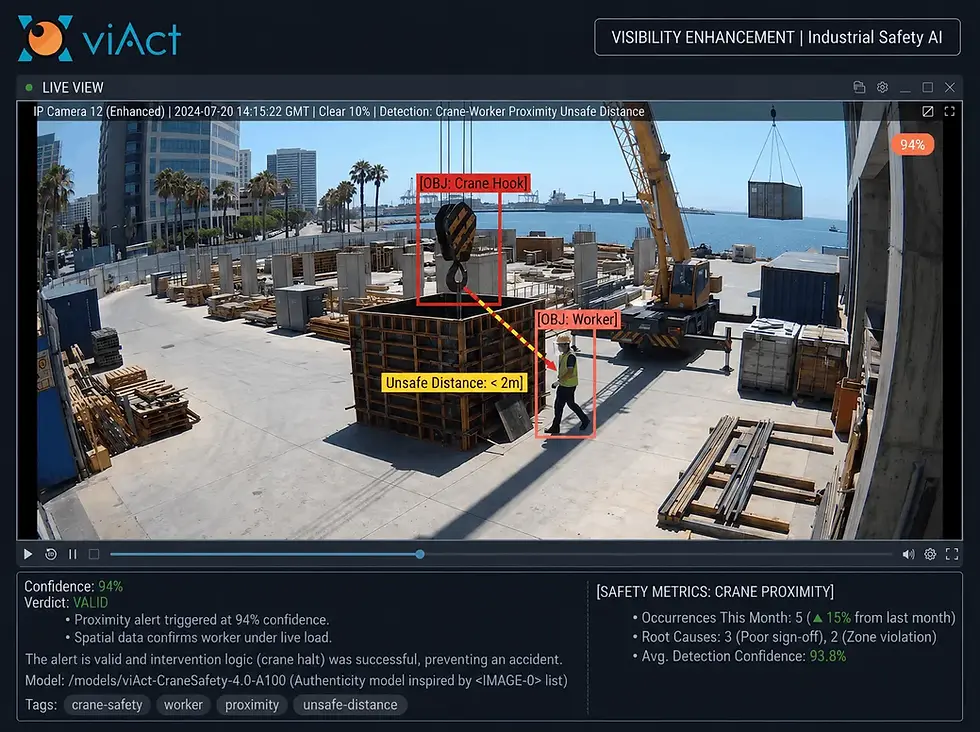
Here’s how an intelligence layer of agentic AI in workplace safety transforms the risk management scenario across high-risk sites.
1. Vision-Language Models (VLMs) Contextual Hazard Understanding
Standard computer vision identifies objects: a person, a hard hat, a machine guard. Vision-Language Models (VLMs) do something more consequential: they understand what is happening. A VLM-powered agent does not just detect a worker near a confined space entry. It reasons that the worker entered without a spotter present, without personal gas detection visible, and against an expired permit, and escalates based on that composite judgment.
Research conducted by Wu et al. (2026) has validated this approach. A VLM framework applied to mining operations, covering 40 high-frequency regulatory violations, demonstrated that context-aware reasoning significantly outperformed earlier object-detection approaches in detecting behavioural safety violations in video streams.
For EHS operations, the practical implication is alert quality. Legacy detection systems generate hundreds of notifications per shift, and supervisors learn to treat them as background noise. VLM-integrated agents understand the difference between a certified operator in a designated zone and an unauthorised worker in a restricted area and only escalate the latter. The result is fewer alerts, but reliable ones.
2. Sensor Fusion and Real-Time Environmental Monitoring
AI agents ingest and correlate data across every source that describes what is happening on a site: CCTV feeds, IoT sensors, mobile edge devices like viMOV or vehicle-mounted edge devices like viMAC, smart wearables like smart helmet or smart watch and posture or access control systems. Sensor fusion merges these streams into a unified operational picture rather than treating each in isolation.
This is where agentic AI separates from a collection of standalone tools. When a gas sensor registers an anomaly, an agent's response is not a threshold alert; it is a contextual judgment. Are workers currently in the affected zone? Are they carrying personal gas detection equipment? Is there an active permit for the work being conducted? Has this sensor triggered false positives in recent shifts?
The agent weighs all of these before escalating, and when it does escalate, the recipient has context, not just a data point.
3. Predictive Maintenance and Equipment Risk Intelligence
AI agents continuously analyse time-series signals from IoT sensors — vibration, temperature, pressure, acoustic signatures, comparing them against baseline performance metrics to detect early signs of equipment degradation before failure occurs. Machine learning models identify anomalies and generate failure probability scores that trigger maintenance workflows automatically.
In an industrial risk context, the significance is direct. Equipment failure is not just a downtime event, but is often a safety event. A crane with a bearing anomaly, a pressure vessel trending outside normal parameters, or a conveyor showing irregular vibration patterns each represent hazard exposure that predictive maintenance agents can flag days before a mechanical failure creates an injury scenario.
4. Autonomous Risk Assessment and Permit Validation
Detection is only the first step. What happens next determines whether a hazard becomes an incident. AI agents triage detected hazards by severity, regulatory threshold, location, and proximity to other risk factors, presenting safety teams with a ranked, actionable queue rather than an undifferentiated alert stream.
More significantly, agents integrate directly with permit-to-work and lockout-tagout workflows. Before energising equipment or authorising confined space entry, an agent verifies that all permit conditions are met: competency certifications are current, atmospheric readings are within safe limits, LOTO steps have been completed, and the appropriate standby personnel are in position.
This autonomous validation removes the gap between procedural requirements and actual site conditions that accounts for a significant share of process safety incidents.
5. Conversational AI for Safety Reporting, Coaching, and Workforce Support
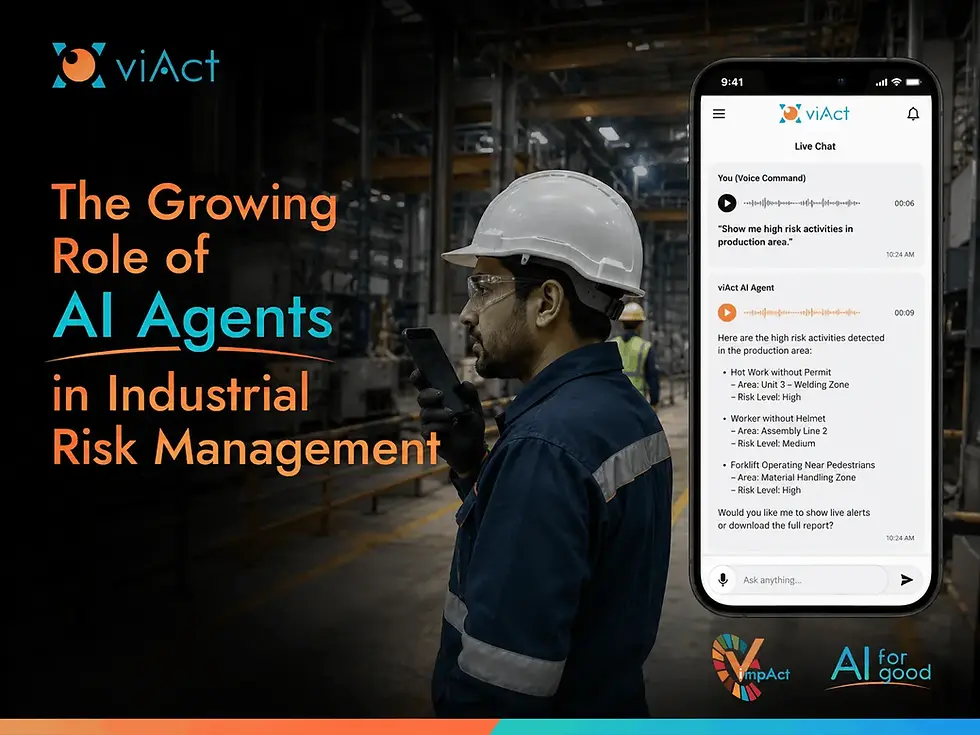
One of the most operationally underappreciated capabilities of agentic AI in EHS is the conversational interface. Conversational AI agents, like viGent deliver toolbox talks in multiple languages, verify contractor documents and certifications, test comprehension through interactive dialogue, and answer workers' real-time safety questions in the field, reducing the language and literacy barriers that often leave non-native-speaking contractors underserved by traditional induction processes.
Workers can report near-misses and hazards by voice or text. The agent routes the report, attaches location data and a timestamp, generates a ticket in the EHS platform, and confirms receipt, removing the administrative friction that drives the underreporting problem.
When workers know a report takes 30 seconds rather than 30 minutes, reporting rates improve.
Real-time coaching is the further frontier. AI agents connected to wearables can warn workers when fatigue patterns appear in physiological signals, when posture indicates musculoskeletal strain, or when noise exposure approaches unsafe thresholds. The intervention arrives at the individual level, before a supervisor is even aware of the condition.
6. Automated Incident Investigation and Root Cause Analysis
When an incident or near-miss occurs, assembling a coherent timeline from camera footage, sensor logs, access records, shift schedules, and maintenance history is typically a manual, multi-day process. AI agents compress this to minutes. They pull every relevant data stream from the centralised management platform, viHUB, correlate the sequence of events, and generate a structured timeline with the evidence attached — automatically.
Natural language processing then extracts key facts, surfaces similar historical incidents, and proposes root cause hypotheses based on established safety frameworks. Corrective action recommendations are generated and routed to the appropriate teams. What previously took two to three weeks of investigator time becomes a starting-point report available within hours of the event.
The downstream effect on systemic risk is significant. Faster, more complete investigations mean better root cause analysis, which means the corrective actions that follow are more likely to address the actual failure than a surface-level contributory factor.
7. AI-Generated EHS Reporting and Operational Intelligence
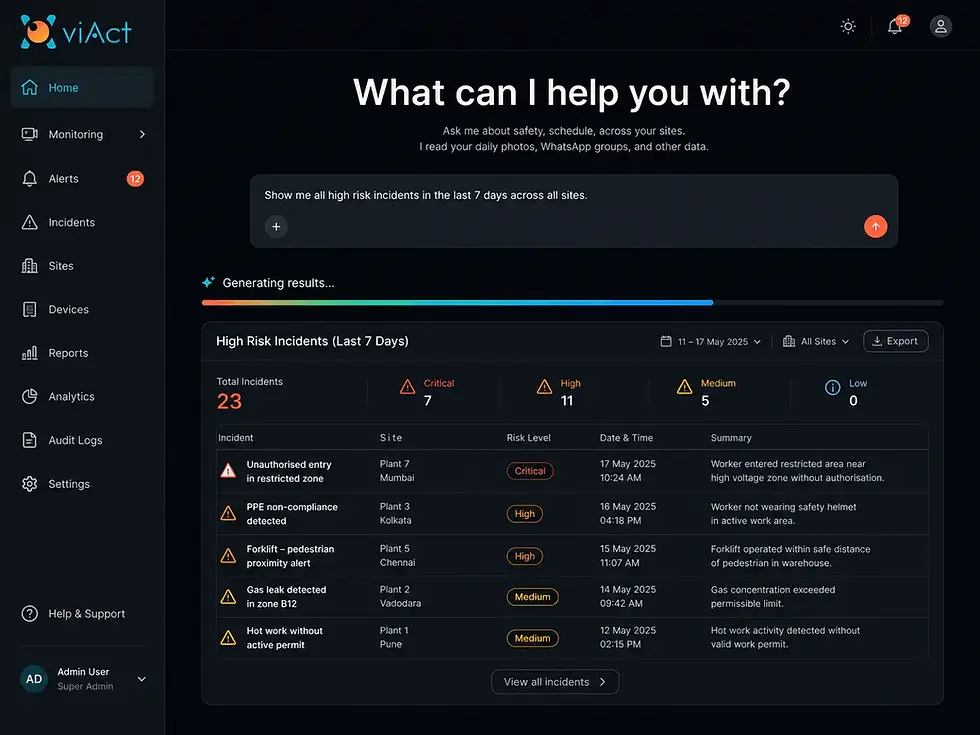
One of the most operationally time-consuming aspects of EHS management is not hazard detection itself, but the manual compilation of reports after the fact. AI agents in industrial risk management automate this entire reporting layer.
By merging multi-source operational data in real time, AI agents can autonomously generate:
daily EHS summary reports,
near-miss trend analysis,
permit compliance reports,
unsafe act and unsafe condition summaries,
equipment risk assessments,
shift-level safety dashboards,
contractor compliance reports,
and incident escalation briefings.
These reports can be automatically formatted into PDF documents and distributed through scheduled email workflows to supervisors, EHS managers, project leadership, operations teams, and executive stakeholders.
This changes reporting from a retrospective administrative exercise into a continuous operational intelligence system.
Table 1: AI Agents vs Traditional Video Analytics and EHS Monitoring Systems
The distinction between agentic AI and its predecessors is not one of degree; it is one of category. The table below maps the practical gap across dimensions that matter to AI in EHS risk management operations.
Dimension | Rule-Based Systems | Basic ML Models | AI Agents |
Detection type | Threshold breach only | Pattern recognition | Contextual multi-source reasoning |
Response mode | Alert on rule violation | Alert on anomaly | Autonomous triage, ranking, and escalation |
Learning capability | None | Periodic retraining | Continuous in-deployment feedback loops |
Integration depth | Single data source | Limited multi-source | Full sensor fusion across all site systems |
False positive rate | High | Moderate | Low — VLM context filtering reduces noise significantly |
Permit validation | Not applicable | Not applicable | Real-time, autonomous, pre-execution |
Regulatory audit trail | Threshold logs only | Anomaly records | Timestamped evidence mapped to specific standards |
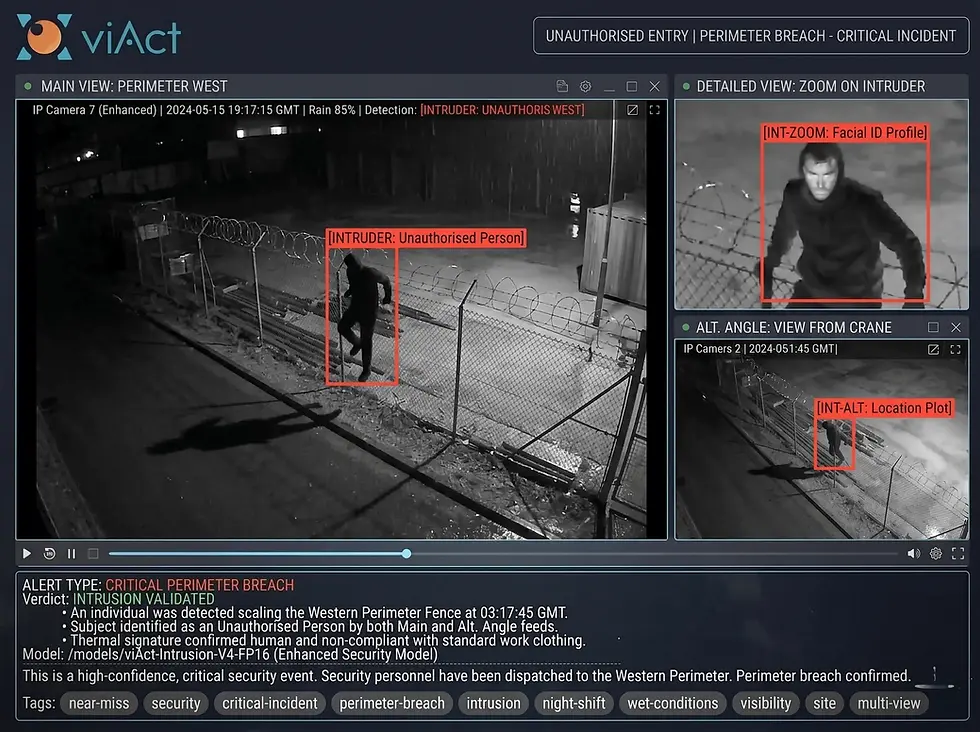
AI agents do not do the same things faster. They do things that were not previously possible: reasoning about context across systems, validating procedures in real time, and when risk thresholds are crossed.
Industrial Applications of AI Agents in Construction, Manufacturing, and Oil & Gas
1. Construction Safety Applications of AI Agents
Fall from height remain the leading cause of construction fatalities and continue to rank among OSHA's most-cited violations globally. Traditional video analytics systems can detect whether a worker is present near an edge, but they cannot independently determine whether the worker is authorised for the task, whether fall arrest systems are properly anchored, or whether surrounding operational conditions have elevated the risk level.
AI agents in industrial risk management add this missing reasoning layer.
When a worker approaches an unguarded edge without verified fall protection, the agent escalates immediately rather than waiting for the next inspection cycle. If scaffolding components appear structurally incomplete or exclusion zones are breached during lifting operations, the system prioritises the event based on operational severity rather than generating a generic alert.
Vision-Language Models (VLMs) further improve construction safety monitoring by interpreting behavioural context rather than isolated visual objects. Instead of merely identifying a worker and a scaffold, a VLM-powered agent understands that:
a scaffold access section is incomplete,
a worker is entering an elevated zone,
and nearby lifting activity increases exposure risk simultaneously.
This contextual reasoning significantly reduces false positives while improving hazard escalation accuracy.
AI agents also expand the role of autonomous inspections. Drone-mounted visual systems integrated with VLM agents can inspect scaffolding structures, temporary work platforms, and elevated access routes between shifts — reducing the need for manual inspection exposure in high-risk areas.
2. Oil & Gas Applications of Agentic AI in Workplace Safety
Confined space entry and hot work operations remain among the highest-risk operational activities in oil & gas, utilities, and heavy industrial processing environments.
Agentic AI in workplace safety connects these systems into a unified operational reasoning framework. Before confined space work begins, AI agents can autonomously verify:
whether atmospheric testing was completed,
whether standby personnel are positioned correctly,
whether worker certifications remain valid,
whether lockout/tagout procedures are active,
and whether permit conditions remain compliant throughout the operation.
This is operationally important because many process safety incidents occur after permits are issued but before tasks are completed. Conditions change dynamically during the work itself.
3. Manufacturing Applications of AI Agents in Industrial Risk Management
Manufacturing facilities generate enormous volumes of operational data across machine vision systems, industrial IoT infrastructure, telematics, IoT wearables, maintenance systems, and workforce operations.
Traditional EHS systems can identify isolated violations such as missing machine guards or unauthorised zone entry. AI agents in industrial risk management interpret these signals within a broader operational context.
For example, an AI agent monitoring machine guarding compliance can determine:
whether a guard was intentionally bypassed,
whether maintenance activity is active,
whether lockout/tagout procedures were completed,
and whether workers remain exposed to rotating equipment simultaneously.
This contextual interpretation is particularly important because caught-in/between incidents often develop through temporary procedural deviations that occur between scheduled inspections.
Also read this: Five Practical Applications of Generative AI for Manufacturers
Wearable-integrated AI agents further expand industrial safety monitoring beyond visual detection alone. By analysing:
posture patterns,
repetitive motion behaviour,
fatigue indicators,
shift duration,
and environmental exposure conditions,
AI agents can identify workers trending toward:
musculoskeletal injury,
fatigue-related operational error,
or ergonomic overexertion before incidents occur.
This predictive capability is one of the clearest examples of how agentic AI in workplace safety moves beyond traditional monitoring systems toward active operational risk prevention.
Cost of Implementing AI Agents for Industrial Risk Management: What Should You Consider?
If you're evaluating AI agents for industrial risk management, focus on the factors that have the biggest impact on both cost and return:
What affects the cost?
Your deployment model – Edge, cloud, or hybrid deployment.
Your existing infrastructure – CCTV, IoT sensors, SCADA, and EHS systems that can be integrated.
Your operational scale – A single site requires a different investment than a multi-site deployment.
Your customization needs – Industry-specific AI models, compliance requirements, and workflow integrations.
Where does the ROI come from?
Reduced time spent on manual monitoring and incident reporting.
Faster hazard detection and incident response.
Improved compliance and lower risk of regulatory penalties.
Fewer workplace incidents, reduced downtime, and stronger operational efficiency.
Before you invest, ask yourself:
What is the current cost of workplace incidents across my sites?
How many hours does my team spend on manual monitoring and reporting?
Which compliance gaps create the highest operational or financial risk?
How much value would proactive risk prevention deliver compared to reacting after an incident?
The answers will help you determine the right deployment strategy—and whether AI agents can deliver measurable value for your operations.
Conclusion: Key Takeaways
AI agents in industrial risk management do not replace video analytics or existing monitoring infrastructure; they add the reasoning layer that turns live data into contextual risk judgment and autonomous action.
Vision-Language Models (VLMs) close the gap between object detection and situational understanding: a VLM-powered agent does not just see a worker near equipment, it understands whether the permit is valid, the guard is in place, and the shift conditions elevate the risk.
Sensor fusion across CCTV, IoT sensors, wearables, SCADA, and permit systems gives agents the full operational picture that no single feed can provide, enabling risk decisions that would take a human team hours to assemble.
Conversational AI agents address one of EHS's most persistent failures: underreporting. When a near-miss takes 30 seconds to report by voice rather than 30 minutes of paperwork, reporting behaviour changes and systemic risk becomes visible.
Autonomous permit and LOTO validation moves compliance from a retrospective documentation exercise to a real-time enforcement mechanism, preventing exposure before OSHA citations or incidents occur.
Predictive capability is the next frontier: agents accumulating site-specific incident and near-miss data will move from detecting hazards to forecasting them, enabling pre-shift risk advisories before dangerous conditions form.
The EHS professional's role does not diminish; it becomes more strategic. AI agents handle monitoring, triage, and reporting at scale; safety officers focus on investigation, coaching, and the systemic changes that actually move injury rates.
The industrial organisations that build agentic AI into their EHS infrastructure today are not just improving safety outcomes; they are building the data foundation, institutional workflows, and predictive models that will define what responsible industrial operations look like for the next decade.

Quick FAQs
1. How is agentic AI in workplace safety different from traditional video analytics?
Traditional video analytics detects predefined events such as missing PPE or restricted zone entry. Agentic AI adds contextual reasoning. It understands whether permit conditions are valid, whether operational risks are escalating, and whether multiple hazards are occurring simultaneously before deciding how to respond.
2. How do Vision-Language Models improve workplace hazard detection?
Vision-Language Models (VLMs) improve workplace hazard detection by understanding operational context instead of identifying isolated visual objects. Traditional computer vision may detect a worker and a machine separately. A VLM-powered AI agent understands that the worker is operating near rotating equipment without guarding protection, while maintenance activity is active and lockout/tagout conditions are incomplete. This contextual understanding significantly improves detection accuracy while reducing false positives.
3. Can AI agents work with existing CCTV cameras and industrial IoT systems?
Yes. AI agents like viAct are designed to integrate with existing CCTV infrastructure, industrial IoT devices, SCADA systems, wearable technologies, permit-to-work systems, and EHS platforms. This allows organisations to upgrade operational intelligence without replacing existing infrastructure.
4. What is the ROI of AI agents in workplace safety?
The return on AI agents in workplace safety typically appears across three time horizons. Near-term returns (0–6 months) include alert triage labour savings, automated EHS reporting, and faster incident reporting through conversational AI. Medium-term returns (6–18 months) include incident investigation compression, permit compliance improvement, and near-miss frequency reduction through predictive maintenance. Longer-term returns include insurance premium recalibration based on documented safety performance data and systemic reduction in total recordable incident rates, which compounds over successive reporting periods.
5. Will AI agents replace safety officers and EHS professionals?
No. AI agents are designed to augment safety professionals, not replace them. AI agents handle continuous monitoring, data correlation, hazard triage, and operational analysis at a scale humans cannot maintain manually. EHS managers and safety officers continue to lead. The role of the safety professional becomes more strategic as AI agents reduce repetitive monitoring and administrative tasks.
Read More: