
Why Incident Reporting Alone Cannot Give EHS Teams Real-Time Risk Visibility
- Shoyab Ali

- Jul 3
- 9 min read
“Quick AI-Powered Insights on the Topic— Freshly Updated!”
|
Up to 91% of workplace injuries or illnesses go unreported to management, according to a publication in BMC Public Health.
That first figure is the core problem with incident reporting as a safety strategy. If nine out of ten risk events never make it into the system, the system does not have a data quality problem. It has a visibility problem. And a visibility problem cannot be solved by encouraging workers to file more paperwork.
Incident reporting alone cannot give EHS teams real-time risk visibility because it only captures hazards after someone notices and reports them, leaving ongoing unsafe conditions and emerging risks invisible.
This guide explains why incident reporting, however well-designed, structurally cannot provide real-time risk visibility — what that visibility gap looks like in practice across industries, how leading organisations are closing it, and what EHS teams should evaluate about their own programme.
What Is Incident Reporting in EHS?
Incident reporting in EHS refers to the process of documenting workplace incidents, hazards, injuries, near misses, or unsafe conditions for investigation, compliance, and corrective action.
Incident reporting is a pull system. Data enters only when a human decides to put it there. That means the quality and completeness of the data are entirely dependent on whether the worker involved decides to report, whether they have time to report, whether they trust that reporting will not result in blame, whether they know how to use the reporting system, and whether the event meets their subjective threshold for what counts as reportable.
What Is Real-Time Risk Visibility?
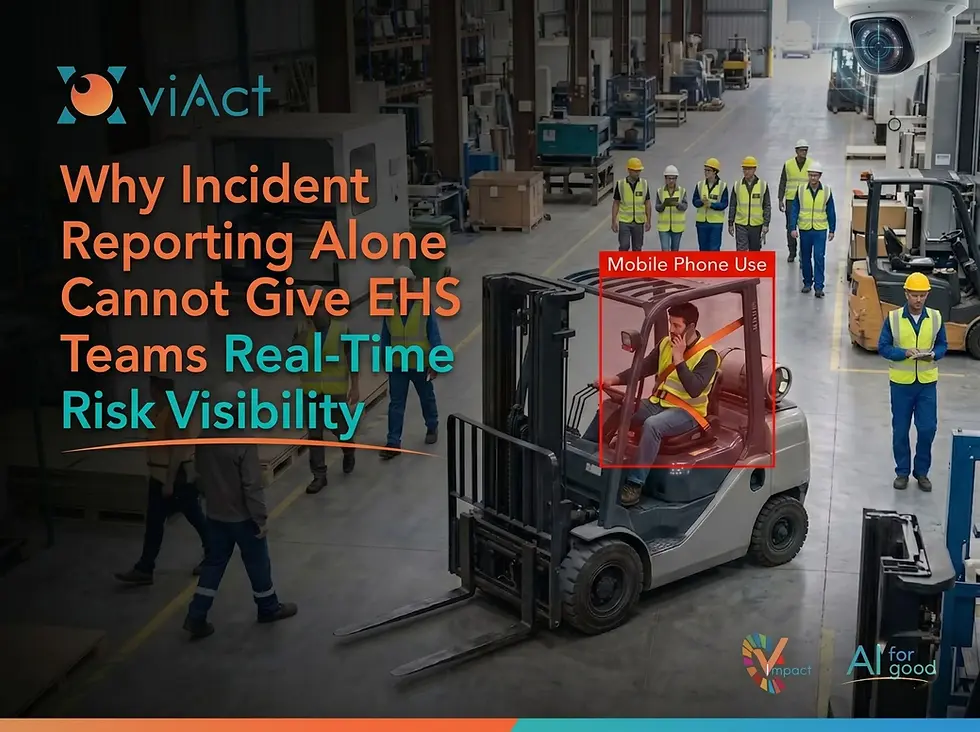
Real-time risk visibility is the continuous monitoring of workplace conditions, behaviours, and operational hazards using live safety data, AI monitoring systems, sensors, or computer vision technologies.
Real-time risk visibility means knowing what is happening on the facility floor now, for example, which zones are generating risk events, at what frequency, on which shifts, and whether the pattern is improving or worsening, without waiting for a worker to decide to report something.
Incident reporting captures a risk condition after they produce harm, in the best case, after a near-miss that someone logs within the same shift. Real-time monitoring ensures near-miss detection as they occur, enabling alert delivery and intervention while the condition exists and before it escalates.
Why Incident Reporting in EHS Alone Lacks Real-Time Risk Visibility
Here are 5 key reasons why traditional incident reporting systems refrain from obtaining real-time visibility around industrial sites -
1. It Activates After Harm Has Occurred
The defining characteristic of incident reporting is that it records events after they happen. A worker sustains a hand injury. A near-miss is observed, and the worker decides to log it. A supervisor notices a hazardous condition on a walkthrough and raises an observation. In every case, something has already occurred before the data enters the system.
For serious injuries or fatalities (SIFs), this means the system is recording outcomes it cannot prevent, because by the time the record exists, the harm is done. For near-misses, the window is narrower, but the fundamental dynamic is the same: the risk condition existed and produced an event before the data appeared.
2. Near-Miss Under-Reporting Is a Common Problem
Most EHS teams understand that near misses are under-reported. The standard response is a cultural intervention: promote a blame-free reporting environment, simplify the reporting process, and celebrate near-miss reports as positive safety contributions.
These interventions help at the margin. They do not solve the structural problem.
Workers make unconscious and conscious decisions about what counts as a near miss, how much time they have to report, and what will happen as a result. Closing that gap through safety culture alone has a ceiling. The organisations that have most substantially improved near-miss capture rates are those replacing voluntary reporting with automated monitoring.
3. Risk Observation Coverage Is Discontinuous
Incident reporting produces data when events occur and are reported. It produces no data the rest of the time. Between the last incident report and the next one, the EHS team has no information about current conditions on the facility floor.
In a facility running three shifts, this means the safety picture available to the EHS manager at any given moment is built from the last set of reports, which may be hours or days old, and which cover only the events that workers chose to document.
4. The Time Lag Degrades Corrective Action
When an incident does get reported, it enters an investigation and corrective action process. That process has its own latency. A near-miss report filed at the end of a shift may not be reviewed until the following day. An incident investigation may take days or weeks to complete. Corrective actions may be assigned and sit unresolved for weeks.
5. Reporting Quality Varies Across Sites and Supervisors
In multi-site EHS programmes, incident reporting data is not comparable across sites. Sites with strong safety cultures and experienced EHS managers generate more near-miss reports. Sites under production pressure or with high workforce turnover generate fewer.
This makes benchmarking across sites using incident data misleading.
Table 1: Incident Reporting vs Real-Time Risk Monitoring: A Comparative Analogy
The table below captures the fundamental differences between programmes built on incident reporting and those incorporating real-time workplace risk monitoring.
Dimension | Incident Reporting Alone | Real-Time Risk Monitoring |
What it captures | Incidents that get reported after they occur | Risk conditions building in real time |
Near-miss visibility | Voluntary, inconsistent, chronically under-reported | Automated, continuous, no friction |
Detection timing | After harm has occurred | Before harm occurs |
Coverage across shifts | Snapshot at time of report or audit | Every shift, every zone, continuously |
Behavioural drift | Invisible until an incident surfaces it | Detected as pattern divergence over time |
Multi-site risk view | Aggregated historical totals only | Live risk scores across all sites simultaneously |
Corrective action trigger | Post-incident investigation | Pre-incident intervention |
Data objectivity | Dependent on reporter judgement and willingness | Objective, consistent, fatigue-free |
EHS team workload | High — manual data collection and report compilation | Low — auto-generated reports and structured alerts |
Regulatory evidence | Satisfies recordkeeping requirements | Supports proactive compliance and audit trail |
How High-Risk Industries Are Closing the Real-Time Visibility Gap
The shift from incident-based safety management to continuous workplace risk monitoring is already underway across construction, warehousing, manufacturing, and oil and gas. The organisations leading this transition are not replacing incident reporting altogether. They are recognising its structural limitation: incident reporting can document what happened, but it cannot continuously show what is happening now.
That distinction matters most in high-risk operational environments where risk conditions evolve faster than traditional reporting systems can capture.
Construction — Monitoring Dynamic Worksites in Real Time

Construction environments are highly dynamic by nature. Work zones change daily, crews move between elevations and trades, and simultaneous operations create overlapping risk exposures across large project areas.
In these environments, maintaining continuous visual supervision through supervisors alone is operationally impossible. Incident reporting systems capture what workers choose to report after the fact. They do not provide continuous visibility into evolving unsafe conditions across multiple active work fronts.
This is why large construction projects are increasingly adopting AI-driven workplace risk monitoring using computer vision, edge devices, and real-time alert systems deployed on existing site cameras.
The operational advantage is straightforward:
PPE non-compliance can be identified immediately
Unsafe work-at-height behaviour can trigger alerts before escalation
Restricted access violations can be detected in real time
Recurring unsafe behaviour patterns can be identified across shifts and zones
At a high-rise development project in Singapore, the construction giant deployed viAct scenario-based AI monitoring to improve real-time visibility. It saved more than 7000 working hours and led to a 10x improvement in the overall site safety score.
Warehousing and Logistics — Detecting Near Misses That Never Get Reported

Warehousing and logistics operations present a different but equally significant visibility challenge. High-throughput facilities operate under constant movement pressure, with forklifts, pallet movers, loading equipment, and pedestrians sharing operational space simultaneously.
In these environments, vehicle-pedestrian proximity breaches occur frequently but rarely enter formal reporting systems. Workers remain focused on operational flow, supervisors prioritise throughput, and close calls become normalised over time.
The result is a major visibility gap between actual operational risk and reported incident data.
Continuous monitoring systems help close that gap by tracking movement patterns, vehicle trajectories, blind-spot interactions, and pedestrian proximity events in real time. Instead of waiting for collision reports or injury investigations, EHS teams gain visibility into recurring exposure patterns before harm occurs.
Manufacturing — From Incident Investigation to Live Operational Safety
Manufacturing facilities operate with high-speed machinery, robotics, electrical systems, conveyors, and human operators working in proximity. In these environments, the escalation window between unsafe behaviour and serious injury is often measured in seconds.
Traditional incident reporting systems operate too slowly to provide meaningful intervention capability in these conditions. By the time an unsafe interaction becomes a documented event, the exposure has already occurred.
This has accelerated the adoption of AI-enabled monitoring systems focused on:
Machine guarding compliance
Lockout/tagout (LOTO) adherence
Worker-machine proximity monitoring
Unsafe access detection
Behavioural drift identification
Hazardous-zone intrusion alerts
Continuous monitoring data enabled the facility to intervene proactively through procedural redesign, physical interlock improvements, and targeted coaching before the unsafe behaviour escalated into a serious incident.
Oil and Gas — Extending Visibility Into Remote and High-Risk Environments
The visibility limitations of incident reporting become even more pronounced in oil and gas operations, where work frequently occurs across remote facilities, red zones, and low-supervision environments.
In these conditions, near-miss reporting rates are particularly low despite the severity of potential consequences.
A confined-space entry deviation, unauthorised restricted-area access, or unsafe maintenance activity may never enter the reporting system unless the situation escalates into a serious incident. Continuous monitoring systems address this challenge by extending operational visibility into environments where permanent supervision is difficult or impossible.
Battery-powered edge devices, like viMOV with WAN-independent monitoring units, and AI-enabled remote detection systems, are increasingly being deployed to monitor:
Restricted maintenance areas
Tank farms
Remote operational zones
Confined spaces
Flare areas
Hazardous material handling locations
At an offshore Oil & Gas facility in Abu Dhabi, the deployment of real-time risk visibility with CCTV AI modules helped to bring down violations by 80%. A total of 1500 operational hours were saved annually with 50% improved annual productivity.
Conclusion: Key Takeaways

Incident reporting remains essential for compliance, investigation, and historical analysis, but it was not designed to provide continuous operational visibility into evolving workplace risk conditions.
The core limitation of incident-based safety systems is architectural: risk enters the system only after an event is observed, interpreted, and formally reported by a human participant.
Real-time risk visibility requires a fundamentally different approach — one built on continuous monitoring, automated detection, and live operational intelligence rather than delayed event documentation.
In dynamic industrial environments, the most critical risk conditions often develop between reports: behavioural drift, repeated unsafe interactions, proximity exposures, and non-compliant operational shortcuts that gradually become normalised.
AI-enabled workplace monitoring extends EHS visibility beyond reported incidents by continuously analysing operational activity across zones, shifts, equipment interactions, and workforce movement patterns.
The value of continuous monitoring is not limited to immediate alerts. Over time, it creates a structured leading-indicator dataset capable of revealing recurring exposure trends, elevated-risk zones, and operational conditions that consistently precede incidents.
As industrial operations become faster, more distributed, and more complex, the speed at which organisations detect and respond to unsafe conditions increasingly determines the effectiveness of the overall safety programme.
Incident reporting tells you what went wrong. Real-time risk visibility tells you what is going wrong right now. No organisation has ever prevented an incident by analysing incident reports quickly enough. Prevention requires seeing the condition before it becomes a record.

Quick FAQs
1. What technologies are used for real-time workplace risk monitoring?
Modern workplace risk monitoring systems like viAct typically use AI video analytics, computer vision, CCTV integration, edge devices, IoT sensors, cloud platforms, and automated alert workflows.
2. Can AI ensure real-time visibility in remote industrial sites with limited connectivity?
Yes. Modern edge AI devices and WAN-independent monitoring systems can support workplace risk monitoring in remote environments such as oil and gas fields, mining operations, offshore facilities, and infrastructure projects. The edge processing and hybrid deployment options continue providing visibility even without electricity or internet connectivity.
3. How much does a real-time workplace risk monitoring system cost?
The cost of a workplace risk monitoring system depends on several operational factors, including:
Number of cameras and monitored zones
Type of AI modules required
Infrastructure requirements
Cloud or on-premise deployment preference
Number of sites and users
Integration requirements with existing EHS systems
Level of real-time alerting and analytics needed
Most organisations begin with a pilot deployment in high-risk operational areas before scaling across facilities.
4. Can workplace risk monitoring systems integrate with existing EHS software?
Yes. Many workplace safety monitoring solutions can integrate with incident management systems, permit-to-work platforms, EHS dashboards, ERP systems, and compliance reporting tools.
5. What are the main benefits of real-time risk visibility for EHS teams?
Real-time risk visibility helps organisations:
Detect unsafe conditions earlier
Improve hazard response speed
Reduce operational blind spots
Strengthen workplace compliance
Improve corrective action efficiency
Identify recurring exposure patterns
Support predictive safety decision-making
viAct is a leading Impact AI company focused on improving safety and efficiency in high-risk industries. Since 2016, we've implemented innovative “Scenario-based Vision Intelligence” solutions across hundreds of organizations. Recognized by Forbes and the World Economic Forum, we aim for a sustainable future through responsible technology.
Read More:


Great insights on the challenges of incident reporting. Real-time visibility can make a huge difference in identifying risks early and improving workplace safety outcomes fnaf.
Very informative article on EHS safety systems and real-time monitoring. It clearly explains why relying only on incident reporting can limit risk visibility and slow down prevention efforts. Levidia Blog always shares useful digital marketing and industry insights like this.