
5 AI Video Analytics Applications in Manufacturing for Workplace Safety

Updated: Jul 28
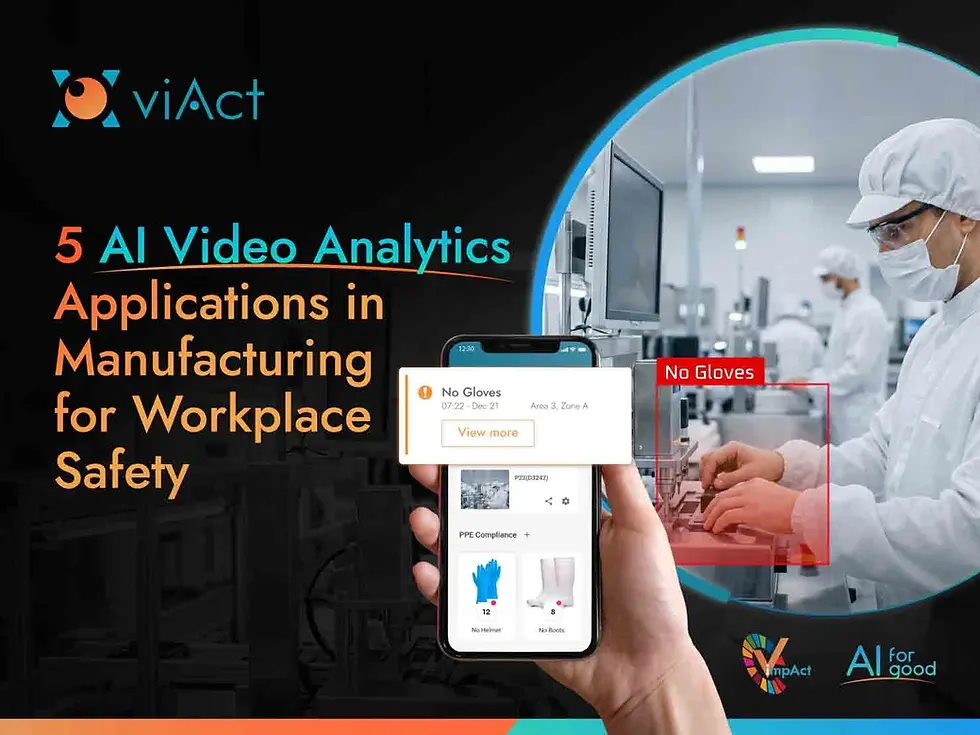
In the dynamic landscape of manufacturing, safety stands as a pivotal concern. The manufacturing industry contends with multifaceted safety risks that endanger workers and disrupt operations. According to the International Labour Organization (ILO), nearly 3 million workers die annually from work-related accidents and diseases globally, with the manufacturing sector among the highest-risk environments due to heavy machinery, hazardous materials, and complex multi-shift operations. Factors such as rapid industrialization, inadequate safety regulations, insufficient training, and often outdated equipment contribute to these alarming statistics.
Out of various safety issues in factory floors, the following forebears are alarming and account for significant portion of incidents:
Machinery-related accidents resulting from improper usage, maintenance gaps, or equipment malfunctions
Hazardous materials handling leading to chemical exposure or fires if mishandled or stored incorrectly
Musculoskeletal disorders related to workplace ergonomics associated with repetitive tasks or poor workstation design
Insufficient training, fatigue, and compounding human errors during Simultaneous Operations (SIMOPS)
These risks make a compelling case for AI video analytics applications in manufacturing. By powering existing cameras with computer vision intelligence, manufacturers gain real-time monitoring and analysis across factory floors, significantly reducing workplace accidents and enhancing operational safety.

Here are how manufacturers can enhance manufacturing safety using AI Video Analytics:
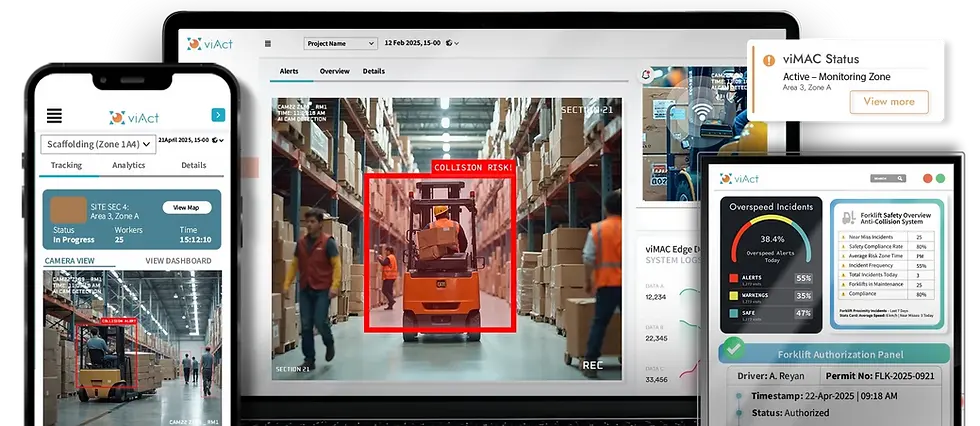
In the manufacturing industry like beverage industries, forklifts play a crucial role but also pose significant safety risks. AI Video Analytics for beverage manufacturing industry has emerged as a game-changer in enhancing forklift safety within these environments. By employing AI-driven systems, cameras strategically placed across floors of beverage manufacturing units can continuously monitor forklift movements and behaviors in real-time. These systems are designed to detect potential safety breaches, such as reckless driving, unauthorized personnel near forklift zones, or imminent collisions with objects or individuals.
viAct’s EHS management system for manufacturing industry triggers immediate alerts, notifying both the forklift operator and designated personnel to take corrective action, preventing accidents and ensuring a safer working environment. This proactive approach not only mitigates risks but also fosters a culture of heightened safety awareness and compliance in forklift operations within manufacturing facilities.
viAct forklift safety capability has delivered verified outcomes in practice. At a Dubai Power Generation facility, deployment of viAct AI-powered forklift monitoring resulted in 65% safer forklift operations and 88% fewer PPE violations across the facility.
Read the full case study here: https://www.viact.ai/case-studies/dubai-power-generation-manufacturer-boosts-safety-with-viact-ai
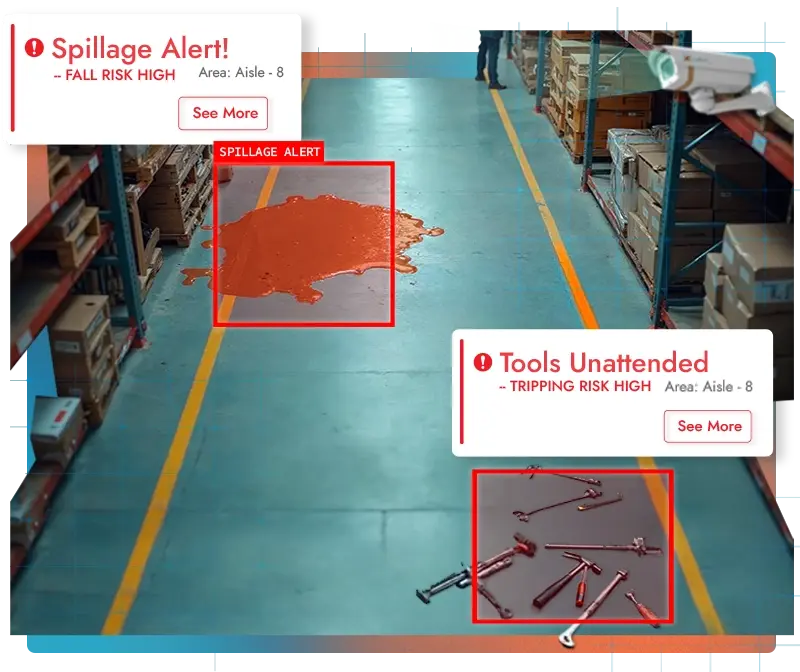
Housekeeping management in the food manufacturing industry is paramount for maintaining stringent hygiene standards and preventing contamination risks. AI Video Analytics introduces a transformative dimension to this aspect by bolstering housekeeping protocols through continuous monitoring and analysis. CCTVs equipped with AI technology are strategically positioned throughout manufacturing facilities to oversee cleanliness standards in real-time. These systems can detect spillages, improper waste disposal, equipment cleanliness, and adherence to sanitation procedures.
viAct’s Digital EHS Management System for food manufacturing units elevates the efficiency of housekeeping management but also ensures compliance with rigorous regulatory requirements, safeguarding the quality and safety of food products. When deviations or cleanliness issues are identified, AI-driven alerts through viAct’s smart video surveillance system (VSS) prompt immediate corrective actions, ensuring swift resolution and upholding impeccable hygiene standards essential in food production.
viAct's effectiveness in food and beverage manufacturing specifically is well demonstrated through the results of its deployment at a dairy and beverage facility in UAE. Post-deployment of viAct video analytics solutions, the facility achieved 95%+ PPE and hygiene compliance accuracy and a 40% reduction in hygiene violations.
Read full case study here: https://www.viact.ai/case-studies/uae-dairy-beverage-facility-ensures-ppe-compliance
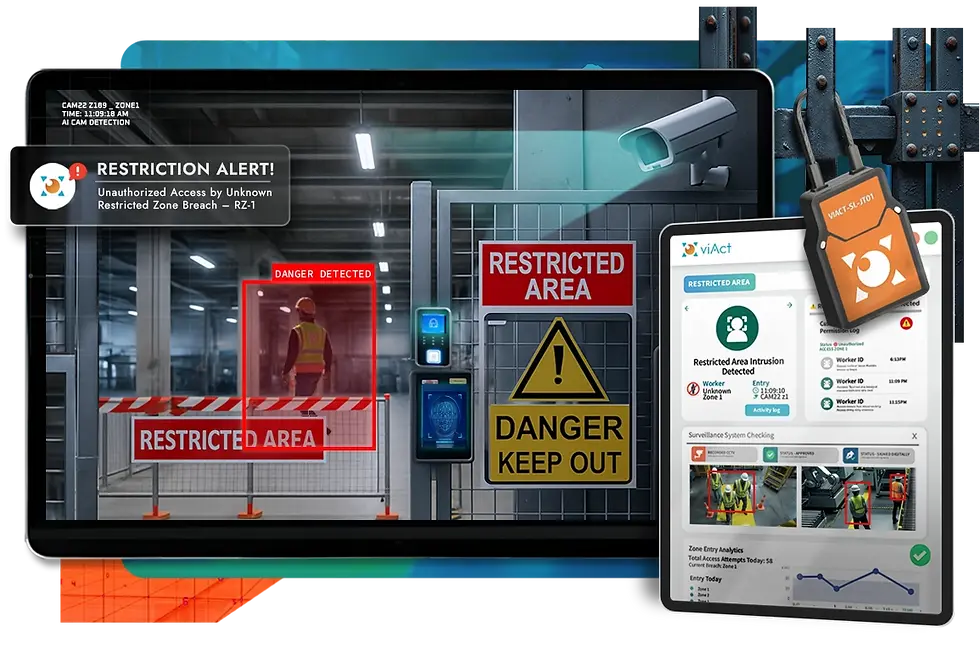
Implementing AI Video Analytics for electric vehicle (EV) manufacturing units is a pivotal step towards enhancing safety protocols. The areas that harbor high-risk zones where stringent safety measures are crucial, AI powered danger zone access control or intrusion detection applications become important. AI-powered systems, integrated with cameras, actively monitor and analyze these danger zones in real-time. Immediate alerts are triggered, notifying designated personnel and preventing access until compliance is ensured.
The smart video surveillance system (VSS) by viAct is a great example. Through advanced object recognition and personnel tracking, its scenario-based AI identifies unauthorized access or potential safety breaches. This includes detecting individuals attempting to enter restricted areas such as Battery assembly areas, High-voltage testing zones, Robotic assembly lines, Charging stations and battery storage areas, Welding and soldering stations. This proactive approach ensures strict adherence to safety protocols, fostering a safer working environment within EV manufacturing units.
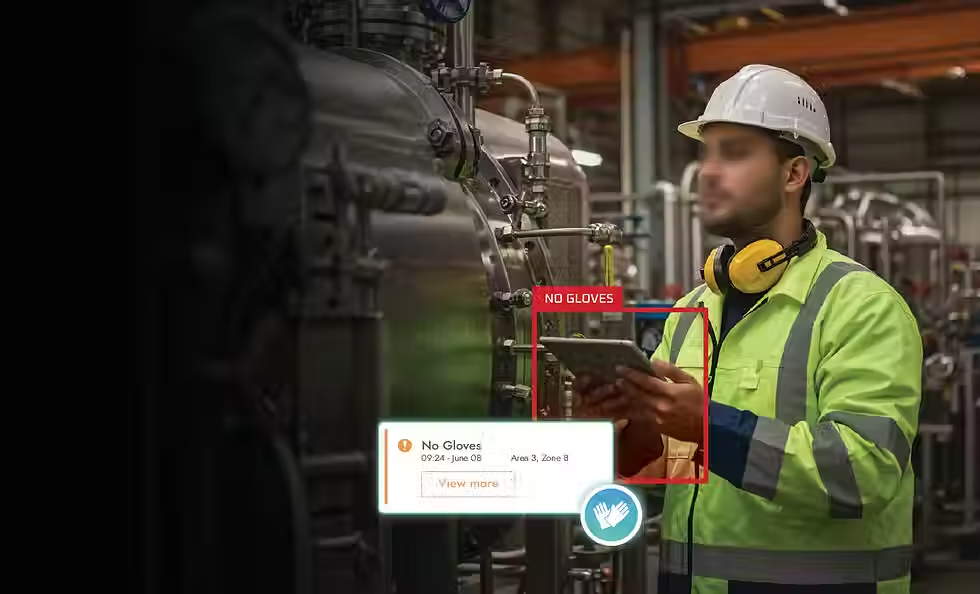
Monitoring Personal Protective Equipment (PPE) compliance through AI Video Analytics in manufacturing industry is a groundbreaking approach for ensuring worker safety. Chemical manufacturing environments often involve exposure to toxic substances, corrosive materials, or airborne particulates that can pose severe health hazards if proper precautions aren't followed. Thus, such AI powered systems powers existing cameras with cognitive ability to actively scan the manufacturing environment for adherence to PPE protocols.
The Digital EHS Management System for manufacturing industry by viAct is trained to recognize specific PPE items such as goggles, masks, gloves, and protective clothing. The scenario-based AI system can identify instances of non-compliance in real-time. Immediate alerts are generated when employees are detected without the required PPE, ensuring swift corrective action and reducing the risks associated with chemical exposure. This integration reinforces safety standards and also creates a culture of heightened compliance, prioritizing the well-being of workers in chemical manufacturing settings.
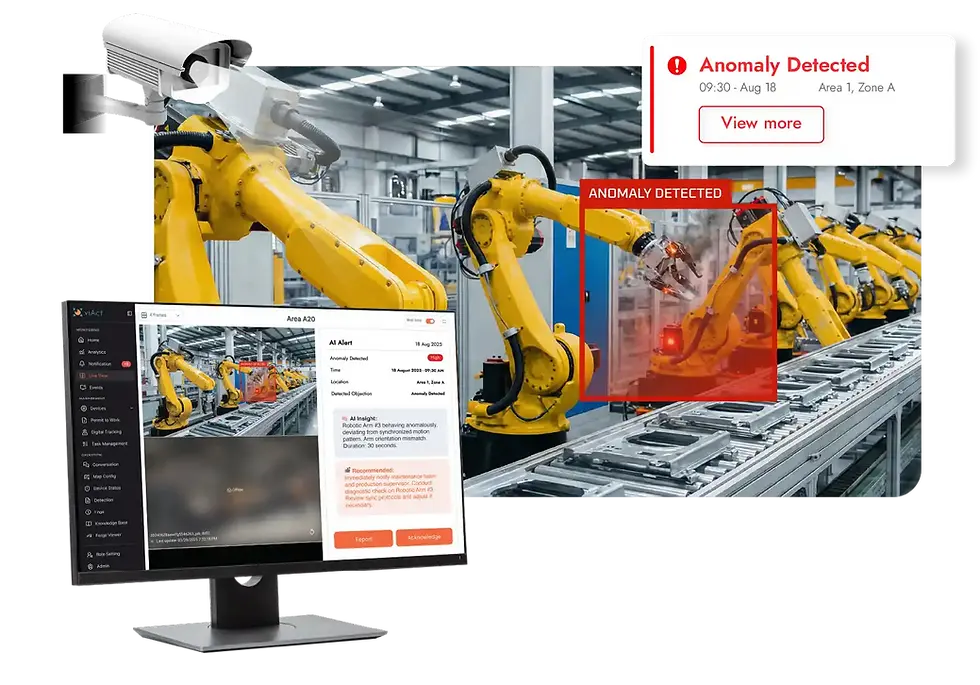
AI Video Analytics in automotive manufacturing industry detects machinery anomalies, ensures operational efficiency, and minimizes accidents. These systems leverage machine learning algorithms to monitor and analyze machinery performance in real-time. They can detect deviations from normal operational parameters, such as irregular vibrations, unusual sounds, or unexpected movements in manufacturing equipment.
viAct’s AI enabled EHS platform for manufacturers identifies these anomalies promptly through AI-powered systems triggering alerts, allowing for immediate intervention, maintenance, or shutdown if necessary. This proactive approach prevents potential breakdowns, reduces production downtime, and, most importantly, ensures the safety of workers by averting accidents related to malfunctioning machinery in automotive manufacturing units.

Musculoskeletal disorders (MSDs) from repetitive tasks, awkward postures, and improper lifting remain one of the most common yet least visible safety issues on any factory floor. Unlike a forklift collision or a missing hard hat, these risks build up over time and often go undetected until an injury has already occurred.
AI video analytics applications extend to ergonomics through computer vision based posture assessment. Using established methodologies like Rapid Entire Body Assessment (REBA) and Rapid Upper Limb Assessment (RULA), the system continuously analyzes worker posture, movement, and body angles through existing cameras, flagging awkward bending, unsafe lifting technique, and prolonged static postures that exceed safe thresholds.
viAct Ergonomics Assessment Software applies this scenario-based AI to detect these risk patterns in real time, alerting supervisors and workers before a hazardous posture results in a musculoskeletal injury. This shifts ergonomics management from periodic manual assessments, which depend on a trained observer physically watching and scoring a worker's posture, to continuous, automated monitoring across the factory floor.
How viAct AI Video Analytics Applications in Manufacturing Reduce Total Recordable Injuries (TRIRs)?
viAct AI-enabled EHS platform for manufacturers serves as a comprehensive solution in mitigating Total Recordable Injuries (TRIs). By analyzing EHS data trends in viAct’s intuitive dashboard, this platform identifies potential risks, analyzes historical incident patterns, and forecasts safety hazards within any manufacturing environments. Through real-time monitoring of workplace conditions, equipment performance, and employee behaviors, viAct’s proprietary scenario-based AI algorithms proactively flag potential safety issues before they escalate.

These capability enables timely interventions, targeted safety training, and the implementation of corrective measures, significantly reducing Total Recordable Injury Rates (TRIRs) across manufacturing operations.
The following outcomes from viAct deployments in manufacturing environments demonstrate what this looks like in practice:
88% fewer PPE violations, 65% safer forklift operations, 71% faster incident response time, 54% overall safety violation decline in a Dubai Power Generation Manufacturing Company
95%+ PPE and hygiene compliance accuracy, 40% reduction in hygiene violations, 24/7 continuous monitoring coverage in a UAE Dairy and Beverage Facility
By fostering a preemptive safety culture and empowering proactive risk management, viAct’s AI video analytics for manufacturing industry diminishes TRIs and bolsters operational efficiency. Thus, viAct’s AI enabled EHS platform ensures a safer and more secure working environment for manufacturing personnel.
For a deeper look at how AI-enabled digital EHS management systems work across manufacturing environments, read our blog on Benefits of an AI-Enabled Digital EHS Management System in Manufacturing.
Conclusion and Key Takeaways
AI video analytics applications in manufacturing covered in this blog are not theoretical capabilities. They are active deployments addressing the specific safety challenges that manufacturing sub-verticals face daily, from forklift proximity in beverage plants to high-voltage zone access in EV facilities to machinery anomaly patterns in automotive manufacturing.
The common thread across all five is the same: AI video analytics powers existing cameras with the intelligence to detect, analyse, and alert in real time, without requiring additional infrastructure or manual monitoring resources. For manufacturers managing complex, multi-shift operations across high-risk factory floors, this shift from reactive incident management to proactive AI-driven prevention is the difference between managing safety and genuinely improving it.
Key Takeaways
AI video analytics applications in manufacturing convert existing CCTV infrastructure into active safety monitoring systems, detecting unsafe conditions and behaviours in real time without requiring new camera installations.
Forklift safety monitoring in beverage and food manufacturing detects reckless driving, unauthorized personnel in forklift zones, and imminent collision risks, triggering instant alerts to operators and safety personnel.
Housekeeping and hygiene compliance monitoring in food manufacturing detects spillages, improper waste disposal, and sanitation deviations in real time, maintaining the regulatory standards that food production requires.
Danger zone access control in EV manufacturing identifies unauthorized entry into battery assembly areas, high-voltage testing zones, and robotic assembly lines, preventing access until compliance is confirmed.
PPE compliance monitoring in chemical manufacturing detects missing or incorrectly worn PPE in real time, generating immediate alerts that drive corrective action before chemical exposure risks escalate.
Machinery anomaly detection in automotive manufacturing identifies irregular vibrations, unusual sounds, and unexpected equipment movements before they result in failure, shifting maintenance from reactive to predictive.

FAQs
1. What is AI video analytics and how does it work in manufacturing?
AI video analytics in manufacturing is the application of computer vision and machine learning algorithms to live or recorded camera feeds, enabling automated detection of safety violations, equipment anomalies, and operational inefficiencies without requiring human review of every camera feed. The AI-powered software is layered on top of existing CCTV or IP camera infrastructure, processing video in real-time through trained models that recognize specific hazards, like PPE non-compliance, unauthorized zone access, machinery irregularities, forklift proximity risks, and housekeeping deviations. When a hazard is detected, the system generates an instant alert to the relevant safety personnel, enabling intervention before the situation escalates.
2. Can AI video analytics integrate with existing CCTV cameras in a manufacturing facility?
Yes. viAct's AI video analytics platform integrates with existing CCTV and IP camera infrastructure rather than requiring new camera installations. The Vision AI-powered software processes feeds from existing cameras in real-time through computer vision models, making AI video analytics applications in manufacturing deployable without significant capital expenditure on new hardware. viMAC, viAct's plug-and-play edge device, can also be attached to mobile equipment such as forklifts to extend AI monitoring coverage to moving machinery across factory floors.
3. How quickly can AI video analytics detect a safety violation in a manufacturing environment?
viAct AI video analytics system detects safety violations in real-time, typically within seconds of a violation occurring in the camera's field of view. Detection speed depends on the specific application: PPE non-compliance and zone access violations are detected at the moment they occur; machinery anomaly detection operates on a continuous monitoring basis, identifying deviations from baseline operational parameters as they develop. Alerts are generated and transmitted to designated personnel immediately upon detection, enabling intervention before the violation results in an incident.
4. What manufacturing sub-verticals benefit most from AI video analytics applications?
The manufacturing sub-verticals that benefit most are those with specific, repeatable high-risk scenarios that computer vision can be trained to detect: beverage manufacturing, food manufacturing, EV manufacturing, chemical manufacturing, and automotive manufacturing. Any manufacturing environment with existing camera infrastructure and recurring safety challenges in these areas can typically deploy AI video analytics rapidly.
5. How does AI video analytics help manufacturers comply with workplace safety regulations?
AI video analytics helps manufacturers comply with workplace safety regulations by generating a continuous, timestamped record of safety events, violations detected, alerts issued, and corrective actions taken. This compliance record is maintained automatically through viAct's centralised dashboard viHUB, rather than requiring manual documentation before each audit or inspection. For manufacturers operating in Singapore, Hong Kong, GCC markets, and Malaysia, each with specific Workplace Safety and Health or equivalent regulatory requirements, the AI-powered platform monitors compliance against applicable standards in real time and generates the audit-ready documentation that regulators require.
Also Read:


Great breakdown — the forklift safety and PPE compliance examples feel especially practical, since those are daily risks on many plant floors. Would love to see more detail on how teams measure ROI for these video analytics deployments.
AI video analytics has some interesting applications in manufacturing, especially when it comes to monitoring processes and identifying issues earlier. I sometimes use a Markdown reader to listen through longer technical articles while working.
This is a great breakdown of how AI video analytics can tackle real safety challenges in manufacturing — the forklift and PPE examples really show the practical impact. Thanks for sharing!
Great breakdown of practical AI use cases in manufacturing—especially the forklift safety and PPE monitoring examples. It’s helpful to see how video analytics can directly tackle real workplace safety challenges.
I appreciate how this Film App APK guide explains the installation steps in a straightforward way. It also highlights useful features without making the information complicated, which makes the article easy for beginners to follow.