
5 Key Applications of Computer Vision for Inventory Management in Manufacturing


Computer vision is no longer a future-state technology for inventory management in manufacturing. Across the sector, it is already being used to improve real-time inventory visibility and reduce losses from shrinkage, stockouts and overstocking.
The scale of the problem is significant. Inventory distortion, including shrink, stockouts and overstock, is estimated to cost global commerce $1.6 trillion annually. Yet many manufacturing facilities still rely on manual counts, barcode scans and periodic cycle audits that reveal inventory problems only after they have occurred.
The financial impact goes beyond inaccurate stock records. Firework reports that poor inventory management can cost companies as much as 11% of annual revenue through stockouts, write-downs, rework and missed lead times.
This is where a camera-based Inventory Verification System changes the equation. Instead of periodically checking what inventory should be available, computer vision gives operations teams continuous visibility into what is actually happening on the manufacturing floor.
The wider business case for AI is also becoming clearer. McKinsey & Company reports that organisations applying AI to supply chains have achieved 35% lower inventory levels and 65% higher service levels.
In this blog, we examine five applications of computer vision in inventory management in manufacturing, what each does on the ground, and how they compare with traditional manual methods.
Why Manual Inventory Management Keeps Failing in 2026?
The biggest problem with manual inventory management is not how long counting takes; it is the visibility gap between counts. Cycle counts, barcode scans and manual audits provide a snapshot of inventory at a particular moment, but they cannot continuously track what happens between checks.
That gap matters in manufacturing. A misplaced pallet may only be discovered when production needs it. An overfilled staging area may become apparent only when the next delivery arrives. By then, teams are reacting to a problem that has already disrupted operations. These small visibility gaps compound as materials move between storage, staging and production while physical inventory gradually diverges from system records and SOPs. Periodic checks can identify discrepancies, but often only after they have accumulated.
Computer vision for Inventory Management changes this from periodic checking to continuous verification. Instead of simply making manual counts faster, cameras can continuously monitor inventory conditions and material movements as they happen.
Here is how that works across five key applications.
Application 1: Automated Stock Counting Without the Audit Window
Traditional cycle counting has a key blind spot: the gap between one count and another. If a unit is miscounted on Monday, it will not be recounted until the audit on the following Thursday, causing ongoing miscounting that distorts replenishment signals, pick accuracy and WMS records for the entire time period between counts. Computer vision removes the gap entirely.
Object detection models running continuously monitor shelves, bins, and racks using overhead cameras. They continuously keep track of the stock units, the quantity counts, and provides real-time variance measurements to expected values with no scheduled audits, manual reconciliation, or any single point of failure associated with a barcode scanner. The system immediately flags a shelf that has fallen below the minimum quantity threshold. Any count that differs from the WMS will emerge as an alert instead of a surprise when it is time to ship.

Vision AI-based monitoring can estimate the quantity of visible stock units and flag a variance when the observed count differs from a defined threshold or system record. Object-detection models can identify items such as pallets, containers, cartons, bins or standardized components in a camera’s field of view. Tracking models can then monitor additions, removals and movements within that zone. If a line-side buffer falls below its minimum level, or the physical count does not agree with the WMS, the system can alert the responsible team.
In manufacturing, this is most useful where a count discrepancy has an immediate production consequence:
automotive plants operating with tightly sequenced component deliveries;
electronics assembly lines with high-mix, low-volume parts;
pharmaceutical facilities managing controlled materials or batches;
food and beverage plants monitoring ingredients and packaging;
maintenance stores holding production-critical spare parts.
Computer vision does not automatically make every visible item countable. Performance is strongest when units have consistent shapes, are sufficiently separated and remain visible. Dense stacks, visually identical SKUs, reflective packaging and frequent occlusion may require another identification method or a combined approach.
Application 2: Misplacement Detection and Zone Compliance
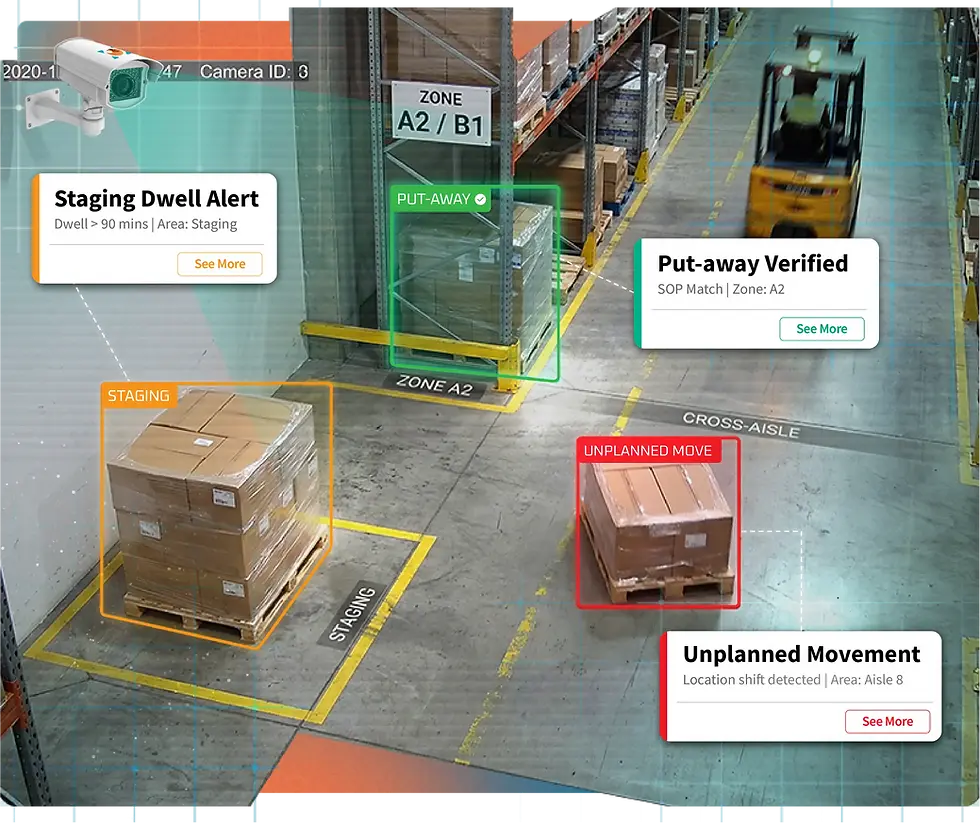
AI-powered visual monitoring can detect when inventory enters, leaves or remains in a zone that does not match the material-handling plan or SOP. A location error is often operationally silent. The system may show that a pallet was received, yet the pallet may have been left in the wrong staging lane. The problem appears later as search time, re-handling, a delayed changeover or an incorrect material reaching the line.
With virtual zones mapped onto a camera view, a computer vision system can identify:
a raw-material pallet placed in the wrong storage bay;
finished goods left in a work-in-progress zone;
a component delivered to the wrong assembly line;
stock that exceeds the permitted dwell time in quarantine or staging;
tools or returnable assets missing from their designated area;
materials placed outside floor markings or approved boundaries.
The business consequence of catching this early is significant. Kardex Remstar conducted a survey of operations leaders on automation adoption. 46% of those surveyed revealed that the first and most impactful area of improvement after implementing automation was inventory control. This clearly indicates how much rework, re-handling and confusion regarding the location of materials on a production floor develop over time due to manual operations.
Application 3: Dock-Level Verification

At a manufacturing dock, machine vision can compare the quantity, type and staging of physical goods with receiving or dispatch records.
Receiving is a high-risk handover because multiple records and physical activities converge: the purchase order, delivery document, label, unload count, inspection status and final put-away location. A discrepancy introduced here can affect production planning long after the truck has departed.
A camera-based verification workflow may:
detect and count units as they cross a defined receiving point;
recognize a pallet, container or package type;
use OCR to read a label, lot code or document field;
compare the observation with a purchase order, WMS or ERP record;
confirm movement into the correct inspection or staging zone;
create an exception when the physical receipt and expected record differ.
The same principle applies to finished-goods dispatch. Cameras can verify that the correct number and type of units enter the loading zone and create time-stamped evidence for investigating a later shortage or loading dispute.
In addition to supporting operational accuracy, the importance of dock-level validation extends further. According to ABI Research's 2025 Supply Chain Survey, 85% of supply chain leaders plan to use AI specifically for inventory management, making it one of the highest-priority deployment areas across the entire function. For facilities operating under compliance frameworks such as ISO, HACCP in food and beverage, or pharmaceutical GDP requirements, dock-level verification also directly supports the unbroken audit trail these standards demand.
Application 4: Inventory-Linked Safety Hazard Detection
The same camera coverage used to monitor inventory can also detect material-placement conditions that create safety risks. Inventory accuracy and workplace safety intersect whenever stored or moving materials affect people, vehicles or access routes. Examples include:
a pallet blocking an emergency exit;
raw materials extending into a forklift or pedestrian route;
unstable or overhanging loads on pallet racking;
goods staged inside a machine-guarding or restricted zone;
excessive stacking that affects visibility at an intersection;
a forklift and pedestrian entering the same defined proximity zone.
According to OSHA, there are 85 deaths and 34,900 serious injuries from forklift accidents every year in the USA. The majority of the physical conditions leading to these accidents — blocked aisles, improper staging, and poor visibility at intersections — stem from failures in managing inventory. Misplaced raw materials or finished goods on the manufacturing floor create production delays and are often dangerous if located near operating machines.

The table below illustrates why operations and EHS leaders in manufacturing should evaluate this as a unified infrastructure decision rather than two separate procurement processes:
Function | Manual Approach | Computer Vision |
Inventory misplacement detection | Discovered during next audit or production disruption | Flagged in real-time at point of deviation |
Zone SOP compliance | Spot-checked manually | Continuously enforced across all camera areas |
Dock / goods receiving verification | Manual count under time pressure | Automated validation against PO/WMS |
Raw material staging near production lines | Periodic visual checks | Continuous monitoring, deviation alert |
Forklift proximity to workers | Mirrors, signage, spot supervision | Real-time proximity alert with video evidence |
Machine guarding zone compliance | Manual patrols, signage | Camera-based zone detection, immediate alert |
PPE compliance | Periodic walkthroughs | Continuous detection, immediate alert |
Emergency exit obstruction | Noticed on inspection | Flagged as soon as obstruction occurs |
Audit documentation | Manual records, incomplete | Time-stamped visual evidence, always-on |
The operations and EHS teams are consistently obtaining the strongest ROI by running a single, properly implemented camera network for both inventory analytics and safety monitoring instead of running two separate projects in parallel that involve different budgets and different groups of stakeholders.
Application 5: OCR-Based Documentation and Audit-Readiness

AI-based OCR can extract visible text from labels and documents and compare it with the lot, batch, expiry or supplier information stored in enterprise systems. This is useful when inventory control depends on more than the presence of an item. A manufacturer may need to verify that the correct batch reached a production line, that a material has not expired, or that the label on the physical unit agrees with the receiving record.
OCR-supported workflows can capture:
lot and batch codes;
expiry or manufacture dates;
serial numbers;
supplier and material identifiers;
purchase-order or delivery-note fields;
container or pallet labels;
certificates linked to a material receipt.
Every instance of entering data manually into an inventory system represents the potential for a latent error. A human data entry error rate of 1% is verified based on research from many industries. This means that 10 out of every 1,000 labels read, lots verified, or shipping documents captured have one or more mistakes. In high-mix manufacturing operations, this error rate not only represents a significant inefficiency; it is also an embedded source of reliability issues within an operation's capacity.
The result across manufacturing is the same: fewer entry errors, faster discrepancy investigations, cleaner shift handovers, and an audit trail that does not depend on human consistency to remain intact.
What to Look for When Evaluating a Computer Vision Inventory Management System

There are many different types of computer vision platforms available today, but not all work as expected in real-world operations for manufacturing. These platforms are being adopted rapidly due to the anticipated growth of the global AI in manufacturing market, which was valued at $34.18 billion in 2025 and is expected to experience a compound growth rate of 35.3% per year through 2030. Therefore, there are only a few key criteria that operations teams need to assess when deciding if they want to invest in an effective deployment or simply purchase a generic version.
The edge AI functionality is essential for manufacturing plants that do not have continual connectivity or tolerate high latency. - This is the line in the first point of this section - What to Look for When Evaluating a Computer Vision Inventory Management System
Compatibility with existing camera infrastructure is important in controlling deployment cost across both sectors. A new technology platform that needs to have all of its hardware replaced before it can become 'operational' will totally change the ROI equation for facilities that already have CCTV coverage.
IoT integrations greatly expand upon the capabilities of fixed cameras by enabling verification of returnable assets, pallets, containers, tools and critical spare parts that travel or are transported across columns, shifts, and facilities. Manufacturers tracking critical components and returnable tooling across multi-line production environments benefit significantly from this technology.
Coverage across both operations and EHS is perhaps the most important evaluation criterion of all, and the one most commonly overlooked. For example, if a single platform could provide both inventory verification & safety monitoring, there would only be one deployment, one vendor, one set of maintenance cycles & one infrastructure cost as opposed to deploying two systems separately.
Responsible AI and data governance round out the checklist, particularly when conducting business in the GCC or Singapore. The scrutiny that regulators are placing around the deployment of AI, data residency and worker's private data has all been increasing. Systems that align with the GDPR legislation that provide controlled access and visible governance are now critical (not optional) for multi-region manufactures.
viAct's Inventory Utilization Monitoring System was built around exactly these criteria. Explore the solution here.

Conclusion: Key Takeaways
Computer vision inventory management is not a single-purpose technology. Therefore, businesses treating it as such are foregoing tremendous value. Computer vision enables automated stock counting, misplaced item detection, dock verification, safety management, and auditing – all with one commonality: a shared camera network that runs continuously serving functions that manual processes can only address partially and retrospectively. The key points below summarise what that means in practice for manufacturing operations evaluating this technology in 2026.
The failure of manual inventory management has less to do with diligence and more to do with timing. As periodic audits and barcode systems are retrospective by their very nature, they create visibility periods in the supply and manufacturing chain during which errors accumulate without detection.
The significant advantage of using computer vision for inventory management is that it does away with audit windows altogether. It replaces scheduled physical counts with continuous verification of inventories through camera-based system and detects any variances at the moment they occur.
Zone compliance monitoring and mis-berthing detection in both warehousing and manufacturing environments is probably one of the most silent forms of operational failure. These types of operational failures create storage and staging deviations that only surface when they have already caused a delay or a production disruption.
Dock-level and goods-receiving verification eliminates the source of most inventory errors by combining object recognition technologies with OCR to automatically validate both inbound and outbound inventory without adding to staffing levels, while also maintaining throughput.
The camera systems used to enhance accuracy in inventory simultaneously monitors forklift proximity, machine guarding zones, PPE compliance, and emergency exit obstruction, making it a single deployment that serves both operations and EHS across manufacturing facilities. - Fifth point in conclusion
Using AI-driven OCR removes manual input of any data from the verification chain, producing a continuous time-stamped audit trail, which meets the compliance requirements of pharmaceutical manufacturing, food and beverage manufacturing, oil and gas production and manufacturing, and industrial manufacturing processes, without adding administrative overhead.
Facilities achieving the highest levels of success in 2026 will not run independently operating inventory management systems and/or independently operating safety-monitoring systems. Rather, they will run a unified monitoring system that serves both functions from shared infrastructure, across the manufacturing floor.- Last point in conclusion

FAQs
1. What is computer vision inventory management?
It is the use of AI-powered cameras to track stock levels, locations, and movement automatically, in real time — instead of relying on manual counts, barcode scans, or periodic audits.
2. Can inventory management in manufacturing work with existing CCTV cameras, or does it require hardware replacement?
Yes. Most platforms, like viAct, are designed to work with existing CCTV infrastructure. The AI analytics layer is deployed on top of the existing feed via edge devices, without requiring a full hardware replacement. Where coverage gaps exist, such as receiving docks, production line staging areas, or high-traffic storage zones, additional cameras may be recommended, but the core system does not demand a rip-and-replace approach. This makes it one of the more practical deployments for manufacturing facility operations that already have camera coverage in place but are not yet extracting operational intelligence from it.
3. How is computer vision different from RFID for inventory tracking in manufacturing?
RFID identifies tagged items when they enter reader coverage and can support location tracking when deployed with suitable infrastructure. Computer vision provides visual context within a camera’s field of view, such as placement, stacking and zone compliance. The technologies are often complementary.
4. How long does it take to see ROI from computer vision for inventory management solution deployment?
Time taken for attaining ROI varies depending on the size of the facility and the scope of the deployment. However, many facilities report seeing measurable improvements within a few months after implementation, mostly in the form of reduced rework from misplaced materials, quicker investigations into discrepancies, and fewer outbound errors. The ROI case accelerates significantly when the same infrastructure is credited across both inventory accuracy and safety incident reduction, as the infrastructure cost is shared across two operational functions rather than justified by one alone.
5. How does viAct handle worker privacy concerns given that its cameras are monitoring the facility continuously?
viAct has developed its platform by adhering to the responsible AI framework and by ensuring that data complies with GDPR. The technology processes video through edge AI locally, and video data is not sent to external servers via streaming. It embeds access controls directly into the system's architecture rather than as a policy or overlay. For operations in Singapore, the GCC, and other regions with tightening data protection regulations, this addresses compliance at the infrastructure level. The system monitors operational activity and inventory movement, not individual worker performance. This distinction is important to communicate clearly to teams before deployment.
Related Blogs:


The source https://softdoes.com/industries/construction I checked out SoftDoes for our construction needs, and I have to say, it’s been a game changer! The interface is super user-friendly, making it easy to manage projects and keep everything organized. I love how it streamlines communication among the team, so we’re all on the same page. Plus, the support team is always there to help if I run into any issues. Definitely worth a look if you want to boost your construction workflow!
SX88 mình mới lướt thử vì thấy bạn bè nhắc hoài, kiểu vào xem cho biết thôi chứ không có thời gian ngồi mò sâu. Cảm giác đầu tiên là giao diện làm khá nhẹ, mở trên điện thoại không bị ì, bấm qua lại mấy mục cũng phản hồi nhanh nên hợp lúc tranh thủ giờ nghỉ. Mình để ý họ tối giản nhiều thứ, đặc biệt mấy thao tác kiểu nạp rút nhìn gọn, ít bước nên đỡ rối cho người mới. Nội dung trên trang cũng chia theo khối rõ ràng, chữ dễ nhìn, không nhồi quá nhiều thứ vào một màn hình nên lướt phát là hiểu bố cục, nhất là cách họ nhóm danh mục…
RR88 mình mới lướt thử vì thấy bạn bè nhắc hoài, kiểu vào xem cho biết chứ cũng không định ngồi khám phá lâu. Cảm giác đầu tiên là trang nhìn khá thoáng, không bị rối mắt như nhiều chỗ khác. Mình thích cái cách họ chia nội dung thành từng khối rõ ràng, nhìn lướt qua là biết phần nào với phần nào, khỏi phải đọc kỹ mới hiểu. Menu để ngay chỗ dễ thấy nên bấm qua lại cũng nhanh, không phải kéo lên kéo xuống tìm. Nói chung dùng vài phút thôi mà thấy đỡ “lạc” hơn mình tưởng, vì mọi thứ được gom gọn lại khá hợp lý. Nhìn tổng thể thì bố cục theo dạng…
33WIN mình thấy dạo này xuất hiện nhiều nên cũng ghé thử cho biết, kiểu vào xem bố cục với cách họ viết bài thôi. Vừa mở lên là thấy họ chia nội dung theo từng khối khá dễ nhìn, tiêu đề to rõ nên lướt nhanh vẫn nắm được đang nói gì, không bị rối mắt. Có một đoạn họ làm nổi bật khuyến mãi tháng 8 2026, mình nhớ mang máng ghi ngân sách thưởng tới 50 tỷ nên nhìn cái là nhận ra ngay. Mình cũng có đọc lướt phần giới thiệu lịch sử, thấy nhắc từ 2012 ở Manila nên ít nhất cảm giác họ có kể nguồn gốc đàng hoàng. Nói chung trải nghiệm xem…
https://www.7c777.com/ showed up while I was scrolling a discussion, so I poked around out of curiosity more than anything. First thing I noticed is the layout feels pretty uncluttered—like you can tell where to click without second-guessing it. I’m not a fan of sites that cram everything together, and this one doesn’t really do that; the info sits in separate blocks so it’s easy to skim. The navigation also seems sensibly grouped, so you’re not bouncing all over the place trying to find the next page. It’s not trying to be flashy, which I honestly prefer when I’m just browsing on my phone. The spacing and those clean content sections make the interface feel really readable.