
Workforce Intelligence for Construction Sites in KSA & UAE

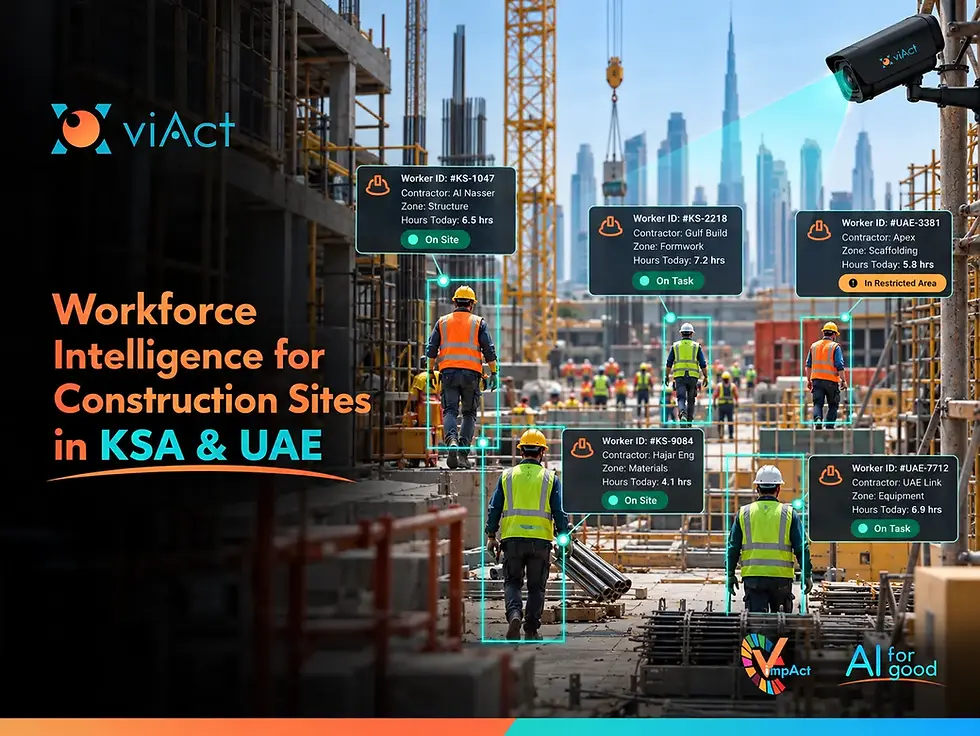
Saudi Arabia and the UAE are undergoing major industrial transformation, supported by large infrastructure programs, manufacturing investments, logistics development and national diversification strategies such as Saudi Vision 2030 and the UAE's industrial transformation initiatives.
The World Bank's latest 2026 regional economic update projects an average of 4.6% growth in 2026-2027 for Saudi Arabia and 4.9% for UAE, while continuing to highlight industrial development, infrastructure investment and employment creation as important priorities for long-term resilience.
In both Saudi Arabia and the UAE, workforce management is also closely connected with local requirements covering working hours, overtime, wage protection and seasonal restrictions on outdoor work. As organizations add contractors and temporary workers across multiple projects, attendance records, shift information, contractor data, payroll and actual site activity can easily become fragmented across different systems.
This is where workforce intelligence goes beyond traditional workforce management. Instead of treating attendance, payroll and workforce activity as separate records, AI workforce intelligence can connect these data sources to identify patterns in workforce distribution, utilization, overtime and contractor deployment.
What Is Workforce Intelligence for Construction Sites?
Workforce intelligence is the process of connecting and analysing workforce and operational data to understand how labour is deployed, how work patterns change, where workforce gaps occur and what decisions may improve site operations.
This makes workforce intelligence broader than workforce analytics. It is also different from basic workforce management. Workforce management typically handles functions such as scheduling, attendance, leave and working hours. Workforce intelligence uses data generated by these systems, together with operational information, to identify patterns and support decisions.
Area | Workforce Management | Workforce Analytics | Workforce Intelligence |
Main purpose | Manage workforce operations | Analyse workforce data | Turn connected workforce data into operational insight |
Typical question | Who is scheduled and when? | What happened? | Where is attention needed and why? |
Common data | Attendance, shifts, leave | Historical workforce metrics | Workforce + contractor + operational + cost data |
Output | Records and schedules | Reports and dashboards | Patterns, trends and decision support |
Role of AI | Automation | Pattern analysis | Continuous analysis and operational intelligence |
For construction, this distinction matters because having 500 workers recorded as present does not tell a project manager whether the required workforce is distributed correctly across the project's active work fronts.
Why Is Workforce Intelligence Important in KSA & UAE?
Saudi Arabia and the UAE share several workforce-management challenges like large projects, subcontracting structures, outdoor work, rotating shifts and geographically distributed work areas. But the regulatory and operational context is not identical in both countries.
Managing Large and Distributed Workforces
On large projects, teams need to know more than who entered the site. They need visibility into where workers are deployed, which contractors they belong to, whether actual manpower matches planned requirements and where workforce gaps are developing. Workforce intelligence brings these different workforce records into a more connected view.
Managing Working Hours and Shifts
Both Saudi Arabia and the UAE generally set normal working hours at eight hours per day or 48 hours per week, subject to applicable exceptions. Saudi regulations also include specific overtime provisions. Connecting attendance, shifts and overtime data can help project teams identify discrepancies earlier and maintain more reliable workforce and payroll records.
Planning Around Heat Restrictions
Outdoor workforce planning is particularly important during summer. In Saudi Arabia, the 2026 direct-sunlight work ban applied from 12:00 p.m. to 3:00 p.m. between 15 June and 15 September. In the UAE, the Midday Break applies from 12:30 p.m. to 3:00 p.m. over the same dates.
Real-time workforce visibility can help teams understand workforce distribution around these restricted periods while supporting—not replacing—the required heat-stress controls.
Connecting Workforce and Payroll Data
Saudi Arabia's Wage Protection Program monitors wage payment in private-sector establishments. MHRSD reported that more than 1 million establishments, representing 94% of private-sector establishments, were registered on the Mudad platform during 2025. In the UAE, MoHRE reports that 99% of workers are registered in the Wage Protection System, which electronically oversees payment of salaries according to employment records.
Workforce intelligence can connect these records with shift and contractor data to support better payroll verification and workforce planning.
What Is the Role of AI in Workforce Management?
Traditional workforce systems are good at recording transactions: a worker checked in, a shift was assigned, overtime was entered, or a contractor submitted a manpower report.
AI workforce intelligence can add another layer by identifying patterns across these records and, where appropriate, combining them with observable site activity.
Computer vision can analyse suitable camera feeds to estimate workforce presence or occupancy within predefined work zones using People Counting Video Analytics. Real-time workforce analytics can show how workforce distribution changes between those areas during the day, giving supervisors another source of information when reviewing actual deployment against the plan.
Attendance information becomes more useful when analysed together with shift schedules, site access and operational records. Instead of only asking: “How many workers attended today?”
Workforce intelligence using zone-based workforce presence tracking can support questions such as:
Which work zones were staffed during the shift?
Where did actual workforce distribution differ from planned deployment?
Are recurring overtime patterns concentrated around particular activities or contractors?
3. Contractor Workforce Intelligence
A major construction project may have a main contractor and multiple subcontractors working simultaneously. AI workforce management can help centralize comparable information on workforce presence, deployment, shift patterns and zone activity across contractors. This can reduce dependence on separate spreadsheets and independently prepared manpower summaries.
4. Predictive Workforce Analytics
Once sufficient historical information exists, predictive workforce analytics can identify recurring patterns that may affect future workforce planning. For example, project teams might find that particular work fronts repeatedly experience manpower shortages at specific stages, that overtime rises around certain activities, or that actual workforce requirements consistently differ from planned deployment.
Historical patterns estimated by a centralised dashboard can then become an input to AI workforce planning, alongside the construction programme, contractor plans and project-manager judgement.
5. Workforce Optimization
Workforce optimization means using workforce information to improve how labour is allocated and optimise productivity. If one work area repeatedly has more labour than the current activity requires while another is consistently understaffed, the project team can investigate whether deployment, sequencing or shift planning using industrial workforce productivity monitoring systems.
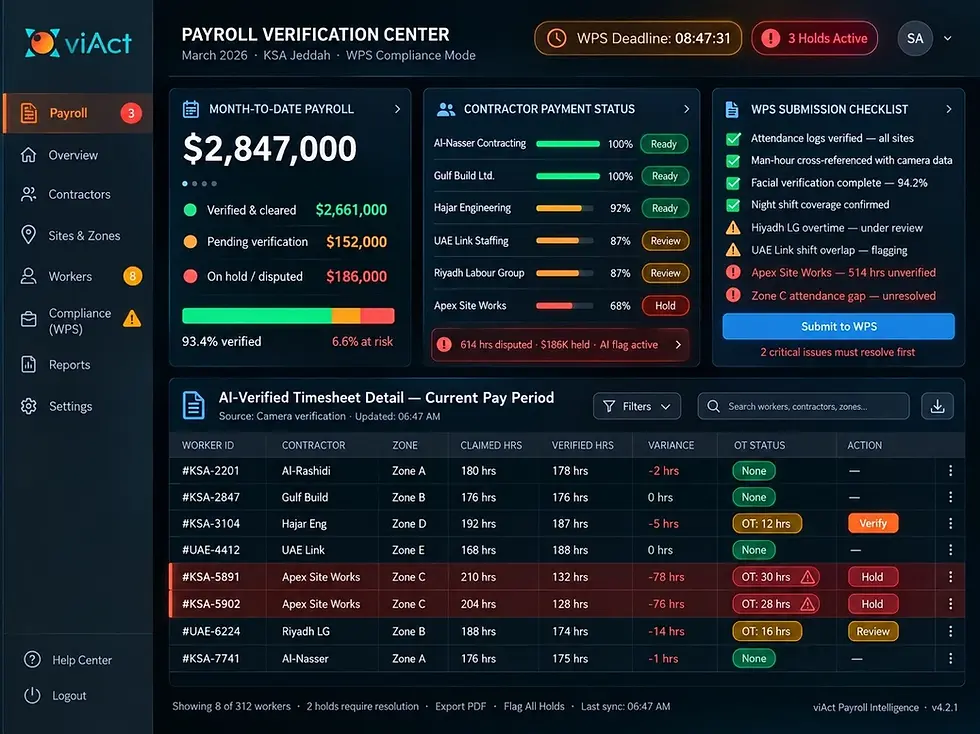
Payroll can then be connected as another data layer. Attendance records, approved shifts, overtime information and contractor submissions can be reviewed together before payroll processing. In KSA and the UAE, where WPS frameworks formalize wage-payment records, this creates a more logical role for payroll within workforce intelligence.
How Does AI Workforce Intelligence Work on a Construction Site?
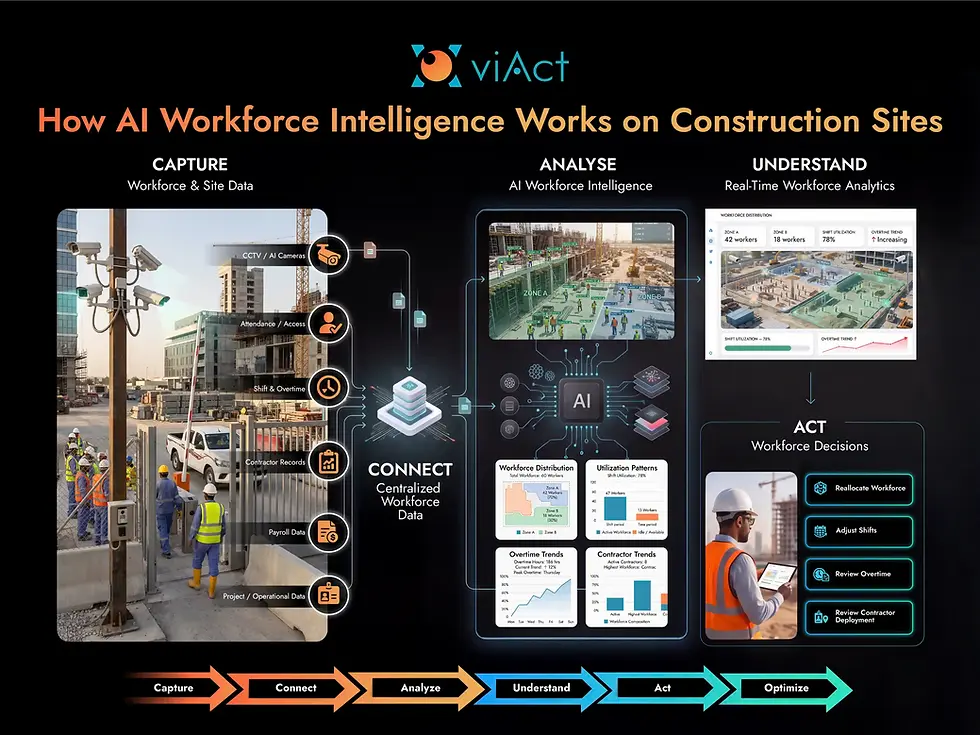
The architecture is relatively simple:
Capture
The system begins with existing workforce and project data, which may include:
attendance and access records;
shift and overtime schedules;
contractor manpower records;
payroll and labour-cost data;
project or operational records; and
AI-enabled camera data from selected work zones.
Connect
Relevant data is brought into a centralized workforce view. This does not mean every construction system must be replaced. The objective is to reduce the gap between systems that already know who should be working, who is recorded as present, where labour is required and what the project is doing.
Analyse
AI and workforce analytics can then identify recurring patterns across shifts, zones, contractors and time periods.
Understand
The resulting workforce intelligence may highlight workforce distribution, utilization patterns, overtime trends, contractor deployment, labour costs or workforce planning.
Act
Project managers, operations teams, HR and contractors then decide whether action is required—for example, reallocating labour, adjusting a future shift, investigating recurring overtime or reviewing contractor deployment.
The important distinction is that AI provides evidence for the decision; it does not replace the manager responsible for making it.
What Is the Impact of AI Workforce Intelligence on KSA & UAE Construction Sites?
The most useful applications are those that address actual construction workforce problems rather than generic HR functions.
Planned vs Actual Workforce Deployment
Construction programmes establish what work should happen and when. Workforce intelligence adds visibility into how labour is actually distributed across monitored work areas. If the structural work front is planned for a particular manpower level but observed deployment consistently differs, the project team has a reason to investigate the gap.
Multi-Contractor Workforce Visibility
Large Saudi and UAE construction projects can involve different subcontractors responsible for civil works, MEP, lifting, logistics, finishing and other packages. A centralized workforce view can help the main contractor compare planned manpower, recorded attendance and actual workforce distribution without relying exclusively on separate end-of-shift reports.
Shift and Overtime Analysis
Working-hour and overtime requirements make this particularly relevant in both markets. Workforce intelligence can identify repeated overtime patterns by contractor, activity or project area so they can be reviewed against approved records and actual operational requirements.
Heat-Period Workforce Planning
KSA and UAE both restrict outdoor work during defined summer midday periods, but their restricted hours differ. Shift planning, outdoor deployment and rest arrangements need to follow the applicable local requirements. Workforce intelligence can help project teams review workforce distribution around these periods and plan labour-intensive outdoor work for appropriate hours.
Labour Cost and Payroll Visibility
By connecting workforce deployment, approved attendance, overtime and payroll records, teams can investigate where labour cost is being generated and whether recurring workforce patterns explain cost changes.
Across 50+ contractor teams managed, disputed man-hours decreased by 90% during FY2024–FY2025 after attendance records were matched against verified worker presence across shifts and work zones. The improvement reduced attendance-to-payroll discrepancies and provided operations teams with a more consistent record for validating contractor hours before payroll processing.
What Are the Benefits of AI in Workforce Management in KSA & UAE Construction Sites?
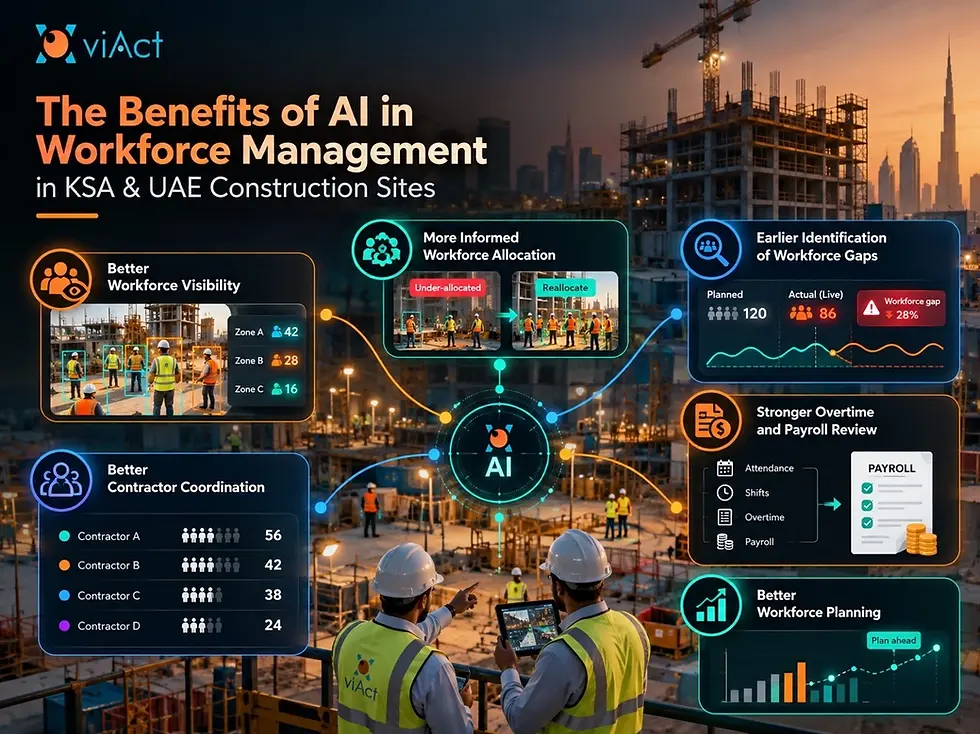
AI workforce management can give project teams a clearer view of how labour is distributed and utilized across construction sites. By connecting real-time workforce visibility with contractor, shift, overtime and payroll data, teams can identify workforce gaps earlier, improve allocation and coordination, and use historical patterns to support better workforce planning.
How to Integrate AI Workforce Intelligence in KSA & UAE Construction Sites?
Implementation should start with a workforce problem, not with a list of AI features.
1. Define the workforce question
Identify what the project actually needs to understand: contractor deployment, workforce distribution, overtime, labour utilization, shift planning or another operational issue.
2. Identify existing data sources
Map attendance, access-control, shift, contractor, payroll and project-management data already available.
3. Define the operational context
Map work zones, contractors, shifts and project activities so workforce data can be interpreted in relation to actual site operations.
4. Add AI monitoring where it provides useful evidence
Use suitable existing cameras or purpose-positioned cameras for defined applications such as workforce presence, people counting or zone distribution. The existing viAct approach supports AI analysis of workforce presence and distribution from camera infrastructure.
5. Centralize relevant data
Bring the selected workforce and operational information into a common dashboard or reporting layer.
6. Establish useful metrics
Prioritize operational metrics such as planned vs actual workforce, zone occupancy, contractor deployment, overtime trends and workforce distribution rather than collecting data simply because it is technically possible.
7. Configure the correct KSA or UAE rules
Working hours, heat restrictions, wage-protection processes and other employment requirements should be configured and interpreted according to the jurisdiction where the project operates—not treated as one GCC-wide rule.
8. Review insights before acting
AI-identified patterns should be validated against project conditions and reviewed by the responsible project, HR or operations team before decisions are made.
Conclusion: Key Takeaways
Workforce intelligence goes beyond attendance and payroll by connecting workforce, contractor and operational data to explain how labour is actually being deployed across a construction project.
KSA and UAE projects share workforce challenges but operate under different requirements, including different midday heat-restriction hours, so workforce rules should remain jurisdiction-specific.
AI workforce intelligence can support real-time workforce analytics, predictive workforce analytics and workforce optimization by identifying recurring patterns across shifts, contractors and work zones.
Payroll remains an important data source rather than the centre of the system, particularly because both Saudi Arabia and the UAE operate formal Wage Protection Systems.
AI should support—not replace—workforce decisions. Presence, movement and zone activity can provide useful operational signals, but productivity needs to be interpreted together with project progress, work output and human review.
As construction projects in KSA and the UAE become more digitally connected, the next step is not simply collecting more workforce data, but turning the data already available into timely, context-aware decisions.

Quick FAQs
1. What is workforce intelligence in construction?
Workforce intelligence in construction is the process of connecting and analysing attendance, shift, contractor, workforce activity, project and labour-cost data to understand workforce deployment and support operational decisions.
2. What is the difference between workforce analytics and workforce intelligence?
Workforce analytics primarily explains patterns in workforce data. Workforce intelligence combines those findings with operational context to help teams understand where attention is required and what workforce decision may be appropriate.
3. How is AI used in workforce intelligence?
AI can analyse workforce data and, where appropriate, computer-vision signals such as workforce presence, people counts and zone occupancy. These patterns can be combined with shifts, contractor records and project data to support real-time workforce analytics, workforce planning and optimization.
4. Can AI workforce intelligence measure construction worker productivity?
Not by itself. Presence, movement or time spent in a work zone does not prove productivity. Workforce productivity analytics should combine observable workforce patterns with relevant measures such as project progress, completed work, task requirements and other operational data.
5. How does payroll fit into workforce intelligence?
Payroll is one workforce-intelligence data source. Connecting payroll and overtime records with approved attendance, shifts and contractor information can improve labour-cost visibility and support record review, while formal wage payment must still follow the applicable Saudi or UAE requirements. Saudi Arabia and the UAE both operate Wage Protection Systems for private-sector wage payments.
6. Can workforce intelligence help with heat-stress workforce planning in KSA and UAE?
It can support planning and visibility, but it does not replace heat-stress controls. Saudi Arabia's 2026 direct-sunlight ban ran from 12:00 p.m. to 3:00 p.m. between 15 June and 15 September, while the UAE's annual Midday Break covers outdoor/direct-sun work from 12:30 p.m. to 3:00 p.m. over the same dates. Workforce data can help project teams plan shifts and review deployment around these restricted periods.
Related Blogs:


Great write-up on the impact of AI Workforce Intelligence in the KSA & UAE construction sectors! The distinction you made between basic workforce management and true workforce intelligence is crucial, especially with regional regulations like WPS and summer heat restrictions.
As site digitisation expands with AI tools and site documentation, creative tech like learning How to Turn Photo Into Cartoon or vector visual formats is also becoming a popular way to make complex site reporting and safety visual aids more engaging for multi-lingual workforces. Excellent insights on predictive workforce analytics!
The explanation of 10.0.0.0.1 Admin is helpful for beginners who may not realize that the extra zero makes the address invalid. The guide also provides useful alternatives for finding the correct router gateway.
Many users search for 10.0.0.0.1 when trying to open their router settings. A simple guide can help explain the correct login process and make basic router access easier to understand.
Accessing the Admin page of the router involves using the IP address 10.0.0.1 for making changes to the Wi-Fi configuration, security setting, list of attached devices, etc., which acts as the default gateway.
Accessing the Admin page of the router involves using the IP address 10.0.0.1 Piso Wifi for making changes to the Wi-Fi configuration, security setting, list of attached devices, etc., which acts as the default gateway.