
AI Video Analytics for Smart Manufacturing in Saudi Arabia: Applications & Benefits


“Quick AI-Powered Insights on the Topic— Freshly Updated!”
|
Saudi Arabia’s manufacturing sector is moving toward more connected, automated and data-driven operations as part of its wider industrial transformation. The Saudi Vision 2030 Annual Report 2025 highlights growing adoption of automation and high-value manufacturing, while the Future Factories Program had enabled around 3,900 factories toward its target of 4,000. The program is designed to help factories adopt automation, artificial intelligence and advanced production systems.
This transformation creates a parallel need for better visibility into what is happening on the physical factory floor. Production systems can provide data about machines and processes, but manufacturers also need to understand how workers, machinery, vehicles and work areas interact in real operating conditions.
AI video analytics for smart manufacturing in Saudi Arabia can provide this visual layer by analysing camera feeds to identify predefined safety risks, operational conditions and unusual events. This article explains how the technology works, its applications in Saudi factories, the benefits it can provide and how manufacturers can introduce it alongside existing safety and production systems.
What Is AI Video Analytics in Smart Manufacturing?
AI video analytics in smart manufacturing is the use of artificial intelligence and computer vision to analyse video from factory cameras and automatically identify predefined objects, activities, conditions or risks.
Traditional CCTV primarily records footage for people to review. AI-enabled cameras or analytics software can analyse video continuously and trigger an alert when a configured condition is detected. For a manufacturing facility, those conditions might include a worker entering a machine danger zone, missing required PPE, a forklift approaching a pedestrian area or materials obstructing a designated walkway.
The objective is not to replace people responsible for safety or factory operations. Instead, AI provides an additional source of real-time information that can help them see conditions that may otherwise be missed between inspections or during busy production periods.
Why Is Smart Manufacturing Growing in Saudi Arabia?
Saudi Arabia is placing advanced manufacturing at the centre of its industrial transformation.
The Vision 2030 Annual Report 2025 describes increasing adoption of advanced technologies, with a growing emphasis on automation and high-value manufacturing. It also highlights development of domestic high-tech manufacturing capacity in areas such as semiconductors, smart devices and AI infrastructure.
The Ministry of Industry and Mineral Resources' basic digitization track provides an even clearer picture of what factory transformation means in practice. Its supported areas include:
production planning systems;
production-line control through systems such as MES and SCADA;
material-handling systems;
warehouse-management technologies;
IoT software and sensors;
factory communication systems; and
access to operational factory data.
The initiative aims to increase productivity, competitiveness and operational efficiency across Saudi factories. As more machinery, automation and digital systems enter Saudi factories, however, manufacturers also need visibility into the human side of increasingly automated operations.
This is where AI video analytics can complement other smart manufacturing technologies.
How Does AI Video Analytics Work in a Factory?
AI video analytics combines camera infrastructure with computer vision models capable of recognizing configured objects, movements and conditions.
A typical workflow can be represented as:

Observe
Cameras capture activity across production areas, assembly lines, loading zones, warehouses and other monitored parts of the factory.
Detect
Computer vision models analyse the video for predefined conditions. Depending on the use case, these could include people, vehicles, PPE, entry into configured zones or worker-machine proximity.
Alert
When the system identifies a configured condition, an alert can be sent to designated personnel through a control room, dashboard or mobile interface.
Verify and Act
Supervisors can verify what happened and determine the appropriate response based on established factory procedures.
Record
The event can be recorded with information such as time, location and detection type, reducing reliance on manually reviewing hours of CCTV footage.
Analyse
Over time, accumulated event data can reveal patterns—for example, whether a particular production area repeatedly experiences unsafe proximity events or whether PPE violations are concentrated around a certain shift or activity.
Depending on the factory's requirements, video analytics can operate through edge, on-premise, cloud or hybrid architectures. Existing compatible CCTV feeds can also be used in some deployments, reducing the need to build an entirely separate camera infrastructure.
The important distinction is that AI video analytics does not need to operate as an isolated factory system. It can form another layer within a wider smart manufacturing environment alongside production-control, IoT and safety systems.
What Are the Applications of AI Video Analytics for Smart Manufacturing in Saudi Factories?
Saudi factories vary considerably, from food and consumer-goods manufacturing to metals, chemicals, machinery and increasingly advanced technology manufacturing. The appropriate AI applications therefore depend on each facility's actual risk profile and operating environment.
Several applications, however, are relevant across many manufacturing environments.

Production lines combine workers, conveyors, automated equipment, materials and moving machine components within a relatively confined operating area. This is particularly relevant in Saudi factories operating automated production lines, conveyor systems and material-handling equipment alongside manual assembly activities, where workers and machinery may interact repeatedly within the same production area.
AI video analytics can monitor predefined conditions such as workers entering machine operating zones, unsafe interaction around conveyors, obstruction of production areas and deviations from established work zones. It can also create time-stamped records of recurring events to help teams identify where risks repeatedly develop.
This is especially useful for assembly line safety, where workers may move repeatedly between workstations and interact with tools, machinery and partially assembled products throughout a shift.
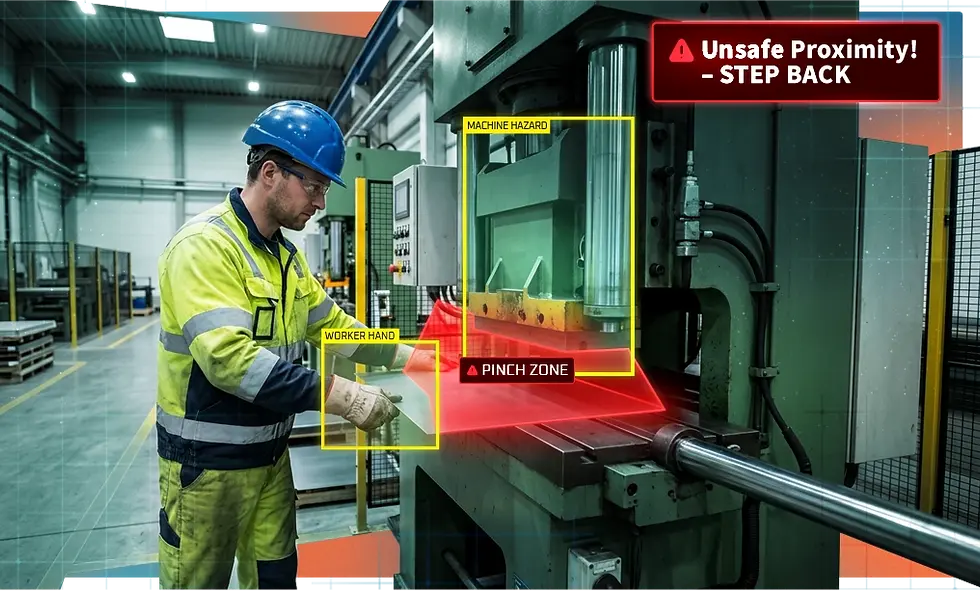
Workers may need to approach machinery during operation, loading, adjustment, inspection, cleaning and maintenance. These interactions can expose them to crushing, caught-in, pinch-point and entanglement hazards.
Computer vision can establish predefined safety zones around machinery and identify when workers move into those zones under specified operating conditions. More advanced proximity monitoring can evaluate the relative position of workers and moving equipment to identify potentially unsafe interactions.
A Saudi example makes this particularly relevant. At a pipe manufacturing facility in Khobar, moving steel pipes created dynamic high-risk areas along the production line. AI monitoring was used to map restricted zones around pipe movement and flag worker intrusion into those areas.

Forklifts routinely move raw materials, pallets and finished goods between warehouses, production areas and loading bays. Shared routes, reversing movements, blind corners and congested staging areas can create collision risks.
The AI system can monitor:
forklift–pedestrian proximity;
workers entering forklift travel paths;
reversing near-miss situations;
blind-zone interactions;
unsafe movement around loading areas;
pallet-handling areas; and
repeated near misses at particular intersections.
There is also a strong Saudi manufacturing example available. viAct reports that a Riyadh manufacturing facility used existing CCTV to identify unsafe forklift-worker proximity around raw-material loading bays and blind storage exits, with forklift-related near misses declining by 62% within three months.

Manufacturing workers may spend long periods lifting, bending, reaching, twisting, standing or performing repetitive assembly tasks. In Saudi manufacturing environments, assembly, packaging and material-handling activities can involve frequent lifting, reaching, bending and repetitive movements, making ergonomic risk monitoring particularly relevant across production operations.
Computer vision can analyse body posture and movement patterns to identify conditions such as:
repetitive bending;
awkward reaching;
unsafe lifting posture;
prolonged static posture;
excessive twisting;
repetitive upper-body movement; and
workstation-related posture risks.
AI-based ergonomic assessment can also support established observational approaches such as REBA (Rapid Entire Body Assessment) and RULA (Rapid Upper Limb Assessment) by providing more continuous observation than periodic manual assessments alone.

AI-based analysis can establish expected visual patterns around selected manufacturing activities and identify deviations such as:
unexpected machine idling → abnormal material accumulation → unusual equipment movement → process-flow deviations → prolonged stoppages
For Saudi factories progressing toward greater automation and digital production, this visual layer can be particularly useful where automated equipment, conveyors and manual workstations operate as part of the same production flow.
This doesn't replace PLC, SCADA or MES data. Instead, it adds visual context around what is physically occurring on the production floor. For example, a system may show that production has slowed, while video analytics can help reveal material accumulation or an abnormal physical workflow around a particular workstation.

Even as Saudi factories adopt more automated and digitally connected production systems, smart manufacturing still depends on basic factory-floor conditions. Materials left in walkways, obstructed access routes or poor housekeeping can create risks regardless of the level of automation.
Where conditions are visually detectable and the system has been configured for them, AI can support monitoring for issues such as:
objects obstructing designated walkways;
materials stored in predefined no-storage areas;
blocked access routes;
certain visible spill conditions; and
recurring housekeeping problems.
Saudi Labor Law Article 121 requires employers to maintain establishments in a healthy and clean condition and comply with applicable occupational safety and health requirements. Article 125 also addresses fire precautions and keeping escape routes usable.
Rather than replacing routine housekeeping inspections, continuous visual monitoring can help identify some conditions that develop between scheduled inspections.
What Are the Benefits of AI Video Analytics for Saudi Manufacturers?
The value of AI in manufacturing comes less from the number of alerts it generates and more from whether those alerts help manufacturers identify and reduce meaningful risks.
Earlier Visibility of Factory-Floor Risks
Traditional CCTV may show what happened after an event. AI video analytics can identify certain configured conditions while operations are taking place. This can shorten the gap between a visible risk appearing and someone becoming aware of it.
Faster Verification and Response
When a configured event is detected, relevant personnel can receive the associated information without continuously watching every camera. Supervisors can then verify the event and respond according to site procedures.
Greater Visibility Across Large Manufacturing Operations
As Saudi manufacturers expand and factories become more complex, manually observing multiple production areas becomes increasingly difficult. Centralized monitoring platform can bring events from different cameras, production zones or even multiple facilities into a common environment.
Better Use of Existing CCTV Infrastructure
Many factories already operate CCTV networks. Where cameras and network infrastructure are technically suitable, AI analytics can be added to existing video feeds. This can allow manufacturers to extract more operational and safety information from infrastructure originally installed mainly for surveillance and recording.
More Data for Continuous Safety Improvement
Individual alerts solve only part of the problem. The greater long-term value comes from identifying patterns. This turns video from isolated footage into structured information that safety teams can use during inspections, machinery risk assessments, production risk assessments and reviews of existing controls.
This data-driven approach aligns with Saudi Arabia's broader move toward greater factory digitization and operational visibility.
How Can Saudi Manufacturers Implement AI Video Analytics?
AI video analytics should not begin with the question, “How many AI detections can we deploy?” . It should begin with the risks and operational problems the factory needs to address.
A practical implementation process can follow:
1. Identify Priority Factory Risks
Start with existing risk assessments, incident records, near misses, inspections and operational observations. Determine where additional visibility would provide practical value.
2. Map High-Risk Areas
Identify machinery zones, production lines, assembly areas, warehouses, loading zones, vehicle routes and restricted spaces where continuous visual monitoring may be useful.
3. Assess Existing Camera Infrastructure
Review camera position, field of view, image quality, lighting, network connectivity and processing requirements. Not every existing camera will necessarily be suitable for every AI application.
4. Select Relevant AI Applications
Choose detections based on actual factory risks. A facility with extensive forklift movement may prioritize vehicle-pedestrian proximity, while a highly automated production facility may focus more heavily on worker-machine interaction and restricted-zone monitoring.
5. Define Alerts and Escalation Procedures
Manufacturers should establish: What should generate an alert?, Who receives it?, Who verifies it? and What action follows?. Without a defined response workflow, more alerts do not necessarily mean better safety.
6. Integrate AI With Existing Safety and Operational Processes
AI monitoring should complement existing controls, including machinery safeguards, safe operating procedures, risk assessments, inspections, training and emergency arrangements. AI should therefore be treated as an additional monitoring capability within the factory's wider safety-management system—not as a substitute for established controls.
7. Analyse Trends and Review Controls
After implementation, manufacturers can examine recurring events by location, shift, activity or risk type. This creates a continuous improvement cycle. If the same risk repeatedly appears despite existing controls, the appropriate response may not be another alert. It may indicate that the underlying process, layout, guarding, training or other controls need to be reviewed.
Conclusion: Key Takeaways
Saudi Arabia’s manufacturing sector is moving toward smarter, more automated factories, supported by initiatives such as the Future Factories Program and the wider industrial goals of Vision 2030.
AI video analytics adds a visual intelligence layer to smart manufacturing, helping factories understand how workers, machines, vehicles, materials and production spaces interact during real operations.
Manufacturing-specific applications go beyond basic safety monitoring, covering production and assembly line safety, machine proximity and entanglement risks, forklift–pedestrian collision prevention, ergonomics, material flow, space utilisation and production anomalies.
AI works best alongside existing manufacturing and safety systems, complementing machinery safeguards, risk assessments, MES, SCADA, IoT sensors and established operating procedures rather than replacing them.
The long-term value comes from turning factory-floor events into actionable data, allowing manufacturers to identify recurring risks, improve processes and make more informed decisions about safety, productivity and resource utilisation.
As Saudi Arabia builds the next generation of intelligent factories, smart manufacturing will increasingly be defined not only by how automated production becomes, but by how intelligently factories can understand, anticipate and respond to what is happening across the production floor.

Quick FAQs
1. What is AI video analytics for smart manufacturing?
AI video analytics for smart manufacturing uses computer vision and artificial intelligence to analyse factory camera feeds and identify predefined activities, objects, conditions or risks. Applications can include worker-machine proximity, PPE monitoring, restricted-area access, vehicle-pedestrian interaction and factory-floor monitoring.
2. How is AI-powered monitoring in smart manufacturing different from traditional CCTV?
Traditional CCTV mainly records footage for live viewing or later investigation. AI video analytics automatically analyses video for configured conditions and can generate alerts and structured event data when those conditions are detected.
3. How can AI video analytics improve manufacturing safety in Saudi Arabia?
It can provide continuous monitoring for selected visible risks such as PPE non-compliance, worker-machine proximity, restricted-zone entry, forklift-pedestrian interaction and housekeeping conditions. It supports established safety controls rather than replacing risk assessments, machine guarding, training or other required measures.
4. Is AI video analytics mandatory for Saudi factories?
The Saudi sources reviewed for this article establish employer responsibilities for occupational hazards, machinery safety, PPE and workplace safety, but they do not establish a general requirement for Saudi factories to deploy AI video analytics. Saudi Arabia is, however, actively promoting factory digitization, automation and AI adoption through industrial initiatives such as the Future Factories Program.
5. How does AI support Saudi Arabia's smart manufacturing goals?
Saudi Arabia's Future Factories Program supports factory automation, AI, production-control systems, IoT, material-handling technologies and operational data capabilities. It can complement these technologies by adding visual information about workers, vehicles, machinery and factory-floor conditions.
Also Read:


Accessing the Admin page of the router involves using the IP address 10.0.0.0.1 for making changes to the Wi-Fi configuration, security setting, list of attached devices, etc., which acts as the default gateway.
xfinity router login is useful for managing connectivity while attending virtual learning sessions. This initiative offers a thoughtful opportunity to build awareness, encourage meaningful dialogue, and support reconciliation.
Although this may feel safer, it often stickman hook slows your progress. Many levels are designed with multiple possible routes, and some hooks can be skipped completely.
Great article. I like when information is explained in a way that doesn't feel overly technical or complicated. If anyone enjoys simple online challenges, you can also try a Click Speed Test. It's a fun way to check your clicking pace and see how consistent you can be over several attempts.
The points about automated safety monitoring and the simple viHUB dashboard really show how practical these tools are for improving efficiency on the floor. Speaking of digital platforms, I recently came across a similar question about trust and legitimacy online: Melbet is fake or real? – the article reviews the sportsbook's payment options, customer service, and betting features to help answer that. Anyway, it's great to see concrete examples like viAct’s IoT integration driving real change in heavy industries.