
We Asked 4 HSE Leaders Across the GCC What AI Actually Does for Workplace Safety. Their Answers Were Refreshingly Honest


“Quick AI-Powered Insights on the Topic— Freshly Updated!”
|
The Gulf Cooperation Council (GCC) is in the middle of one of the most ambitious construction booms in history. Saudi Arabia's Vision 2030, NEOM, or the Red Sea Project, are all reshaping the region's skyline and its workforce. As per Modor Intelligence market analysis, the GCC construction market, valued at $175.24 billion in 2025, is projected to reach $222.38 billion by 2031.
But with this scale comes a parallel surge in risk. Even in a region making steady safety progress, the General Authority for Statistics (GASTAT) report suggest reports 1.3 fatalities per 100,000 workers in Saudi Arabia —a reminder that traditional safety approaches are being stretched to their limits.
This is where AI for workplace safety in the GCC is moving from buzzword to necessity, positioned as a critical driver of EHS digital transformation.
Yet beyond the technology, one question matters most:
How do the people responsible for safety on-site actually view this shift?
We spoke to four HSE leaders who have experience of operating across different regions in the GCC to find out. Here is what they shared.
4 Safety Leaders Who Shared Their Truth on AI in EHS GCC
Parthiban Pandurangan, FIIRSM — HSE Head, Global Anti Corrosion Techniques Co., Saudi Arabia Syed Umair Ahmed, CertIOSH — HSE Engineer, Dar Al Riyadh, Saudi Arabia Asif Iqbal — HSE Assistant Manager, National TalentS Company, Saudi Arabia Saifullah Khan — HSE Officer, NWC, Saudi Arabia |
The GCC Workplace Safety Challenge That Technology Still Hasn't Solved
Across all four conversations around the biggest safety challenge on site, one theme came up without fail: Unsafe Behaviour Detection at Work.
Not missing PPE. Not faulty equipment. The deeply human tendency to take shortcuts at work, especially under schedule pressure, remains the single most persistent challenge for EHS safety leadership in the GCC.
This is consistent with global findings. The Lloyd's Register Foundation's World Risk Poll 2024, developed in consultation with the ILO, found that nearly one in five workers globally reported being harmed at work in the previous two years — a figure that has remained stubbornly unchanged for years.
"Even with systems, procedures, and training in place, people tend to take shortcuts — especially under schedule pressure. The human factor remains the biggest challenge." — Parthiban Pandurangan, HSE Head, Global Anti Corrosion Techniques Co.
"Unsafe behaviour in Saudi construction is driven by weak safety culture, limited worker awareness, and strong production pressure." — Syed Umair Ahmed, HSE Engineer, Dar Al Riyadh
"The art of subconsciously knowing what is better for me needs to be injected into the minds of workers." — Saifullah Khan, HSE Officer, NWC.
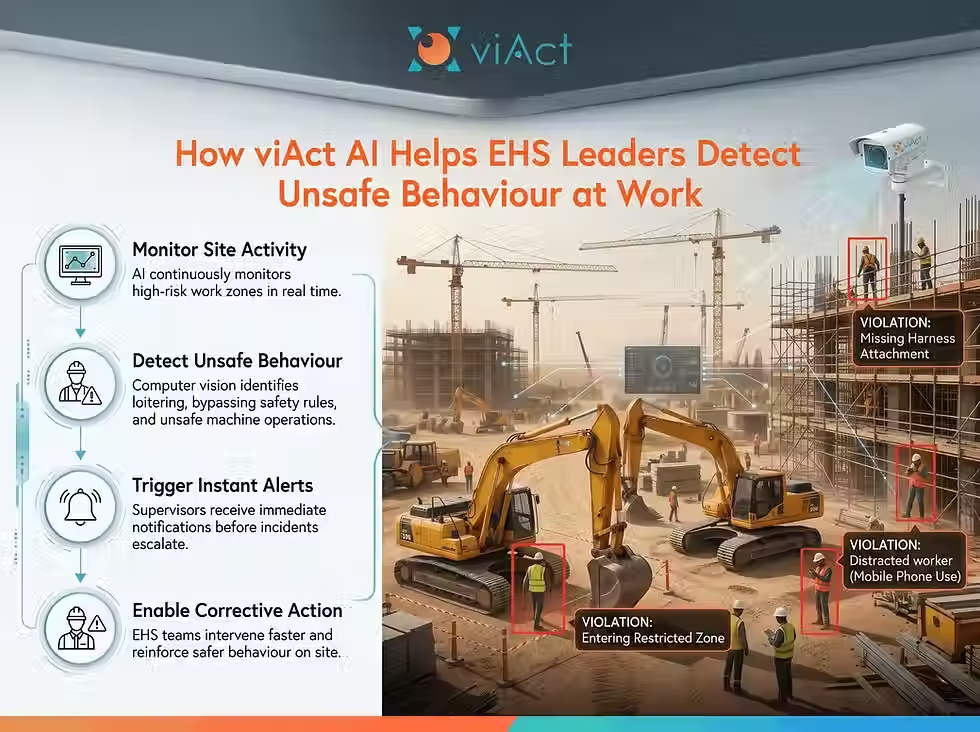
The key insight: Unsafe behaviour is rarely a pure knowledge gap, as most workers already understand the basic safety rules. The challenge is that, under production pressure, fatigue, time constraints, or dynamic site conditions, safe decision-making can momentarily break down. Detecting those unsafe actions at the right time, before they escalate into incidents, is where AI is beginning to play a critical role in EHS Digital Transformation in Middle East.
The Biggest Misconception About AI in EHS Across the GCC
When asked what people get wrong about AI in workplace safety, all four leaders pointed to the same overreach: the belief that AI can replace human judgment.
"AI is only a support tool — it cannot understand site conditions, human behaviour, or make critical judgment decisions like an experienced HSE professional." — Syed Umair Ahmed, HSE Engineer, Dar Al Riyadh.
"Over-reliance on AI without proper human involvement can create new risks." — Asif Iqbal, HSE Assistant Manager, National TalentS Company.
Syed Umair went further, addressing a belief that is common even among safety professionals: "Another overhyped belief is that AI alone can eliminate unsafe behaviours. While it can detect risks, it cannot address root causes — poor safety culture, training gaps, or work pressure."
But the sharpest observation came from Saifullah Khan — and it is one the industry urgently needs to hear:
"Generative AI is making fake Risk Assessments, fake Method Statements, and fake permits. People are creating documents through it without visiting the site, and it's damaging the integrity of Safety Rules and Documents." — Saifullah Khan, HSE Officer, NWC.
A strategic report by the Future of Commerce found that 92% of construction companies are already using or planning to use AI. AI adoption is growing at the fastest rate possible, yet some sites are ending up with safety documents that look complete on paper but are not actually followed on the ground.
The key insight: AI works when it extends what a safety officer can see and act on. It fails or actively causes harm when it becomes a shortcut around the professional judgment it was designed to support.
The High-Impact AI Use Case for Workplace Safety in the GCC
Despite their cautions, all four leaders see real, high-impact potential in specific AI applications. Three out of four named the same one: Real-Time Proximity Detection Between Workers and Heavy Equipment.
In GCC construction environments where heavy cranes, excavators, and haulage vehicles operate alongside thousands of ground workers, struck-by incidents are among the most lethal and preventable hazards. OSHA lists them as one of the construction industry's "Fatal Four."

"AI can instantly detect unsafe distances and trigger alerts, significantly reducing high-risk interactions on site. This is especially critical in large-scale KSA projects with heavy plant movement and congested work zones." — Syed Umair Ahmed, HSE Engineer, Dar Al Riyadh.
"Real-time proximity alert systems integrated with cameras and sensors can significantly reduce struck-by and caught-in incidents by providing instant alerts to both operators and ground personnel, especially in blind spot areas." — Asif Iqbal, HSE Assistant Manager, National TalentS Company.
Saifullah Khan made the case for a different but equally impactful use case — AI-powered permit-to-work verification:
"Permits are taken as liability on most sites. It's just another form of a document — they fill it just to show it to people. It's not used for controlling hazards in real terms." — Saifullah Khan, HSE Officer, NWC.
AI that cross-references issued permits with actual site activity can help to flag violations in real time rather than in post-incident reviews. This adoption represents a genuine leap forward for permit integrity across the region.
The key insight: In large GCC construction environments, the most valuable AI use cases are the ones that strengthen real-time visibility across complex human-machine interactions, heavy equipment movement, and live permit-controlled activities in active work zones.
The Real Barriers to AI Adoption in EHS Digital Transformation in the Middle East
If the use cases are clear and the technology exists, why isn't AI more widely deployed? The leaders identified three honest barriers.
Worker trust and false alarm fatigue. When AI systems generate too many incorrect alerts, workers learn to ignore them — which can be more dangerous than no alert at all.
"Many workers see AI as monitoring rather than a safety support tool. Frequent false alarms and system reliability issues can reduce confidence and lead to bypassing the system." — Syed Umair Ahmed, HSE Engineer, Dar Al Riyadh.
Ken Research's GCC AI Construction Safety Market analysis identifies worker acceptance and trust as the primary adoption barrier across the region.
Saifullah Khan's answer here was a single word: "Infrastructure." Stable connectivity, sensor integration, and the hardware to run real-time AI monitoring across large desert construction sites are not a given. Technology ambitions frequently outpace site realities.
The key insight: Adoption barriers in the GCC are not primarily about awareness or interest. They are about trust, infrastructure, and skills, all of which require investment and change management alongside the technology itself.
How an Integrated Safety Ecosystem Bridges the Gap for EHS Leaders in the GCC
The leaders in this piece are not just describing a technology gap but are indicating towards a visibility gap.
Parthiban Pandurangan’s point about shortcuts under schedule pressure, Saifullah Khan's frustration with permits that exist only on paper, and Syed Umair's concern about workers bypassing systems they don't trust; these are not problems that a single tool solves.
They are symptoms of safety management that is stretched beyond what any human team can physically monitor at the scale GCC construction demands.
What closes that gap is not more technology layered on top of broken processes. It is a connected safety intelligence architecture, one where what happens on the ground is seen, verified, and acted on in real time, without adding friction for the people it is meant to protect.
That means continuous monitoring in the blind spots around heavy equipment that no supervisor can watch simultaneously. It means environmental intelligence through measured heat exposure levels and detecting gas presence. Estimating fatigue and signs of physiological stress through an IoT-based smart watch, which surfaces risk before it becomes an incident, not after.
And critically, it means digital workflows that permit integrity impossible to fake. For example, replacing Saifullah Khan's "form to show people" with a verified, site-condition-aware process that actually controls the hazard.
Most GCC construction sites today are not under-monitored. They are fragmented. The information exists but the architecture to connect it does not.
Computer vision technology, IoT sensor networks, and Digital Permit-to-Work (PTW) systems each solve part of the problem in isolation. The shift happens when they operate as a single closed-loop system: where a proximity breach triggers a permit re-verification, where a Heat stress reading automatically suspends a work order, where every detection feeds a unified operational view that reflects site reality at the current moment, not as it was documented three hours ago at the gate.
That is the difference between a collection of safety tools and a safety ecosystem. And at the scale the GCC is building, that distinction is no longer a competitive advantage. It is a baseline requirement.
Workplace Safety AI Trends in the GCC: What the Next 3–5 Years Look Like
In the future, all four leaders were cautiously optimistic.
The shared vision: AI will shift safety from reactive to proactive. Live monitoring, predictive risk signals, and automated reporting will allow EHS teams to identify hazards before they escalate — and give safety professionals more time for the cultural and relational work that determines whether safety actually sticks.
"AI will help shift safety towards a more proactive approach. Instead of reacting after incidents, we'll be able to identify risks earlier and act before they escalate. That said, strong leadership and safety culture will always remain the backbone." — Parthiban Pandurangan, HSE Head, Global Anti Corrosion Techniques Co.
"AI will work alongside HSE professionals, not replace them — allowing supervisors to focus more on critical decision-making, training, and improving overall safety culture on site." — Asif Iqbal, HSE Assistant Manager, National TalentS Company.
The key insight: The future of workplace safety AI trends in the GCC is not about more cameras. It is about an integrated intelligence layer — one where computer vision, IoT, digital workflows, and human expertise work in a closed loop, each making the others more effective.

Conclusion: Key Takeaways
The core safety challenge in GCC construction is not technological; it is behavioural and cultural. AI cannot fix that alone. Unsafe behaviour driven by production pressure and weak safety culture remains the defining challenge on GCC construction sites, and no technology addresses that without strong EHS safety leadership in the GCC to back it up.
The most impactful applications of AI are worker-machinery proximity detection and real-time permit-to-work verification.
Real-time monitoring for worker-machinery proximity and permit verification — when deployed with accuracy and worker trust in mind directly addresses the two highest-risk scenarios GCC construction sites face, including the blind spots no human supervisor can cover at scale.
The misuse of generative tools to produce Risk Assessments, Method Statements, and permits without any physical site visit is quietly eroding documentation integrity across the region. As EHS digital transformation in the Middle East accelerates, governance must keep pace.
The Safety Leadership GCC who will get the most from AI are those who treat it as a force multiplier for human judgment and not a replacement for it.
The future of AI-powered workplace safety in the GCC belongs to organisations that architect safety as a closed-loop system, where computer vision, IoT intelligence, digital workflows, and human expertise each reinforce the other, turning real-time detection into real-time prevention.

Quick FAQs
1. What skills are required for EHS teams to use AI systems for workplace safety?
EHS teams don’t need to be AI experts. They need:
Basic system understanding
Ability to interpret alerts and dashboards
Training on digital workflows
The technology should simplify decision-making, not complicate it.
2. How does viAct computer vision technology work on a live GCC construction site?
viAct deploys scenario-based computer vision models, processed through cloud, edge or a hybrid form. Each model (you can choose from their 200+ pre-built modules) is pre-trained for specific safety scenarios like:
PPE non-compliance
Danger zone intrusion
Work-at-height violations
Confined space access
Heavy equipment proximity
When a violation is detected, an alert is generated in real time and routed to the relevant supervisor through the Project Control Centre without any manual review required.
3. Do AI safety platforms like viAct record or store personal worker data?
Most modern systems are designed to:
Detect patterns and behaviors, not identities
Avoid facial recognition unless explicitly required
Data is typically:
Aggregated
Used for safety insights, not personal profiling
They follow both worldwide and local regulations like GDPR and PDPL.
4. How do smart wearables connect to the broader safety ecosystem?
viAct IoT layer, which includes smart helmets, smart watches, gas detectors, and weather stations, feeds physiological and environmental data into the same operational platform as the computer vision layer.
This means a heat stress reading from a smart helmet, a gas anomaly from a fixed detector, and a proximity breach captured by a camera can all trigger a coordinated response from a single dashboard rather than sitting in three separate systems that no one is watching simultaneously.
5. Is viAct available across the entire GCC region?
Yes. viAct has been operational across countries like Saudi Arabia, Qatar, the United Arab Emirates, Kuwait, Oman and Bahrain. It caters to different industries including construction, manufacturing, oil & gas, mining, ports and logistics.
viAct is a leading Impact AI company focused on improving safety and efficiency in high-risk industries. Since 2016, we've implemented innovative “Scenario-based Vision Intelligence” solutions across hundreds of organizations. Recognized by Forbes and the World Economic Forum, we aim for a sustainable future through responsible technology.
Read More:


Siempre es interesante encontrar recursos que faciliten la consulta de resultados. La lotería de la florida números ganadores hoy puede ser una referencia práctica para comprobar los números después de los sorteos. Tener la información organizada permite ahorrar tiempo y revisar los resultados con mayor facilidad.
The bit about unsafe behavior detection being the hardest nut to crack really resonated with me — no amount of tech can fully predict when someone's going to skip a step under deadline pressure. That said, it's interesting how AI is being positioned as a support layer rather than a replacement for human judgment, which feels like the right approach. This might seem unrelated, but I've been messing around with the bad quality image maker for a different project, and it made me think about how sometimes we need to degrade information rather than enhance it — like when you're testing how well safety protocols hold up under imperfect conditions. There's something to be said for preparing for the worst-case…
Unblurr Image tools are useful for improving blurry photos and restoring important details. They help make images sharper, clearer, and more polished with simple enhancement features.
Pour moi, le vrai test d’un club en ligne commence après quelques jours d’utilisation, pas lors de la première visite. Beaucoup de plateformes donnent une bonne impression au départ, puis on découvre que certaines sections sont mal organisées. Je vérifie toujours si l’historique des sessions reste accessible facilement et si les recherches précédentes sont conservées. En comparant plusieurs options récemment, j’ai trouvé intéressant que Casino Leon affiche rapidement les catégories récemment consultées sans obliger à recommencer toute la navigation. Quand on explore régulièrement de nouveaux contenus, ce petit détail permet de gagner beaucoup de temps et rend l’utilisation quotidienne nettement plus agréable.
The point about AI not replacing HSE judgment felt important, especially the warning about fake risk assessments. For safety training visuals, we could used Pixlio to draft scene ideas, then edit image with AI when a worker pose or equipment detail looked off.