
Top 5 AI-Driven IVMS Solutions for Construction Fleets in Middle East

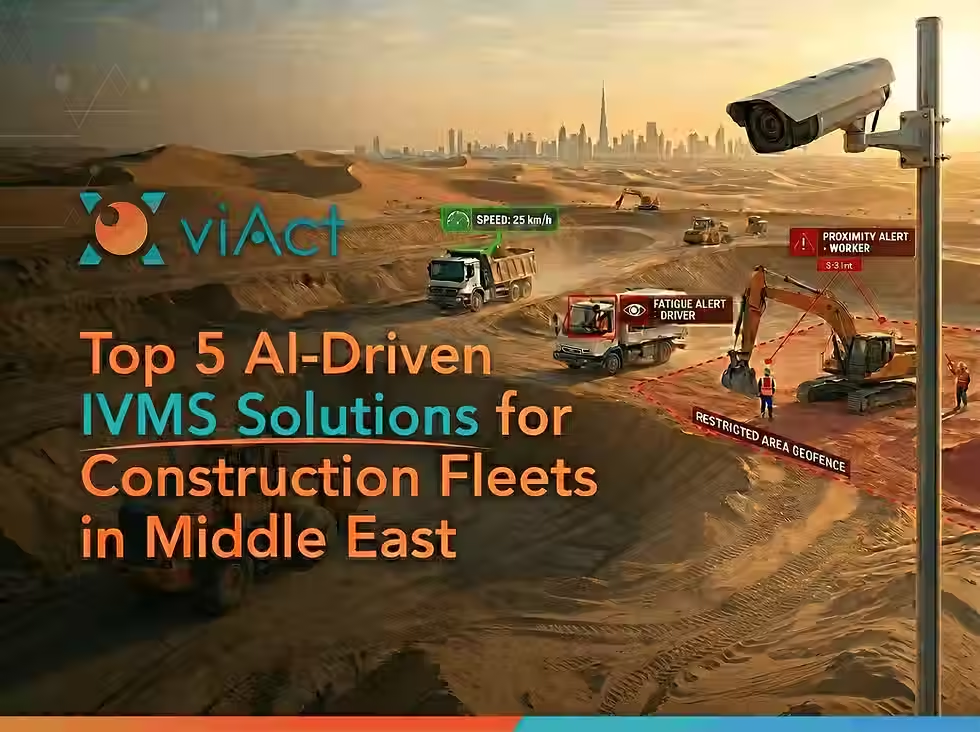
In the Middle East, construction fleets are operating at a scale and complexity that few other regions can match. Saudi Arabia's Vision 2030 megaprojects, UAE's infrastructure pipeline, Qatar's post-World Cup development drive, and Kuwait's national development plan collectively represent a USD 2 trillion construction investment across the GCC. Each project relies on various types of heavy equipment to complete the work, e.g., dump trucks, excavators, mobile cranes, concrete mixers, water bowsers and personnel carriers; typically, around-the-clock in close proximity to thousands of workers on foot in the same area.
The most significant contributor to serious injuries and fatalities (SIFs) associated with construction work worldwide is vehicle-related incidents. As per an EHS article, transportation-related incidents continue to be the second most fatal category of incidents after falls from height. Thus, selecting the right In-Vehicle Monitoring System (IVMS) for each contractor's fleet is one of the most important safety decisions a contractor's fleet manager or EHS leader need to make on any given jobsite, including the Middle East.
For contractors operating specifically in Saudi Arabia, viAct IVMS guide for Saudi construction fleets covers the regulatory and deployment landscape in greater depth.
This blog aims at evaluating the top five AI-driven IVMS solutions operating in the Middle East construction market, with a focus on the capabilities that matter most in the specific conditions GCC construction fleets face.
What Separates an AI-Driven IVMS from Basic Telematics?
Before comparing the solutions in the market, it is important to understand what makes an IVMS genuinely AI-driven and how an AI-driven IVMS differs from basic telematics. This is especially important because the term has been loosely used across the market.
A typical telematics system provides a historical perspective of the event by providing data regarding the location of a vehicle via GPS, speed and driver hours. An AI-Driven IVMS, on the other hand, provides real-time data as well as intervenes before an incident occurs. The practical difference between both systems is the difference of a post-event report versus the prevention of a fatality.
The evaluation criteria for construction fleet safety that matter in the Middle East are:
Real-time detection of driver fatigue, distraction and in-cab behaviour
Proximity detection between workers and vehicles on active construction jobsites
Edge AI processing for remote sites with limited connectivity
Construction-site-specific AI that has been trained on the hazard scenarios of heavy mixed-fleet environments
lignment with GCC regulatory compliance standards including those from ADNOC, PDO, Saudi Aramco and local HSE regulations
Centralized multi-site fleet visibility for large contractors operating numerous concurrent projects
Below are the 5 top most AI-driven IVMS solutions operating in the Middle East construction market.
1. viAct

viAct’s approach to construction fleet safety management in Middle East is a holistic one. The platform delivers the full suite of core IVMS functions that enterprise fleet operations demand: real-time GPS tracking, speed monitoring against site-defined limits, seatbelt detection, driver identification and authentication, driver fatigue monitoring, harsh driving detection, geofencing with configurable zone alerts, and unauthorised vehicle usage alerts. This operational foundation means EHS managers are not trading standard fleet visibility for advanced AI. They get both within a single integrated system.
At the heart of viAct’s construction vehicle monitoring system is the viMAC – viAct Edge AI device for vehicle control. Mounted on construction vehicles, viMAC processes video and sensor data locally on the vehicle, delivering real-time alerts to operators and site supervisors without depending on cloud connectivity. This edge device architecture is particularly relevant for the remote jobsites throughout Saudi Arabia and the UAE megaprojects, where connectivity is inconsistent.
What makes viAct the top AI-driven IVMS solutions in the Middle East is its purpose-built AI. viAct’s AI modules are trained on scenario-based construction hazard data, meaning that its system can not only detect in-cab driver behaviour, but also efficiently detect worker proximity risks outside the vehicle. For example, the system can detect a worker entering blind zone of a reversing dump truck in real-time; or a ground crew member crossing into the swing radius of an active crane; or, a pedestrian approaching the path of a reversing excavator. These are the type of risks that cause many construction fatalities and that cannot be identified by mere GPS-based IVMS platforms.
Additionally, viAct IVMS solution connects to the Enterprise Centralised Management Software (ECMP), giving EHS managers a single unified view of vehicle activity, worker proximity events, driver behaviour alerts, and fleet compliance across multiple sites concurrently. This multi-site visibility is essential to large contractors who manage multiple simultaneous projects throughout Saudi Arabia, UAE, and Qatar.
Further, viAct is deployed across construction, oil & gas, manufacturing, and other heavy industrial operations in Saudi Arabia, the UAE, Qatar, Singapore, and Hong Kong, with an impairment-free performance record and improved performance in vehicle-related near-miss incidents reductions.
Key strengths for Middle East construction fleets:
Purpose-built AI trained on construction site hazard scenarios including worker-vehicle interactions
viMAC edge AI device processes data locally on the vehicle without cloud dependency
Single platform covering both standard IVMS functions and construction site-specific detection
Multi-site fleet visibility via viHUB across concurrent GCC projects
Documented construction deployment track record across Saudi Arabia, UAE, Qatar, Singapore and Hong Kong
In the GCC and MENA region, FMSi is one of the most established IVMS provider for more than twenty years, primarily serving the oil and gas industry, construction, and heavy industry.
FMSi's most significant credential for construction fleet safety in the Middle East is its ADNOC (Abu Dhabi National Oil Company) approval status. This status signals its alignment with the most rigorous HSE standards applied to contractor fleets operating in the GCC. Their AI video telematics platform covers driver fatigue and distraction detection, journey management, route planning, and driver identification, all delivered through their FMSiTrack centralised platform.
FMSi's depth of market integration in the GCC provides it with a lot of advantages. For long, it has been a preferred provider of IVMS solutions for some of the world's top oil & gas and construction companies within Saudi Arabia, the UAE, Oman and Qatar. Its systems are well-understood by regional HSE teams and regulatory auditors, giving it a higher edge.
FMSi's platform focuses mainly on drivers and vehicles, like tire pressure monitoring system, driver identification, load management, satellite tracking, etc. For contractors requiring IVMS primarily to monitor driver behavior and to satisfy regulations for road transport, FMSi is one of the most complete options available in the region.
Key strengths for Middle East construction fleets:
ADNOC-approved status and deep GCC regulatory alignment
AI video telematics with fatigue and distraction detection
Journey management system for controlled route compliance
Long-standing regional deployment track record
Recognised top distributor across GCC and MENA
With more than 20 years of experience and deployment across 48 different countries, Sicuro Technology has a very solid presence throughout Australia, New Zealand, and the expansive MENA Region, as well as have considerable presence within both Saudi Arabia, and UAE. Its IVMS platform includes GPS tracking, driver behaviour monitoring, driver fatigue detection using AI cameras, fuel usage and assets tracking, along with driver management.
For construction contractors managing fleets across multiple GCC countries simultaneously, Sicuro's multi-country network infrastructure is an added advantage. Their platform provides complete support for local & global SIM cards compatible with major regional networks including e& (Etisalat), Du, STC, and Ooredoo, ensuring uninterrupted vehicle visibility even as fleets cross borders between project sites in Saudi Arabia, UAE, and Qatar.
Sicuro’s established construction vehicle monitoring system meets all of the IVMS standard parameters, including real-time vehicle speed monitoring, detection of harsh braking/acceleration events, geofencing, driver identification and AI camera-based safety compliance. Additionally, their fuel management solution is of particular interest to larger construction fleets operating within the GCC, as managing fuel costs and controlling fuel consumption is extremely important.
Similar to FMSi, the Sicuro platform also focuses heavily on the driver and the road and misses the construction site specific AI capabilities. Overall, the contractor who need general fleet visibility, management of multi-country operations, fuel management and AI-based fleet safety at construction sites, Sicuro is a strong, well-regarded regional provider.
Key strengths for Middle East construction fleets:
Operational across 48 countries with deep MENA infrastructure and on-ground support
Multi-country SIM compatibility covering all major GCC mobile networks
Comprehensive IVMS suite covering fatigue, fuel, driver management and asset tracking
Particularly strong fuel management module relevant for large GCC construction fleets
Flexible connectivity options including satellite for remote site coverage
4. Samsara
Samsara is the most recognised name in AI fleet management globally. Construction is one of Samsara's strongest industry verticals with many thousands of construction companies switching to Samsara's fleet management platform.
Samsara's AI fleet safety platform consists of fleet tracking using GPS, AI dash camera with in-cab driver coaching, harsh driving alerts, fatigue alerts and distraction alerts, geofenced tracking, asset tracking and maintenance management all integrated into one Connected Operations Platform. For large construction contractors with mixed fleets performing at multiple locations at the same time, Samsara's unified interface creates one view of their entire operation.
For Middle East construction fleets, Samsara operates primarily through regional partners rather than direct in-country presence across the GCC. Its platform is however, not purpose-built for construction site environments. For multinational contractors operating large-scale construction fleets where global standardisation, enterprise integration, and proven AI fleet safety at scale are the primary requirements, Samsara is one of the most credible and data-backed options available.
Key strengths for Middle East construction fleets:
Most recognised name in AI fleet management globally
AI dash cameras with real-time in-cab driver coaching and risk detection
Single Connected Operations Platform covering vehicles, equipment, and sites
Strong construction industry vertical with documented fleet safety outcomes
5. Geotab
Geotab is the global benchmark in commercial telematics, ranked number one by ABI Research in 2025. For multinational construction contractors based in the Middle East, the Geotab platform provides enterprise-level visibility into fleet operations, advanced data analytics, and an extensive AI dash cam ecosystem via the GO Focus Plus device range.
Geotab's strength lies in its data and global integration. Their MyGeotab platform provides comprehensive reporting tools with features such as driver behaviour analytics, fleet reporting using Generative AI, route optimization, compliance management and integration with many third-party construction and ERP platforms. For contractors with fleet in the Middle East, that are part of a larger global operation and require consolidated reporting across different regions, Geotab has an unparalleled enterprise architecture.
Its trade-off is regional specificity. Geotab operates in the GCC primarily through reseller partners in the region instead of having a direct regional presence and its platform is not designed specifically for use on construction sites. As such, Geotab’s upper tier of AI fleet safety capabilities related to construction sites do not constitute Geotab’s primary offering.
For multinational contractors that need global fleet standardisation alongside Middle East construction operations, Geotab is a credible and proven option, but it is best understood as a global enterprise platform rather than a construction-site-first solution.
Key strengths for Middle East construction fleets:
Ranked number one in commercial telematics globally by ABI Research 2025
GO Focus Plus AI dash cam with real-time driver risk detection
Generative AI analytics for fleet performance reporting
Enterprise-scale multi-region fleet integration
Strong ROI track record with an average time-to-ROI of 10.31 months
Comparison at a Glance
Evaluation Parameter | viAct | FMSi | Sicuro | Samara | Geotab |
Real-time driver fatigue and distraction detection | Yes | Yes | Yes | Yes | Yes |
Worker-vehicle proximity detection on construction sites | Yes | No | No | No | No |
Edge AI for remote/connectivity-limited sites | Yes | No | No | No | No |
Construction site-specific AI scenarios | Yes | No | No | No | No |
GCC regulatory compliance alignment | Yes | Yes (ADNOC-approved) | Yes | Patrial | Partial |
Multi-site centralised fleet dashboard | Yes | Yes | Yes | Yes | Yes |
Multi-country GCC fleet operations | Yes | Yes | Yes | No | Yes |
Global enterprise integration | No | No | No | No | Yes |
Which IVMS Solution is Right for Your Construction Fleet in the Middle East?
Choosing the right IVMS solution for your construction fleet management ultimately comes down to the risk level of your fleet and how complicated the environment is in which your fleet operates.
In construction and multi-use public sites where vehicle traffic is co-mingled with worker traffic on the jobsite, and where the risk profile reflects behavioural risks of both workers and vehicles, viAct's construction site-specific AI and IVMS solution addresses hazards that no other solution on this list covers.
If your primary objective is securing regulatory compliance in the GCC region and monitoring driver behaviour for on-road transport fleets on large oil and gas or construction projects, FMSi's ADNOC-approved platform and deep regional track record make it the strongest compliance-first choice.
Alternately, if your priority is managing construction fleet across multiple GCC regions, and therefore require broad operational visibility, advanced fuel management and connectivity across countries, the existing regional infrastructure from Sicuro Technology provides the best, proven solution available.
If your Middle East construction fleet is part of a broader global operation and you require a globally recognised platform with proven AI fleet safety outcomes and enterprise-scale visibility across multiple regions, Samsara's Connected Operations Platform is one of the most data-backed options available.
Similarly, for contractors whose Middle East fleet operations demand the deepest level of data analytics, custom reporting infrastructure, and a telematics platform with the longest enterprise track record in the region, Geotab's MyGeotab platform and established GCC reseller network offer a level of data granularity and customisation that newer fleet platforms have not yet matched.
Conclusion: Key Takeaways
The construction fleet safety challenge in the Middle East is not simply about monitoring drivers on the road. It is about managing complex vehicle-worker interactions across active megaproject sites where a single blind spot event can be fatal. The top IVMS solutions for construction fleets in the Middle East differ not in whether they offer GPS and driver behaviour monitoring, because all five do, but in how far beyond the cab they can see, and how purpose-built their AI is for construction site hazard scenarios.
As GCC infrastructure investment continues to accelerate through 2026 and beyond, the EHS leaders and fleet managers who get this decision right will be the ones who matched their IVMS selection to the actual risk profile of their site, and not just the features listed on a product page.
Apart from the core IVMS functions, viAct's purpose-built AI and viMAC edge device addresses the construction site-specific risk layer, like, worker-vehicle proximity, site hazard scenarios, and edge processing for remote megaproject environments, that standard telematics platforms were not designed for.
FMSi is the strongest choice for GCC regulatory compliance-first deployments, backed by ADNOC approval and two decades of regional track record.
Sicuro Technology suits multi-country GCC fleet operations where cross-border connectivity, fuel management, and broad operational visibility are the primary requirements.
Samsara is the strongest choice for multinational construction contractors seeking a globally recognised, enterprise-grade fleet safety platform with documented AI-driven safety outcomes and broad construction industry adoption.
Geotab serves multinational contractors who need enterprise-scale fleet standardisation across global operations, with the Middle East as one region within a broader deployment.
Disclaimer: This blog has been compiled using publicly available secondary sources including official product and company websites, published industry reports, and third-party research data. viAct does not make claims about competitor products beyond what is stated on their respective official websites. Readers are encouraged to conduct their own due diligence and engage directly with each provider before making procurement decisions. |

FAQs
1. Does viAct's IVMS solution integrate with existing CCTV infrastructure on construction sites?
Yes. viAct's platform is designed to integrate with existing IP camera infrastructure on construction sites, meaning contractors do not need to replace installed CCTV system to deploy viAct’s AI-powered IVMS solution. The viMAC edge device works alongside existing camera networks, reducing deployment costs and implementation time on active GCC megaprojects where infrastructure is already partially in place.
2. Is IVMS mandatory for construction fleets in the Middle East?
IVMS is mandated or strongly recommended across most major GCC markets for construction and industrial fleet operations. In Saudi Arabia, IVMS compliance is required for contractors working under Saudi Aramco and NEOM project HSE standards. In the UAE, IVMS is a standard requirement under Abu Dhabi and Dubai infrastructure project contracts. Qatar similarly enforces IVMS requirements for contractors operating on large-scale infrastructure projects. Non-compliance can result in contract penalties, site access restrictions, and failed HSE audits.
3. What is the difference between IVMS and fleet telematics?
Fleet telematics is the broader category covering GPS tracking, route data, and basic vehicle diagnostics. IVMS is a more comprehensive standard that additionally covers driver behaviour monitoring, driver identification, fatigue detection, and event-based reporting against defined safety thresholds. In the GCC context, IVMS carries a specific regulatory meaning tied to HSE compliance frameworks, whereas telematics is a general technology term. All IVMS systems include telematics capabilities but not all telematics systems meet IVMS compliance standards.
4. Can viAct's IVMS scale across multiple construction sites simultaneously in the GCC?
Yes. viAct's centralised management dashboard, viHUB, is built for multi-site deployment, allowing EHS managers and fleet supervisors to monitor vehicle activity, driver behaviour alerts, and proximity events across multiple concurrent project sites from a single interface. This is particularly relevant for large GCC contractors running several Vision 2030 or UAE infrastructure projects simultaneously, where consolidating IVMS visibility across sites is both an operational and reporting requirement.
5. How does viAct AI-driven IVMS solutions handle data privacy and video footage security on construction sites?
viAct follows a privacy-by-design approach across its IVMS and video analytics platform. Video footage is processed locally on the viMAC edge device, meaning raw footage does not need to leave the site to generate alerts. Automated face masking and number plate obfuscation are applied by default, ensuring worker anonymity in all recorded and stored data. For contractors with strict data sovereignty requirements, viAct supports full on-premise deployment where all footage and event data remain within the site's own infrastructure. Cloud storage, where used, is hosted on AWS with encryption and role-based access control. The platform is fully compliant to GDPR and other such regional compliances.
viAct is a leading Impact AI company focused on improving safety and efficiency in high-risk industries. Since 2016, we've implemented innovative “Scenario-based Vision Intelligence” solutions across hundreds of organizations. Recognized by Forbes and the World Economic Forum, we aim for a sustainable future through responsible technology.
Related Reads:


