
What Are BSIS and MOIS? What UN R151 and R159 Require for Heavy Vehicle Blind Spots

“Quick AI-Powered Insights on the Topic— Freshly Updated!”
|
London's lorry safety rules show what visibility technology can do. Transport for London (TfL) reported that pedestrians, cyclists and motorcyclists killed or seriously injured in collisions with HGVs over 12 tonnes fell from an average of 71 a year in 2017 to 2019 to 35 in 2024. This reduction occurred under London's wider Direct Vision Standard (DVS) and HGV Safety Permit Scheme, which includes multiple safety measures, including blind-spot technologies such as BSIS and MOIS.
This piece explains what those two systems are, what UN R151 and R159 require, where the EU and London make them mandatory, and why type approval matters. The same blind spot problem exists on construction sites, in mines and in warehouses, where forklifts, excavators and haul trucks fall outside these rules. For those machines, a vehicle management system can apply the same principle: detect people in a vehicle's blind spots and warn the operator in real time.
What Are BSIS and MOIS?
BSIS (Blind Spot Information System) and MOIS (Moving Off Information System) are driver-assistance systems that warn the driver of pedestrians and cyclists close to a heavy vehicle. BSIS, covered by UN Regulation 151, watches the nearside (passenger-side) blind spot. MOIS, covered by UN Regulation 159, watches the area directly in front of the cab when the vehicle moves off.
Under applicable EU requirements, these regulations cover relevant buses, coaches and trucks in vehicle categories M2, M3, N2 and N3, subject to the implementation requirements and applicable exemptions. Both systems provide information and warnings to drivers rather than taking control of the vehicle.
Area | BSIS | MOIS |
Operating speed | Up to 30 km/h | Up to 10 km/h (moving off from rest or travelling straight ahead slowly) |
Main targets | Cyclists | Pedestrians and cyclists |
Driver signal | Optical, acoustic, haptic or a combination | Optical, acoustic, haptic or a combination |
What Does UN R151 Require from a Blind Spot Information System (BSIS)?
UN R151 requires a system that monitors the nearside blind spot of M2, M3, N2 and N3 vehicles and signals the driver when a cyclist is there. It is meant to inform the driver, not brake the vehicle, and it is aimed at the turning manoeuvres where collisions with cyclists typically happen.
What Does UN R159 Require from a Moving Off Information System (MOIS)?
UN R159 requires a proximity information signal when a pedestrian or cyclist enters the critical blind spot in front of the vehicle while it is preparing to move off or travelling straight ahead slowly. The system must detect adult and child pedestrians as well as adult cyclists and their bicycles. A further collision warning signal is given if a collision becomes imminent.
Are BSIS and MOIS Mandatory in the EU?
Yes. Under the EU General Safety Regulation, Regulation (EU) 2019/2144, BSIS and MOIS are mandatory for relevant new heavy road vehicles in categories M2, M3, N2 and N3, subject to applicable scope provisions and exemptions. The requirements first applied to new vehicle types from 6 July 2022 and extended to newly registered vehicles within the applicable scope from 7 July 2024.
The same package also covers reversing detection under UN R158, plus systems such as intelligent speed assistance, driver drowsiness and attention warning, and event data recorders. The regulation applies to vehicles built after the cut-off dates.
The EU expects the wider General Safety Regulation package to save more than 25,000 lives and avoid at least 140,000 serious injuries by 2038. For the two UN regulations on reversing and moving off (R158 and R159) alone, the European Commission estimated about 860 lives saved and 10,000 serious injuries avoided each year across the EU (CLEPA, citing UNECE).
What Do BSIS and MOIS Mean for London's Progressive Safe System for HGVs?
In London, BSIS and MOIS are two of the seven measures that make up the Progressive Safe System (PSS). Under London's Direct Vision Standard, HGVs over 12 tonnes must either hold a three-star direct vision rating or fit PSS measures to operate in Greater London.
The PSS requires:
A camera monitoring system (CMS) on the nearside, to remove the remaining nearside blind spot.
Class V and VI mirrors, or a CMS that replaces them, at the front and nearside.
A BSIS giving full coverage down the nearside, which must not trigger for roadside furniture or stationary vehicles.
A MOIS at the front, to warn of vulnerable road users when moving off from rest.
Side under-run protection on both sides, where practicable.
Audible warnings when the vehicle turns.
External warning signage, with TfL recommending A3 or larger where possible.
Importantly, CMS, BSIS and MOIS serve different purposes and are not interchangeable. CMS provides drivers with a visual view of blind spots, BSIS warns of vulnerable road users along the nearside, and MOIS warns of vulnerable road users in front of the vehicle when moving off.
However, under Transport for London's Progressive Safe System guidance, an additional nearside CMS may not be required where appropriate factory-fitted systems approved under UN R151 (BSIS) and UN R159 (MOIS) provide an equivalent safety benefit, subject to TfL's qualifying conditions.
Why Do BSIS and MOIS Type Approval Matter?
Type approval under UN R151 (BSIS) and UN R159 (MOIS) confirms that a vehicle system meets the relevant regulation's defined performance and testing requirements, including detection coverage, operating conditions and warning behaviour. For fleet operators, it provides a consistent regulatory safety baseline and documented evidence of compliance, rather than relying solely on supplier claims.
Do Forklifts, Excavators and Haul Trucks Need BSIS and MOIS for Blind Spot Risk on Site?

No regulation requires BSIS or MOIS on most site machinery, because R151 and R159 cover road-going M and N category vehicles. The physical problem is identical, though: a large machine, a raised cab, and people on foot close to it. Without a mandate, blind spot protection on site depends on each operator's own risk assessment.
Recent UK statistics show why vehicle–pedestrian safety remains a concern beyond public roads. According to the Health and Safety Executive (HSE), 24 workers were fatally injured after being struck by moving vehicles in Great Britain in 2025/26. In the transportation and storage sector, the fatal injury rate was approximately 2.2 times the all-industry average in 2024/25.
The risks are also evident on public roads. The UK Department for Transport reported that 15.3% of pedestrian casualties in collisions involving a single HGV were fatal between 2021 and 2025, compared with 1.5% in collisions involving a single car. While these figures do not isolate blind spots as the cause, they highlight the importance of visibility, pedestrian separation and proximity monitoring around heavy vehicles, both on roads and industrial sites.
How Does Vision AI Apply Blind Spot Detection Principles to Industrial Vehicles?
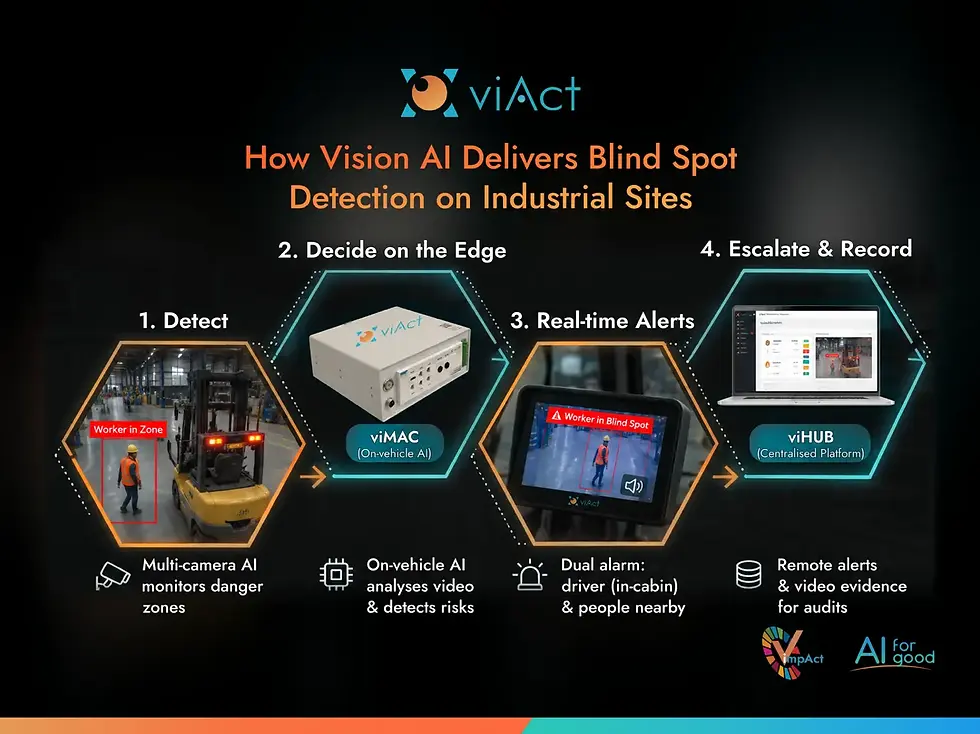
Computer Vision can help industrial vehicles address similar blind-spot hazards by detecting workers in configured danger zones and generating real-time warnings. Unlike UN R151- and R159-approved systems, these industrial applications are designed around site-specific operating risks rather than road-vehicle requirements.
Both regulated systems are counted among the advanced driver assistance systems (ADAS) now required on new heavy vehicles, and the site version follows the same logic of detect, warn and record, applied to forklifts, dump trucks, cranes and excavators instead of road-going lorries.
The workflow below shows how this runs on a vehicle fitted with viAct viMAC, an edge AI device installed in the cabin, and its vision AI monitoring.
The device keeps checking the zone and only alerts when a person is detected.
Detect: Multi-camera 360° vision monitors a 1 metre safety zone around the machine, with 5 metres of horizontal coverage, 6 metres of vertical reach and a 90° downward field of view. It is used on forklifts, dump trucks, cranes, tankers, excavators and powered haulers.
Decide on the edge: Video is processed on the vehicle, so detection continues without internet. The software adds proximity breach alerts, blind spot intrusion detection, unsafe reversing detection, zone-specific movement restriction and speed-limit enforcement in vehicle operation zones.
Real-time Alerts: A dual alarm alerts the driver inside the cabin and people nearby across the site, while an in-cab display shows the operation zone, much as ADAS supports the driver on the road.
Escalate and record: Remote managers receive notifications, and alerts are saved with video evidence for supervisors and audits in the centralized platform.
Radar, RFID/UWB tags and vision AI offer different approaches to blind-spot detection.
Radar detects nearby objects and can provide distance, speed and, depending on the system, target classification, although distinguishing pedestrians from other objects may be challenging in some environments. RFID/UWB systems can identify equipped workers and track their proximity to vehicles, but depend on personnel carrying tags and suitable infrastructure. Vision AI uses camera footage to identify pedestrians and other visible hazards, although its performance can be affected by lighting, dust and camera obstructions.
Rather than competing technologies, these approaches can complement one another, with the most suitable combination depending on the vehicle, operating environment and safety requirements.
Two deployments illustrate the approach. Both come from viAct's own customer case studies and are specific to those sites.
During a facility relocation in FY2025-26, a 65% improvement in forklift safety and a 71% reduction in response time were reported by a Dubai power generation manufacturer. The system monitored forklift movements and pedestrian proximity 24/7, generating real-time alerts for unsafe interactions.
A 70% reduction in proximity risks and 65% fewer zone intrusions were reported in a Chilean open-pit mining operation in 2025 when AI-based dynamic safety zoning monitored haul truck movements and worker proximity, adjusting risk zones according to vehicle speed, direction and distance.
One boundary is important. viMAC and the vision AI-based vehicle monitoring module are built for industrial and site vehicles. They are not presented as UN R151 or R159 type-approved systems, and they do not replace type approval on road-going trucks.
How Can Fleets Apply BSIS and MOIS Principles to Site Machinery?

Fleets can apply the logic of R151 and R159 to site machinery even though no mandate covers it: map each machine's blind spots, set detection zones and speed thresholds by manoeuvre, and alert both the operator and the supervisor. The five steps below put that in order.
Map each machine's blind spots: Use manufacturer data or NIOSH blind-area diagrams, and repeat the exercise when attachments or loads change the view.
Define detection zones by manoeuvre: Separate the front, rear and sides, and set a low-speed threshold for each, as the two regulations do.
Choose detection for the environment: Radar, tags and AI vision each have trade-offs in dust, rain, clutter and false alarm rates, so test them on the actual machine.
Alert the operator and the supervisor: An in-cab warning handles the immediate moment, and a site-level alert handles the pattern.
Review the alert log: Repeated blind spot breaches at the same junction or loading bay point to a layout or traffic plan problem, not just a driver problem.
Conclusion: Key Takeaways
BSIS and MOIS establish specific safety requirements under UN R151 and R159, helping drivers identify cyclists and pedestrians in critical blind spots around heavy vehicles.
Computer vision extends blind-spot monitoring to industrial vehicles, including forklifts, excavators and haul trucks, where road-vehicle regulations generally do not apply.
Edge AI enables real-time detection and alerts, identifying workers entering configured danger zones without requiring continuous internet connectivity.
AI-based proximity monitoring supports more targeted warnings, distinguishing visible workers from other objects, although performance depends on camera coverage, visibility and calibration.
AI-generated event records help improve workplace traffic safety, allowing supervisors to identify recurring blind-spot intrusions, review unsafe interactions and implement corrective measures.
Blind spot detection works best when it is specified, tested and enforced, and site operators can get closer to that standard by applying the same logic to the machines no regulation covers.

Quick FAQs
1. Are BSIS and MOIS mandatory for all heavy vehicles?
No. Under the EU General Safety Regulation, BSIS (UN R151) and MOIS (UN R159) are required for applicable new M2, M3, N2 and N3 vehicles, including heavy trucks, buses and coaches. The requirements generally applied to new vehicle registrations from 7 July 2024. Older vehicles are not automatically subject to the same EU retrofit requirements, although local schemes, such as London's Direct Vision Standard, may impose additional obligations.
2. Can existing CCTV cameras meet BSIS and MOIS requirements?
Existing CCTV cameras can improve driver visibility, but ordinary CCTV alone does not establish compliance with UN R151 or R159. Compliant systems must meet specified detection, warning and performance requirements and have the appropriate type approval. AI-enabled cameras may support blind-spot detection, but their suitability depends on camera coverage, vehicle configuration, calibration and regulatory certification.
3. How accurate are AI-based blind spot detection systems, and can they produce false alerts?
AI-based blind spot detection accuracy depends on camera placement, lighting, weather, vehicle movement and detection-zone configuration. False alerts may occur when objects are partially obscured or operating conditions change. Operators should evaluate detection accuracy, missed detections and false-alert rates during a site-specific pilot. Configurable warning thresholds and alert routing can help reduce unnecessary alarms.
4. Can AI blind spot monitoring work without internet connectivity and integrate with existing vehicle systems?
Yes. Edge AI systems can process camera footage locally and generate proximity warnings without continuous internet connectivity. Depending on the solution, they may also integrate with vehicle monitoring systems, central dashboards and other safety platforms. However, integration compatibility, available interfaces, hardware requirements and offline data synchronisation should be confirmed before deployment.
5. How much does AI blind spot detection cost for forklifts, excavators and haul trucks?
Costs depend on the vehicle type, number of cameras, edge AI hardware, installation requirements and software features. Additional expenses may include calibration, integration, maintenance and technical support. Operators should request a vehicle-specific quotation and consider a pilot to evaluate detection accuracy, false alerts and operational suitability before expanding across a fleet.
Read More:


