
Construction Data Integration: How AI Agents Bring Project Information Together

Updated: Aug 21
“Quick AI-Powered Insights on the Topic— Freshly Updated!”
|
Construction generates enormous amounts of data every day: schedules, material specifications, safety logs, RFIs, compliance documents; yet most of it lives in disconnected systems that rarely talk to each other. Construction data integration is the process of connecting these scattered sources into a single, usable picture, and it is quickly becoming the foundation that determines whether new technology like AI Agents actually works on a jobsite. In the digital age, data has become the backbone of informed decision-making, and the construction industry is no exception.
viAct has pioneered the use of construction data encompassing a wide range of applications, from improved communication and collaboration to predictive maintenance, safety risk management to name a few. By harnessing data from various sources, viAct helps construction professionals like EHS teams, safety mangers to gain insights that were previously unimaginable.
The Construction Data Integration Problem
Most construction sites run on data that is scattered across separate tools: one system for scheduling, another for material specifications, another for safety logs, and spreadsheets or email threads filling the gaps in between. This fragmentation is what construction data integration sets out to fix, bringing project information into a single, connected view instead of forcing teams to check five different places for one answer. When that data is unified, decision-making speeds up. Historical data and project parameters can be analysed together to optimize schedules, real-time information can be cross-checked instantly, and problems can be caught before they become costly rework.
Through viAct’s data integration approach, construction professionals can unlock new levels of productivity, making construction projects more sustainable, cost-effective, and responsive to dynamic challenges in the following ways:
Optimized Resource Allocation: Connected data across scheduling, materials, and labour systems makes it possible to allocate resources efficiently instead of working from partial information.
Improved Construction Schedules: Historical and real-time data pulled into one view helps minimize delays and keep timelines on track.
Proactive Problem-Solving: Real-time data analysis enables proactive identification and resolution of issues, reducing the risk of errors and costly rework.
Enhanced Productivity: Bringing project information together removes the time lost on switching between systems and chasing updates.
Streamlined Decision-Making: With unified data, construction professionals can make quicker, more informed calls.

How AI Agents Solve Construction Data Integration Problem?
AI agents take construction data integration a step further. Instead of just centralizing information, AI agents connect systems, schedules, safety logs, compliance records, and live site data, so that information doesn’t site in separate places waiting for someone to cross-reference it. Real-time monitoring through computer vision feeds directly into this connected data layer, so unsafe conditions surface immediately instead of getting buried in a report nobody reads until later.
By continuously learning from incidents using computer vision and connecting that data with the rest of the project, viAct helps foster a proactive safety culture and a more secure work environment in the following ways:
Connected Incident Data: Linking safety logs with scheduling and site data helps surface patterns that a siloed report would miss.
Faster Alerts: Real-time site data feeding into one connected system means unsafe conditions surface immediately instead of waiting for a report.
Consistent Documentation: Centralized data keeps safety records aligned with schedules and site activity instead of existing in isolation.
Ergonomic and Design Insight: Connected data can inform site and structure design decision that improve worker well-being over time.
Looking to bring your construction data together with AI agents? Reach out viAct. Our team can help you fight the right way to connect and act on your project data.
How LLM Chatbots Paved the Way for AI Agents in Construction Data Integration?

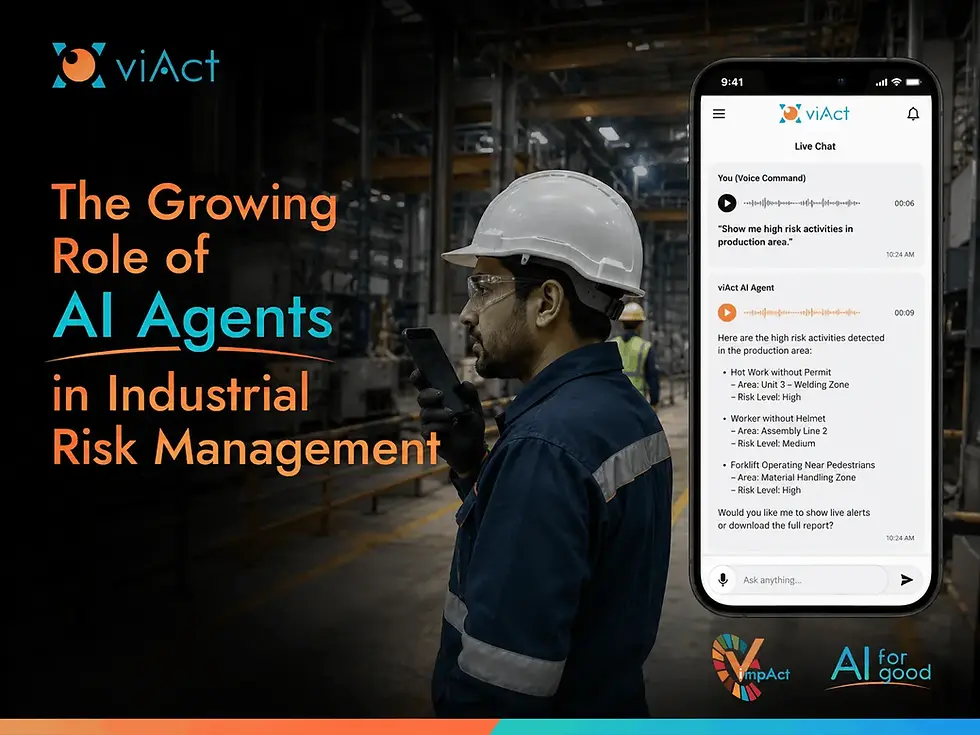
Before AI Agents, LLM (Large Language Model) chatbots were construction industry’s first real attempt at solving the data integration problem. These Generative AI-powered bots leverage natural language processing to interpret and respond to user queries, pulling together information that used to require checking several different systems. Construction professionals like EHS professionals and safety officers can use LLM chatbots for quick access to project information, such as schedules, material specifications, and progress updates, all from one place.
Moreover, LLM chatbots streamline communication by providing instant responses to common queries, reducing the need for manual intervention. They contribute to project collaboration by enabling real-time communication, helping teams stay informed and aligned. Additionally, these chatbots can assist in training and onboarding processes, ensuring that team members have access to the information they need.
LLM chatbots assist in project planning, providing real-time updates on construction progress, weather conditions, and material availability. They streamline collaboration by enabling instant communication between team members and stakeholders, reducing delays and improving decision-making processes. Moreover, these chatbots enhance safety by disseminating crucial information about potential hazards and safety protocols.
LLM chatbots are transforming the ConTech landscape by fostering efficient communication, improving project management, and harnessing data for better decision-making, ultimately leading to more streamlined and cost-effective construction processes.
In the ConTech ecosystem, LLM chatbots also play a pivotal role in data analysis. They process vast amounts of construction data, offering insights into trends, cost estimations, and risk assessments. This data-driven approach empowers construction professionals to make informed decisions and optimize resource allocation.
viAct in this sphere has launched a game-changing chatbot which is a cutting-edge safety chatbot for construction professionals. The chatbot augments construction data integration in the following manner.
Project Planning and Scheduling: The LLM (Large Language Model) Chatbot assist in generating detailed project plans and schedules by analysing vast amounts of data, specifications, and historical project information. They streamline the planning process by considering various factors such as resource availability, weather conditions, and potential risks.
Communication and Collaboration: The chatbot facilitate real-time communication among construction teams, stakeholders, and project managers. LLM chatbots enhance collaboration by providing instant language-based interfaces for exchanging information, addressing queries, and resolving issues efficiently.
Risk Assessment and Mitigation: The LLM chatbot by viAct helps in providing recommendations for risk mitigation strategies by analysing historical project data and current conditions ensuring a more resilient and adaptive construction process helping in proactive risk management.
Regulatory Compliance: The chatbot keeps construction teams informed about the latest industry regulations and standards to ensure compliance. This assists in generating documentation required for permits and approvals, reducing the risk of legal issues and delays.
Training and Onboarding: The chatbot facilitates training programs for construction workers through interactive and personalized modules. This supports onboarding processes by providing information on safety protocols, equipment usage, and project-specific guidelines.
Data Analysis and Insights: The chatbot analyses large datasets to extract valuable insights regarding project performance, cost trends, and productivity metrics enabling data-driven decision-making by presenting actionable information in an easily understandable format.
Remote Project Monitoring: The LLM chatbot by viAct allows project managers to remotely monitor construction sites through integrated sensors and cameras, providing real-time updates and alerts. This enhances the ability to manage multiple projects simultaneously by centralizing monitoring and control.

Conclusion and Key Takeaways
viAct LLM chatbot in construction serve as intelligent virtual assistants, an early step towards full construction data integration, connecting people to the information scattered across a project. But chatbots alone still rely on someone asking the right question. AI agents take this further, connecting systems continuously and acting on what they find, closing the data integration gap that chatbots could only bridge one query at a time.
Key Takeaways
Construction data integration means connecting scattered project information, schedules, specifications, safety logs, compliance records, into one usable view instead of forcing teams to check multiple systems.
AI agents build on chatbots, moving from answering questions or requests to continuously connecting data and acting on what they find.
Integrated data supports faster decisions, fewer errors, and safety information that surfaces in real-time instead of after-the-fact.
viAct approach combines chatbots, computer vision, and connected data to help construction teams close the integration gap on their own sites.

FAQs
1. What is construction data integration?
Construction data integration is the process of connecting information from separate systems, like scheduling software, safety logs, material specs, and compliance records, into one connected view. viAct AI platform brings these sources together instead of leaving them scattered across disconnected tools.
2. How does viAct approach construction data integration?
viAct connects data from scheduling, safety logs, compliance records, and live site monitoring into a single view, then uses AI agents to act on that data rather than just display it.
3. Do viAct AI agents replace its LLM chatbots?
Not exactly. viAct chatbot answers a question when someone asks it. Its AI agents build on that by continuously connecting data across systems and acting on what they find without waiting to be prompted.
4. What kind of construction data can viAct integrate?
Common sources include project schedules, material specifications, safety and incident logs, regulatory and compliance documents, communication records between site and office teams, and live site data from cameras, IoT devices, wearables, AI-powered drones, and LiDAR.
5. Why does construction data integration matter for safety specifically?
When safety data lives in a silo separate from scheduling and site activity data, patterns are easy to miss. viAct connects these sources so unsafe conditions and trends surface earlier instead of only in a report after the fact.
Read more:


Solid write-up — thanks for sharing. On a related note, we built Kepo so Mac users can turn RSS, social, and market feeds into custom desktop widgets without juggling tabs.
Home Wi-Fi security is easier to manage when credentials are reviewed from time to time. If your Cox WiFi password has been shared widely or has not been updated for a long period, changing it may be worth considering. A unique password can provide better control over access, while authorized household devices can simply be connected again afterward.
I appreciate the depth of research and clarity in your writing. The way you presented complex information so simply is remarkable. bear clicker
I like how this post keeps everything clear without making the topic feel overwhelming. 😊 It also reminded me of this reaction testing tool. The results appear instantly, and it's interesting to see how consistent you can stay after multiple attempts on different days.
The quick restarts make it Stickman Hook Game easy to try again, allowing you to refine your technique without frustration. Over time, you develop a natural sense of rhythm that helps you handle even the most difficult levels.