Construction Safety in Colombia: How AI Can Improve Fall Protection and Risk Monitoring


“Quick AI-Powered Insights on the Topic— Freshly Updated!”
|
Construction safety in Colombia is under the most pressure where the consequences are hardest to undo: work at height. In 2025 alone, the country recorded 534,444 work accidents and 438 fatalities at work, which means approximately 1 death in every 20 hours, according to an occupational accident report. Out of those fatalities, construction was responsible for 61 deaths, coming second after mining. According to reports, falls from heights are among the most frequent injury causes within the construction industry, along with blows and contact with machinery.
Fall protection is one of the most critical parts of construction safety in Colombia, because work at height is where a single lapse is most likely to be fatal. AI video analytics can improve fall protection on Colombian construction sites by monitoring work-at-height zones through existing CCTV, continuously and in real-time. It can flag workers at height without a harness, open edges, missing barricades and work outside an active permit. It then alerts the safety team the moment these happen, on every shift. This supports the controls required by Resolution 4272 of 2021, which depend on constant observation that periodic inspections cannot provide.
What is the Current State of Construction Safety in Colombia?
With respect to the overall situation in the nation, trends are mixed. Reports show, while the rate of accidents has decreased to 3.96 per 100 employees in 2025, the number of deaths increased to 16.8%, and the mortality rate rose to 3.24 deaths per 100,000 employees, compared to 2.89 in 2024. In other words, there were fewer accidents per worker, but the number of fatal accidents has increased.
Construction follows the same pattern. The same report shows: reported accidents in construction fell by 7.6% in 2025, yet, the industry’s mortality rate of 5.78 per 100,000 workers ranked amongst the five highest in the country. This is almost 1.8 times the national rate. It means that if something goes wrong on a Colombian construction site, it is likely to end fatally, with falls from height being the most frequent cause of death.
Location is also crucial. Bogotá, for instance, reported more workplace accidents and work-related deaths, than any other territory in 2025 (137,878 accidents and 104 deaths), while Antioquia had the highest accident rate of 5.18 per 100 workers, as per published reports.
The official numbers likely understate the problem. Occupational risk coverage reached only 56.7% of employed people in 2025, indicating that two in five workers sit outside the system.
Construction is especially exposed. As per a report, in 2024, 79% of 946,000 workers in the residential building construction sector worked informally. Informal crews are less likely to hold valid work-at-height permits and certifications, and their incidents are less likely to be reported.
Work at Height Regulations in Colombia: What Resolution 4272 of 2021 Requires
Resolution 4272 of 2021, issued by the Ministry of Labour, is the core of work at height regulation in Colombia. It entered into force on 8th August 2022 and applies to all employers, contractors, workers and apprentices who carry out work at height, as well as risk insurers (ARLs) and training centres. The requirements that matter most on an active site are:
2-meter threshold. Work at height means any activity that exposes a worker to a fall of more than 2.0 meters. Fall protection is also required below that height when the risk analysis finds hazard that are capable of causing injury to the workers, such as sharp edges, protruding elements, energised systems or moving machinery.
A fall prevention and protection programme. Every employer must identify each fall risk and control it according to the hierarchy of controls in Decree 1072 of 2015.
Defined roles with set training hours. A work-at-height coordinator needs at least 80 hours of training, an authorized worker at least 32 hours. Sites can also appoint a safety helper to control access to fall-risk areas.
Collective measures with hard specifications:
Warning lines must sit at least 1.80 meters from an unprotected edge, with a safety officer supervising so no one crosses without fall protection.
Guardrails must be at least 1 meter high, with intermediate rails no more than 48 cm apart and toe boards of at least 9 cm.
Covers over floor openings must hold twice the maximum expected load, be secured against displacement and carry a warning.
A permit for every height task. The permit must be revalidated when shifts, coordinators, authorized workers or initial conditions change. Employers must also put technical or technological mechanisms in place to prevent non-compliance with permit issuance and sign-off.
A practised rescue plan. Every worker at height must have a support person available to report an incident immediately and activate the emergency plan.
One thing worth noting here: many of these rules depend on continuous observation. A warning line works only if someone watches it. A cover protects only while it stays in place. A permit means something only if the conditions it describes still hold at the next shift change.
Where Fall Protection in Construction Breaks on Colombian Sites?
Construction companies in Colombia have the paperwork for fall protection in construction. The breakdown happens between inspections; in moments no one is positioned to see.
Layered subcontracting and informal teams: Main contractors can check certificates at the gate, but not how every subcontracted worker behaves on the slab. With informality so high, certification gaps are a structural risk, not an exception.
High worker rotation: Resolution 4272 requires retraining whenever a worker joins a new company or project. On sites where crews change often, it is hard to know who on today’s slab is actually authorized.
One safety officer, many edges: A residential tower floor can have open edges on every side, plus shafts and openings in the middle. One person cannot watch them all at once.
Protections removed and not replaced: Guardrails and opening covers often come off for formwork, hoisting or concrete pours. Restoring them depends in someone remembering.
Conditions that change after the permit is signed: A permit approved in the morning may no longer reflect the site after afternoon rain, a crew change or a new task on the same floor.
How AI Helps Improve Fall Protection on Colombian Construction Sites?
Every control in Resolution 4272 works only if someone is watching when the risk appears. AI fall protection monitoring, part of viAct construction safety solution, covers the moments supervisors miss. These are the five work-at-height situations on Colombian sites where that matters most.
In the case of high-rise residential buildings, the warning line 1.80 meters from the edge is often the main collective control. It depends entirely on the safety officer’s attention. AI video analytics can monitor what goes on in the area between the line and the edge. It can trigger can alert the moment a worker enters without a harness, or with a lanyard not connected to an anchor. This gives the safety officer a second set of eyes on very edge at once.

The openings for lifts, staircases, and utility shafts are most dangerous and often overlooked once a floor gets busy. Vision AI can detect open edges and missing or displaced barricades around these openings. It can also alert supervisors about violations when a cover or a barrier is missing, instead of waiting for the next scheduled inspection.

Resolution 4272 recognizes scaffolds, ladders and personnel lifts as access systems for work at height, and each must be certified and inspected. Under time pressure, workers tend to climb onto excavator buckets, forklift forks, or formwork to reach a slab or beam. Here, Computer Vision can detect improper means of climbing and alert supervisors immediately before the worker is up and exposed.

Resolution 4272 requires work-at-height procedures to be reviewed whenever an incident or accident occurs. But a worker who slips on a wet slab and recovers rarely reports it, so the procedure is never reviewed and the hazard stays in place. AI can detect slips, trips and almost-falls automatically and log each one with time, location and video evidence. Coordinators then have the near-miss record they need to fix the hazard before the next worker falls.

Facade finishing, painting and window installation on high-rise towers are often done from gondolas and other suspended platforms. Resolution 4272 requires every component of these cable-suspended systems to be certified, and counterweights to be installed exactly as the manufacturer specifies. Workers on suspended platforms must also be tied to a second, independently anchored safety system. Even with these controls, uneven loading, wind or a mechanical fault can make a platform tilt with little warning. AI can monitor the tilting motion of the gondola and alert workers and supervisors at the first sign of imbalance, before it becomes a fall.
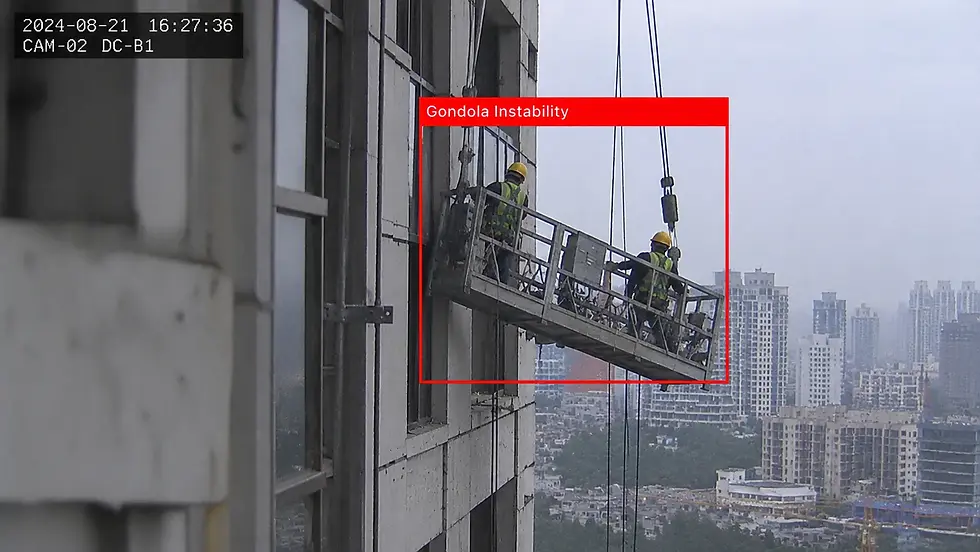
On a busy Colombian construction site, fall risks rarely appear alone. The worker near an open slab edge may also be standing under a crane’s swing radius, and the scaffold being climbed may sit beside an excavator’s blind spot. The same cameras watching for fall protection gaps can also flag missing PPE, machinery proximity and restricted-zone entries. When an AI construction safety platform covers all of these together, safety teams get one connected view of site risk instead of separate checks for each hazard. The section below shows how that monitoring runs on an active site, from camera feed to corrective action.
From Work at Height Safety to Holistic Construction Risk Monitoring with viAct AI
Work at height safety is a critical aspect of viAct construction safety solution. Same scenario-based AI detects unsafe climbing, missing harnesses and open edges, watches for PPE non-compliance, as well as machinery proximity, and restricted areas. All of this functions on the existing CCTVs on a site. Every detection is recorded in viHUB, viAct centralized management platform, where safety teams and other project stakeholders can review it anytime, and from anywhere.
For contractors in Colombia, that means fall protection can be the starting point. Once the cameras are connected and technology is in place, the same setup can be extended to holistic construction risk monitoring by simply adding the required modules from viAct 200+ pre-built AI modules library.
How viAct Works on a Construction Site?
CCTV Capture: Connect existing IP cameras to viAct via RTSP. Safety teams can mark height zones on the live view in viHUB, such as slab edges, warning-line areas, openings and scaffold platforms.
Real-time AI Detection: Construction-specific vision models flag fall risks as they happen. Instant alerts reach the site by light and sound siren, and the supervisors remotely by WhatsApp, SMS, Telegram and the viAct app.
Event Logging and Analysis: Every event is logged with an image, time and location. Processing runs in the cloud, or On-Prem or Hybrid modes.
LLM-based Reports: Reports are generated by LLM and sent automatically to the coordinator, project manager and subcontractor leads. Together they build a running evidence trail for the fall prevention program management indicators.
Workflow Management with a Human-in-the-loop: The safety team verifies each alert, assigns corrective action and closes it in viHUB. The AI flags risks, and people make the decisions.
What viAct Detects During Work at Height?
viAct fall protection solution covers:
Harness and life safety rope use detection, including ropes not (properly) clipped on
Open edges and missing barricades detection
Improper means of climbing detection
Risky acts or unsafe behaviour on elevated platforms, such as leaning over guardrails
Roof and inclined surface work monitoring
Detecting near misses, such as slips, trips and almost-falls
Connecting Work-at-Height Permits to What the Cameras See
viAct work at height monitoring integrates with its digital permit to work system. Together they can:
Flag entry into a height zone without an approved permit
Compare platform headcount against the authorised list
Warn when workers stay even after the permit window
Log any violation against the permit record.
For Colombian contractors, this links the permit required by Resolution 4272 to what actually happens on the platform. It also gives the coordinator an auditable record for each shift.
Results from viAct Construction Deployments
Across viAct’s construction deployments:
TRIR fell 50%, protecting more than 32,000 workers across FY24 and FY25
Lost-time injuries fell 65%, saving over 7,200 lost workdays across 400 sites.
These figures cover all construction risks monitored, not falls alone.
In an emerging-market project closer to Colombia’s context, Alliad cut PPE non-compliance by 41.7% and intrusion violations by 46.3% in three months on a hospital construction site in Côte d’Ivoire.
Read the full case study: https://www.viact.ai/case-studies/alliad-cuts-ppe-deviations-with-viact-ai
Conclusion: Key Takeaways
Colombia’s work-at-height rules are detailed and demanding, and most contractors take them seriously. The problem is not the paperwork. It is what happens between inspections, when a barrier is moved for a concrete pour, a new crew starts on an upper floor, or a permit signed in the morning no longer matches the site by afternoon. Fall protection on Colombian construction sites depends on constant observation, and no safety team can watch every edge, opening and platform on every shift.
That is where we see the real value of AI. It doesn’t replace the coordinator, the safety officer or the training a worker needs. It gives them visibility they could never get on their own, using cameras that are already on site. And because work at height safety is one part of a wider construction safety picture, the same monitoring that protects workers at height can grow into a connected view of every risk on the project.

Key takeaways
Fall protection fails in the gaps between inspections, not in the safety plan itself.
Controls like warning lines, guardrails and opening covers only work while someone is watching them.
viAct AI video analytics on existing CCTV turns periodic checks into continuous monitoring, with no new cameras needed.
Alerts are most useful when people stay in the loop to verify each one and act on it.
Work at height safety is a natural starting point for holistic construction risk monitoring

FAQs
1. Is AI video monitoring of construction workers legal in Colombia?
Yes, with the right safeguards. Images captured by video surveillance are personal data under Ley 1581 de 2012, so Colombian guidance on video surveillance calls for visible notice, authorisation, use only where necessary for the stated purpose, and limited retention. Face blurring and encrypted footage keep monitoring focused on safety.
2. Can AI tell if a harness is clipped on?
Yes, viAct AI can detect if a harness is clipped on, conditioned the camera has a clear view of the lanyard and anchor point.
3. Is fall protection required below 2 meters in Colombia?
Yes, if a fall from a lower height could still cause serious injury, for example near sharp edges, protruding objects, energised systems or moving machinery. viAct monitors work at any height, meaning these lower-height hazard areas can also be covered just like work above 2 meters.
4. Who is responsible for subcontractors’ fall protection in Colombia?
Both the main contractor and the subcontractor. The contracting employer must verify that its contractors comply with Resolution 4272, and the work-at-height permit procedure must define each party’s responsibilities. viAct records unsafe acts at height on every camera zone, which gives main contractors evidence of how subcontracted crews actually work on site.
5. Is viAct available in Colombia?
Yes. viAct runs on a construction site’s existing CCTV, with Cloud, On-Prem or Hybrid deployment, so Colombian sites can use it without new cameras or hardware imported for the purpose. viAct already works with operators in Latin America, including a mining operator in Chile.
Read More: