
Construction Safety in Japan: Key Risks and How Computer Vision Can Help


“Quick AI-Powered Insights on the Topic— Freshly Updated!”
|
Construction safety remains an important issue in Japan despite the country's advanced construction practices and growing use of digital technology. In 2025, 214 construction workers died at work, about 31% of the 700 workplace deaths recorded across all industries. Falls from height are the leading cause of construction accidents. Heat-illness prevention became a legal duty on 1 June 2025. A shrinking, ageing workforce and the April 2024 overtime cap are pushing the industry toward automation under the Ministry of Land, Infrastructure, Transport and Tourism (MLIT) plan, i-Construction 2.0.
This guide explains the current state of construction safety in Japan, the main risks, how computer vision can improve site safety, the benefits of technology, and how construction companies can implement AI safety monitoring. Every statistic links to its original official document.
What Is the Current State of Construction Safety in Japan?
In short, construction safety in Japan is improving, but construction still records more workplace deaths than any other industry.
Deaths: Construction recorded 214 deaths in 2025, 18 fewer than the 232 in 2024.
Share of deaths: Construction accounted for about 31% of all 700 workplace deaths in Japan in 2025, which was a record low for the country overall.
Injuries: 13,437 construction workers were injured badly enough to miss four or more days of work in 2025. That is 3.0% fewer than 2024 (13,849) and about 11% fewer than 2016 (15,058).
Since April 2024, construction is subject to the general overtime limits total of overtime and holiday work to less than 100 hours per month and an average of 80 hours over a two-to-six-month period .i-Construction 2.0 aims to reduce on-site labour by at least 30% and raise productivity 1.5 times by FY2040, built on three pillars: automation of construction, of data linkage and of construction management.
Japan therefore continues to strengthen conventional safety measures while the construction sector also adopts new technologies for monitoring, automation and site management.
What Are the Main Construction Safety Risks in Japan?
The main construction safety risks in Japan are falls from height, accidents involving machinery and vehicles, heat illness, collapses, and workforce factors such as ageing and the use of foreign and self-employed workers.
1. Falls from height

Falls are the biggest single cause of construction accidents in Japan. In 2025, falls caused 4,343 of 13,437 construction injuries (32%). Common exposure points include scaffolding, roofs, ladders, openings, temporary structures and other elevated work areas. Physical controls such as guardrails, appropriate scaffolding and fall-protection equipment remain essential. Technology can complement these measures by providing additional monitoring of defined high-risk areas and activities.
2. Caught-In and Caught-Between Accidents

In 2025, 1,496 construction workers (11%) were injured by being caught in or between objects. Workers can become trapped or caught between machinery, equipment, structures or materials. These incidents are particularly relevant where workers and heavy equipment operate within the same space. Excavators, mobile machinery and other moving equipment can create risks when workers enter operating areas or equipment blind spots.
Clear separation between people and machinery therefore remains an important construction safety control.
3. Heat illness

Heat-illness countermeasures became mandatory in Japan on 1 June 2025 through an amendment to the Industrial Safety and Health Regulations (Article 612-2; MHLW Ordinance No. 57 of 2025). Employers must:
Set up a system for workers to report heat-illness symptoms.
Write response procedures (leaving the task, body cooling, medical care, emergency contacts).
Make both known to everyone on site.
The rule applies when work is expected at a WBGT (heat index) of 28 or higher, or an air temperature of 31°C or higher, for more than one hour continuously or more than four hours a day. Heat illness killed 31 workers across all industries in 2024, the third year in a row at 30 or more and remain a critical hazard in the industry.
4. Collapses and cave-ins

Collapses and cave-ins remain a serious construction safety risk, particularly during excavation, trenching and earthwork. Collapses killed 30 construction workers in 2024. Earth and rock collapses accounted for 12 of them (40%).Workers may be exposed when working near excavations, trenches, unstable slopes or temporary structures. Controls such as ground assessment, shoring, safe excavation procedures, restricted access and regular inspections are essential for reducing these risks.
5. Workforce Monitoring

Workforce monitoring with AI can help construction teams maintain visibility across active work areas, particularly as Japan faces an ageing workforce and increasing pressure on available labour. Workers aged 60 or over made up 3,354 of the 13,437 construction injuries in 2025 (25%) while workers aged 50 or over made up 6,230 (46%). AI-based monitoring can provide additional visibility into where workers are operating, whether they enter predefined high-risk areas, and whether observable safety events require attention.
How Can Computer Vision Improve Construction Site Safety in Japan?
Construction sites in Japan are becoming more digitally connected, but safety oversight still depends heavily on what supervisors and workers can observe during day-to-day operations. As projects become more complex and safety teams are expected to maintain consistent oversight across multiple work areas, continuous visibility becomes increasingly difficult through manual monitoring alone.
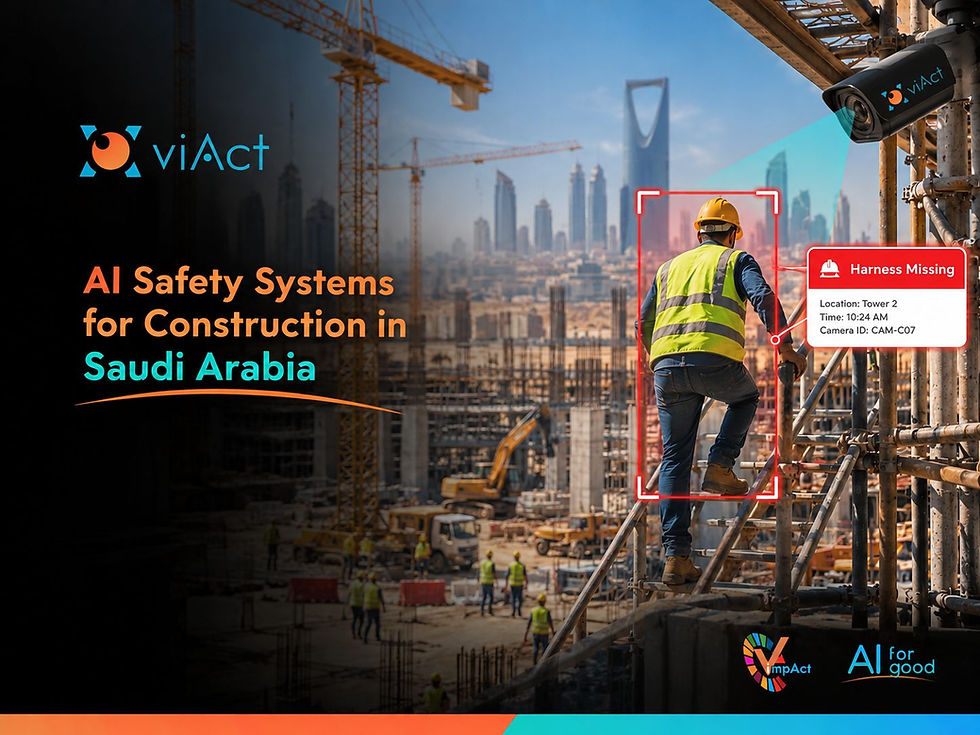
Computer vision improves construction safety by turning video feeds from site cameras, drones, IoT-based sensors or BIM/CIM into continuous, real-time safety monitoring. The system analyses footage against predefined safety rules and conditions, and when a potential risk is identified, it generates an alert for the HSE team to verify and respond to.
Each detected event can also be recorded, creating a traceable source of safety data that helps teams understand where and when risks repeatedly occur. Over time, these insights can support faster corrective action, more targeted safety measures and better-informed risk prevention.
For Japan, this makes computer vision particularly relevant as a supporting layer between existing site controls and human decision-making. It does not replace inspections, training or physical safety measures; rather, it helps safety teams see developing risks sooner and use site video more proactively.

Here’s the process followed by computer vision in a construction AI safety solution to detect common construction safety risks in Japan:
Construction safety risk | How computer vision support safety teams |
Vision AI can monitor defined fall-risk areas and flag situations like proximity to open edges, lack of harness or missing guardrails that require safety-team verification. | |
AI cameras monitor worker–equipment distance, entry into equipment operating zones, blind-spot exposure and unsafe approach to moving vehicles or machinery. | |
Falling-object exposure | Computer vision can identify workers entering lifting exclusion zones, standing beneath suspended loads or remaining within areas where overhead work is taking place |
Collapses and cave-ins | AI can monitor entry into excavation exclusion zones, workers approaching trench edges or access to areas designated as unstable or collapse-prone. |
AI video analytics can check for the visible presence or absence of configured PPE such as helmets, high-visibility clothing, gloves, harness and other visually identifiable protective equipment. | |
Restricted-area entry | Computer vision can monitor virtual boundaries and detect workers crossing into machinery zones, lifting areas, loading zones or other predefined restricted spaces. |
Video analytics can identify materials or objects obstructing walkways, access routes, emergency paths or areas configured to remain clear. | |
Heat-related emergencies | AI cameras paired with an IoT-based smart watch can monitor observable events such as a worker falling due to fatigue, abnormal body temperature or heart rate, collapsing or remaining motionless beyond a configured period. |
Experience across viAct wider construction deployments shows how continuous AI-based safety monitoring can translate into measurable outcomes. Across 400+ construction sites, viAct reported a 65% reduction in Lost Time Injuries (LTI), contributing to more than 7,200 fewer lost workdays in FY 24-25.
For Japan, where construction companies are balancing persistent safety risks with workforce constraints, these results illustrate the potential value of using continuous AI-based monitoring to strengthen existing site safety practices.
What Are the Benefits of Technology for Construction Safety?
Construction technology is most useful when it addresses a clearly defined safety problem.
Earlier hazard identification: AI monitoring can identify configured safety events while work is taking place rather than relying only on retrospective review.
Faster response: Real-time alerts can help relevant personnel become aware of selected events sooner.
Continuous monitoring: Cameras and sensors can provide additional coverage of high-risk or frequently changing areas.
Better safety data: Recorded events can reveal repeated hazards by location, activity or time.
Additional layer to human monitoring: Technology does not replace the employer's legal duties, worker training, or physical controls such as guardrails and scaffolding. MHLW's notice lists patrols, buddy systems and wearable devices as ways to build a reporting system.
The value therefore extends beyond individual alerts. Over time, safety data can help teams understand where risks repeatedly occur and whether corrective measures are working.
How Can Construction Companies in Japan Implement Vision AI for Safety Monitoring?
Short answer: Start with your own highest risks, pilot one or two use cases on one site, connect alerts to existing safety routines, protect worker privacy, and measure results before scaling.
Start from your risk assessment. List the top hazards on your sites, usually falls, machinery and vehicles, and heat. The 14th Plan sets a target of 85% of construction sites carrying out fall-prevention risk assessments.
Choose one or two use cases. Examples are unprotected edges and openings, worker-to-machine proximity, or restricted-zone entry.
Check your infrastructure. Review camera coverage, power, network and whether analysis runs at the edge (on site) or in the cloud.
Connect alerts to existing routines. Feed alerts and clips into hazard prediction activity (KY), morning meetings (chorei) and safety patrols, so the technology supports practices workers already follow.
Address privacy and worker communication. Camera images that identify people can fall under Japan's Act on the Protection of Personal Information. Tell workers what is recorded and why, limit retention, and get legal review.
Deliver alerts in workers' languages. Use multilingual signage and alerts, and MHLW's multilingual heat-safety leaflets for training.
Run a pilot of four to eight weeks. Track leading indicators such as alert volume, false-alert rate, response time and near-miss reports, not only injury counts.
Scale and review. Expand to more sites, and review results against your own targets and the national plan.
Conclusion: Key takeaways
Falls remain a major construction safety concern, accounting for a substantial share of construction fatalities and casualties.
Caught-in/between accidents, falling objects, slips and worker–machinery interaction also require continued attention.
Construction technology can provide additional visibility into hazards that are difficult to monitor continuously.
AI and computer vision can analyse camera footage for defined risks such as worker–equipment proximity, restricted-area entry and PPE compliance.
Japan's i-Construction 2.0 programme reflects the broader movement toward automated and data-driven construction.
Digital monitoring should complement physical safety controls and human supervision rather than replace them.
The role of technology in construction safety is therefore not simply to generate more alerts. Its value lies in helping safety teams identify relevant risks earlier, respond consistently and learn from recurring patterns.
Quick FAQs
1. What are the main construction safety risks in Japan?
Falls from height are a major construction safety risk in Japan. Other important hazards include caught-in/between accidents, falling objects, slips and interaction between workers and construction machinery.
2. What technology is used for construction safety in Japan?
Construction safety technologies can include AI-enabled cameras, computer vision, IoT sensors, drones, BIM/CIM, automated machinery, remote operation and digital safety-management systems. Different technologies address different operational and safety needs.
3. How can AI improve construction site safety?
AI can analyse site data or video to identify predefined safety events. Computer vision, for example, can monitor conditions such as PPE compliance, restricted-zone entry and worker–equipment proximity and alert responsible personnel when configured events occur.
4. Can existing CCTV cameras be used for construction safety monitoring?
In some cases, yes. AI video analytics can work with compatible existing camera infrastructure, provided the video quality, positioning, coverage and connectivity are suitable for the required detection task. Additional cameras may be necessary where existing coverage is insufficient.
5. Can AI replace construction safety officers?
No. AI can support safety teams by monitoring defined conditions and highlighting events that may require attention. Risk assessment, supervision, investigation, worker engagement and safety decisions still require appropriate human oversight.
Read more:


Great insights into construction safety in Japan! Clear safety signs and inspection records are essential on job sites. An AI image text enhancer can also help make blurry text in site photos and scanned documents easier to read.
If you want to learn about 10.0.0.1 piso wifi, it is helpful to understand how the local login page works. Following the correct instructions can make it easier to access available session settings.
Revisar los numeros ganadores puede ser más cómodo cuando toda la información está agrupada correctamente. Además, contar con la fecha del sorteo permite comprobar que los datos consultados corresponden realmente a la jornada indicada.
The appeal of Poople game comes from its simplicity. You only change one letter at a time, but finding the perfect sequence can be surprisingly challenging.
Few puzzle games have achieved the lasting appeal of Tetris Online. Its combination of strategic depth, accessible gameplay, and real-time multiplayer action creates an engaging experience that continues to attract players from around the world.