
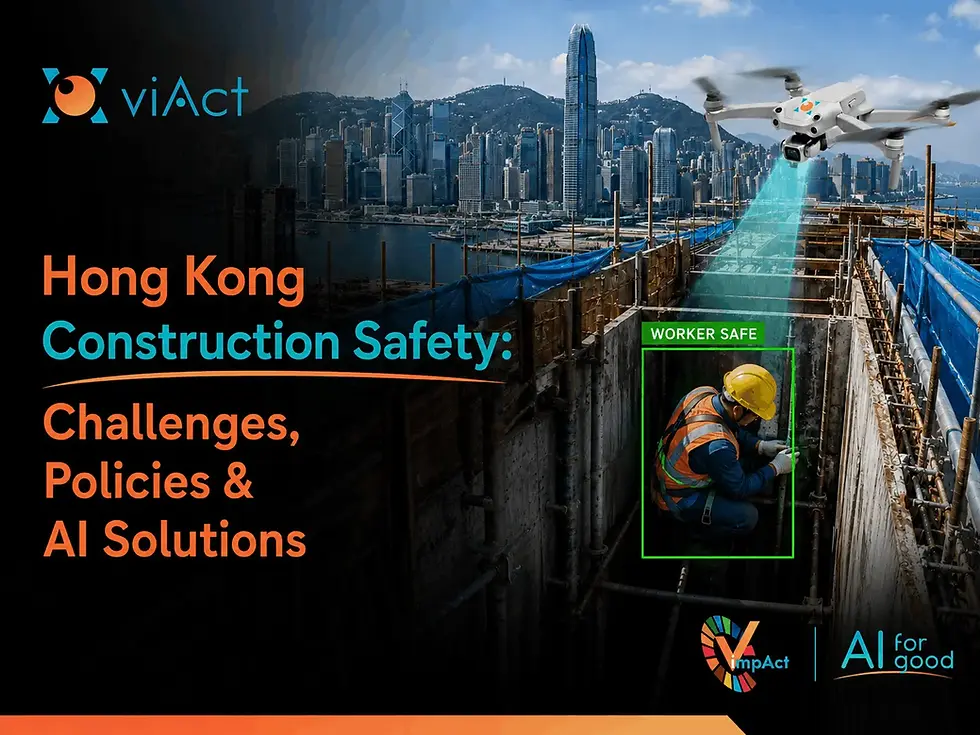
Hong Kong Construction Safety: Challenges, Policies & AI Solutions

“Quick AI-Powered Insights on the Topic— Freshly Updated!”
|
The Hong Kong construction industry is booming, with large-scale infrastructure projects and urban development transforming the skyline every year. However, the rapid pace and complexity of these projects bring significant safety challenges.
According to the Construction Industry Council (CIC), workplace accidents remain a pressing concern, where the implementation of Artificial Intelligence (AI) in the construction industry steps in as a game-changer.
Meeting the standard of construction safety in Hong Kong today means understanding three things together: the specific challenges the city's sites face, the policies now governing how contractors respond to them, and the AI-driven solutions making compliance and prevention possible at scale.
This guide covers all three in detail.
What Are the Key Construction Safety Challenges in Hong Kong?
Hong Kong construction sites operate under conditions that few other markets share, which is exactly why generic safety approaches fall short here:
Dense, constrained urban sites — many projects are squeezed into limited footprints with little room for error, increasing the risk of falls, collisions, and equipment-proximity incidents
High-rise, vertical risk — a large share of active sites involve tall-building construction, where height-related hazards and lifting operations carry outsized consequences
A highly diverse workforce — varying languages and training backgrounds across the labor force make standardized, real-time communication of hazards difficult through manual methods alone
High activity density — multiple subcontractors and trades often operate in narrow, shared zones simultaneously, raising the risk of near misses
Limits of manual monitoring — traditional site walks and paper logbooks cover a single point in time; they cannot deliver the continuous, 24/7 visibility dense, high-risk sites require
Scaffold-related risk — falls from scaffolding account for a significant share of fatal site accidents in Hong Kong in recent years, making scaffold lifecycle management a persistent challenge
These pressures are precisely why Hong Kong has moved toward regulation-backed, technology-driven safety requirements rather than relying on manual compliance alone.
What Are the Major Construction Safety Policies in Hong Kong?
Hong Kong's construction safety framework rests on a long-standing statutory base, with two newer, technology-specific mandates now built on top of it.
Foundational Legal Framework
Factories and Industrial Undertakings Ordinance (Cap. 59) — the core law governing safety and health across Hong Kong's industrial sector, including construction sites. It places general statutory duties on proprietors and workers alike, with criminal liability for contravention.
Construction Sites (Safety) Regulations (CS(S)R) — enacted in 1973 under the FIUO, this is the regulation set most directly enforced on Hong Kong construction sites day-to-day, covering PPE, plant and machinery, scaffolding, excavation, and site access.
Occupational Safety and Health Ordinance (OSHO) — broader workplace safety legislation that applies alongside the FIUO, extending employer safety duties beyond industrial-specific settings.
Construction Industry Council Ordinance (Cap. 587) — established the CIC as a statutory body in 2007, giving it the authority to set industry-wide safety standards and lead initiatives such as the 4S mandate below.
Against this base, two newer mandates now define how technology fits into compliance:
The 4S Mandate (Smart Site Safety System)
In 2023, the Development Bureau of the Government of the Hong Kong Special Administrative Region (DEVB) adopted a regulation requiring the implementation of a Smart Site Safety System (4S) for public works contracts above HK$30 million. The mandate reflects a broader shift in Hong Kong from safety systems that document incidents after the fact to systems that are expected to prevent them in real time, combining AI-powered video surveillance, sensor data, and instant alerts as a baseline requirement rather than an optional upgrade.
The Low-Altitude Economy (LAE) Regulatory Sandbox and Drone Policy
Hong Kong's drone regulatory framework has moved quickly. The city's Low-Altitude Economy Regulatory Sandbox officially began on March 20, 2025, with the government approving 38 pilot projects out of 72 applications, spanning uses from infrastructure inspection to surveillance and emergency response.
Construction is one of the direct beneficiaries of this framework. The Development Bureau has piloted drone deployment for site management, asset management, and emergency response across a set of pilot construction sites under the sandbox, positioning drones as a sanctioned, increasingly mainstream tool for site oversight rather than an experimental one.
Together, the 4S mandate and the LAE drone framework mean Hong Kong contractors are no longer choosing whether to adopt AI-driven safety technology; for a growing share of public projects, it's a compliance requirement.

Each of the policies above connects to a specific AI solution in the section below.
AI Solutions Addressing Hong Kong's Construction Safety Challenges
The technologies below map directly onto the challenges and policies above — each is a practical, deployed response, not a theoretical one.

Smart Site Safety Systems combine AI-powered video surveillance, sensor data, and real-time alerts to monitor the safety parameters that matter most on a Hong Kong site: PPE compliance, worker location, and hazardous-zone entry.
Cameras integrated with AI can detect whether a worker is missing a helmet or safety vest and trigger instant alerts to supervisors. The same systems monitor crane lifting zones and restricted areas, flagging when workers or equipment move into dangerous proximity. Wearable devices, such as AIoT-enabled smart watches, add another layer — continuously tracking vital signs like heart rate and body temperature to catch early signs of fatigue or distress.
4S is the direct technology mandate issued by DEVB under the standard-setting authority of the CIC (Cap. 587), and in practice it's how proprietors demonstrate they're meeting the general duty to ensure safety and health at work set out under the Factories and Industrial Undertakings Ordinance (Cap. 59) — not just on paper, but continuously and in real time.

The Danger Zone Alert Sensoring System (DZASS) addresses a specific, high-consequence risk within 4S's broader scope: hazardous zones such as excavation pits, electrical fencing, and crane lifting zones, where space constraints and complex site layouts heighten risk across Hong Kong's dense sites.
DZASS combines video analytics with sensor data to continuously monitor these zones. When a worker or piece of equipment enters a predefined danger zone, the system sends an immediate alert to site supervisors and operators, preventing potentially fatal accidents caused by unauthorized or accidental entry.
DZASS corresponds to the Restricted Zone Intrusion Detection and Crane & Hoist Safety Monitoring capabilities tracking swing radius, suspended-load movement, and worker proximity to lifting zones to prevent struck-by incidents.
This maps directly to the excavation, plant and machinery, and lifting-operation standards set out in the Construction Sites (Safety) Regulations (CS(S)R) — DZASS is how those standards are enforced continuously rather than through periodic manual checks.

Scaffolding remains one of the riskiest aspects of construction in Hong Kong, as per CIC, leading to fatal site accidents in recent years linked including falls. A Scaffolding Safety Management System addresses this challenge by combining computer vision and machine learning to automate scaffold lifecycle monitoring.
These modern scaffolding systems are deployed to track scaffold erection, modifications, and dismantling. Using digital scaffold tags (green, yellow, red) linked with QR codes, site workers and safety officers can instantly verify scaffold conditions.
This directly addresses the scaffolding standards set out in the Construction Sites (Safety) Regulations (CS(S)R), which govern scaffold erection, inspection, and safe use on Hong Kong sites.

The Digital Work Supervision System (DWSS) addresses one of Hong Kong's most persistent challenges: the limits of manual site walks. Traditional supervision relied on physical logbooks and once-daily inspections, leaving long windows of blind exposure between checks.
DWSS uses real-time video feeds and AI-driven alerts to monitor multiple work zones simultaneously, around the clock, rather than at scheduled intervals. The exact gap DWSS is built to close through five core features: RISC (Request for Inspection/Survey Check), Site Diary, Site Safety Inspection Records, Cleansing Inspection Checklists, and Labour Return Records.
This directly modernizes what the Construction Sites (Safety) Regulations (CS(S)R) require of site supervision — continuous oversight of PPE use, plant and machinery, and site access. Where the CS(S)R's inspection standards were historically met through periodic manual walks, DWSS extends that same supervisory duty to 24/7 coverage.
DWSS aligns with the Agentic AI layer on modern safety monitoring platforms, automating incident reports, generating compliance documentation, and surfacing safety trends so supervision output becomes structured, audit-ready data rather than scattered manual logs.
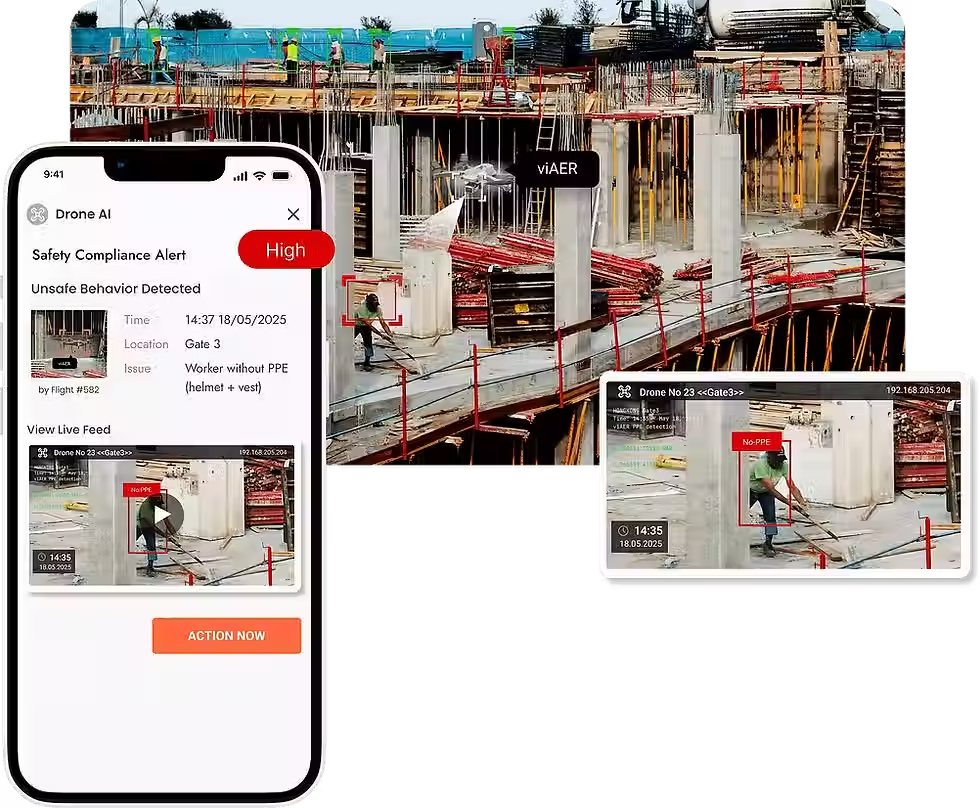
Drone AI is leading a new era of construction safety in Hong Kong by extending site oversight to the areas hardest to monitor manually, such as building facades, rooftops, and large or hard-to-access site perimeters. Under the LAE Regulatory Sandbox framework described above, this is no longer an experimental application in Hong Kong; it's an increasingly sanctioned part of how sites are managed.
The Development Bureau's own pilot use of drones spans site management, asset management, and emergency response applications— capabilities directly relevant to construction safety oversight, particularly for Hong Kong's ageing building stock and vertical, space-constrained sites where physical inspection carries its own risk to workers.
This is the same role drones like viAER play as a dedicated layer on each safety platform: autonomous aerial inspection for scaffolding integrity, elevated work zones, structural progress monitoring, and confined or hard-to-access areas, height and hard-to-reach risk monitoring that computer vision alone, tied to fixed camera positions, cannot fully cover.
6. viHUB (ECMP): Centralizing Site Data
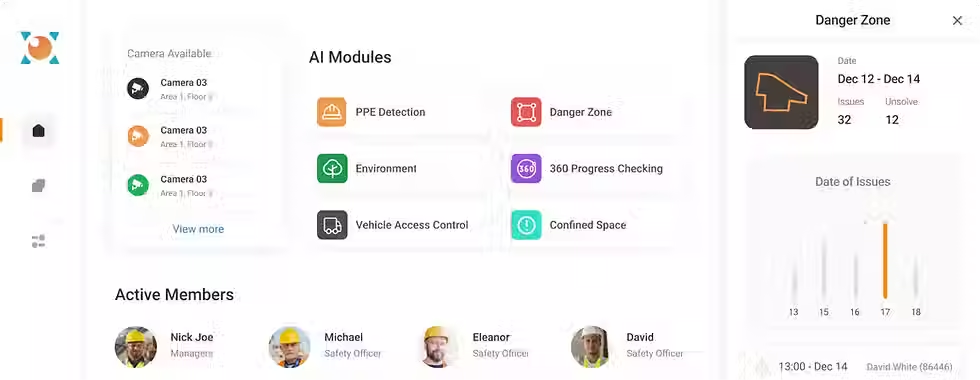
Where 4S, DZASS, and DWSS generate real-time detection at the site level, viHUB, Enterprise Management Platform (ECMP) for Safety and Project Tracking serves as the bridge that brings that data together. Rather than safety officers switching between disconnected systems per site, a single dashboard can surface safety scores, alerts, and compliance status across every active zone.
This matters directly for Hong Kong's dense, multi-site contracting environment: a regional safety manager overseeing several concurrent projects can monitor site-level metrics including incident rates and near-miss trends from one consolidated view, without requiring on-the-ground technical expertise at each location. It's this centralization that turns individual detection events from 4S, DZASS, and DWSS into portfolio-level safety intelligence.
It also supports the broader compliance-documentation duty employers carry under the Occupational Safety and Health Ordinance (OSHO): a centralized, timestamped record across every active site gives proprietors a defensible audit trail, rather than fragmented records held separately per location.
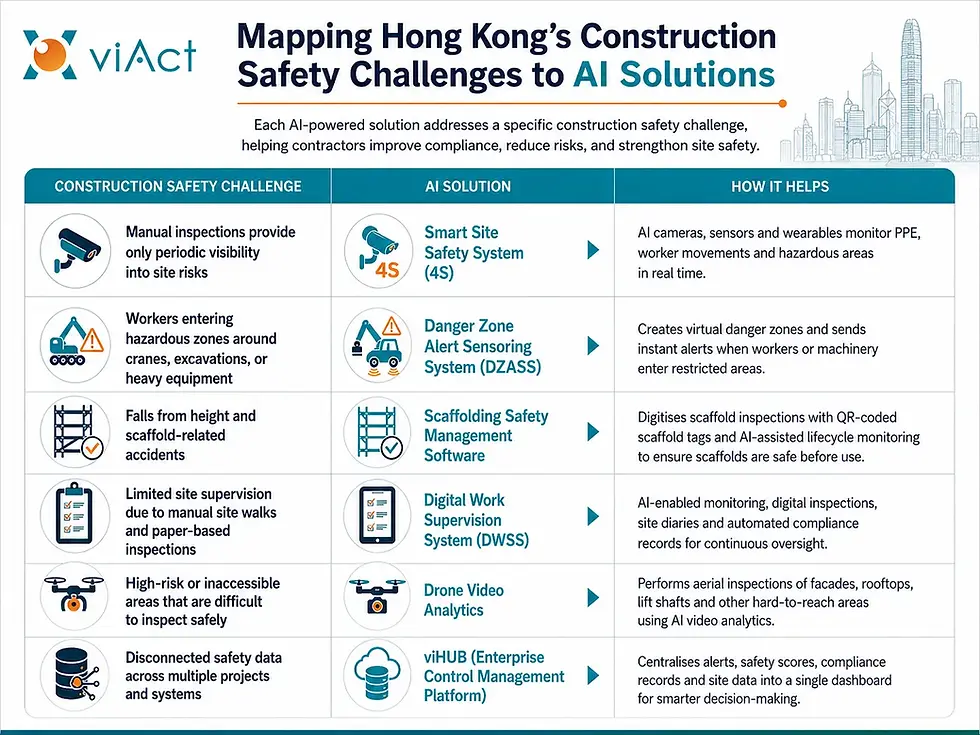
Taken together, these six solutions aren't a checklist of separate tools; they are layers of the same system, each addressing a specific challenge and mapping back to a specific policy requirement, with viHUB tying the detection layer into one connected, auditable view of site safety.
Conclusion: Key Takeaways
Hong Kong's dense sites, vertical risk, diverse workforce, and reliance on manual oversight are the specific challenges driving the city's shift toward policy-backed, technology-driven safety
A long-standing statutory base (FIUO, CS(S)R, OSHO, CIC Ordinance) already required proprietors to ensure continuous site safety and documentation — 4S and the LAE framework are newer mandates built on top of it
4S and DZASS work together at the site level: 4S covers PPE, worker location, and hazardous-zone monitoring broadly, while DZASS focuses specifically on high-consequence zones like excavation pits and lifting operations
DWSS extends supervision from periodic manual walks to continuous, 24/7 coverage across multiple work zones
viHUB centralizes data from 4S, DZASS, and DWSS into one dashboard, turning site-level detection into portfolio-level safety intelligence
Drone video analytics, now operating under the LAE Regulatory Sandbox, extends oversight to facades, rooftops, and hard-to-access areas that manual inspection struggles to cover safely
For contractors and developers in Hong Kong, adopting these systems is no longer just a competitive edge — for a growing share of public contracts, it's a compliance requirement
As the Hong Kong construction industry continues to grow, embracing AI will be essential to meet safety standards, protect workers, and boost productivity. For forward-thinking contractors and developers, embracing AI-powered construction safety systems is no longer an option—it’s a necessity to stay compliant, efficient, and safe in the evolving urban landscape of Hong Kong.

Quick FAQs
1. What are the biggest construction safety challenges in Hong Kong?
Dense, space-constrained sites, high-rise/vertical risk, a diverse multilingual workforce, and reliance on manual inspections instead of continuous monitoring.
2. Why is AI important for construction safety in Hong Kong?
AI enables 24/7 real-time hazard detection and instant alerts, closing the gap left by periodic manual inspections on dense, high-risk sites.
3. Is the 4S system mandatory for construction projects in Hong Kong?
It is mandatory for public works contracts above the HK$30 million threshold set by DEVB; adoption on other projects is increasingly common as a safety best practice even where not formally required.
4. What is DWSS and is it mandatory in Hong Kong?
The Digital Works Supervision System (DWSS) digitizes site supervision through features including RISC (Request for Inspection/Survey Check), Site Diary, Site Safety Inspection Records, Cleansing Inspection Checklists, and Labour Return Records. While specific mandates vary by contract, it is built to align with Hong Kong's Construction 2.0 and Smart Site Safety System (SSSS) government initiatives, and is widely adopted across DEVB-supervised projects as a supervision standard.
5. What is Hong Kong's drone policy for construction?
Under the Low-Altitude Economy (LAE) Regulatory Sandbox, launched in March 2025, approved drone use for construction site management and inspection is permitted under relaxed flight restrictions.
Read More:


Great breakdown of the unique safety challenges facing the Hong Kong construction industry. Many contractors focus purely on immediate compliance, but neglecting the backend tech upgrades builds up significant technical debt (https://tkxel.com/blog/what-is-technical-debt-definition-impact/) over time. Integrating AI early not only protects workers on site but also keeps digital infrastructure manageable as projects scale.
Great breakdown of Hong Kong's 4S mandate and how AI is transforming construction site safety! Managing complex, high-density sites requires top-tier talent and reliable execution. Just as AI helps safety officers prevent incidents before they happen, Mantner helps startups, tech firms, and corporates hire the people who move their business forward fast, carefully vetted, and matched to fit. Thanks for sharing these valuable insights!
Awesome breakdown of Hong Kong's 4S mandate and how AI is changing site safety! Managing multi-site projects in high-density urban areas like HK definitely requires top-tier intelligence, and having reliable data is key—which is why turning to a custom expert sourcing team makes such a big difference, just like 24/7 AI monitoring helps safety officers prevent incidents before they happen!
This article does a great job highlighting the unique safety challenges of Hong Kong construction sites. Given the complexity of these high-density urban projects, it is clear that AI integration is the next logical step for site management. Just as your next component is you generator, the industry needs to focus on building more intelligent, automated safety workflows to protect workers effectively.
Really insightful take on how AI is making construction safety more proactive rather than reactive. Real-time monitoring, smart sensors, and drones can help identify risks before they turn into serious incidents. This kind of technology-driven approach is a great step toward safer and more efficient construction sites. For property owners, keeping up with safety requirements is equally important, including understanding the landlord safety certificate london requirements.