
Computer Vision in Logistics: Key Use Cases & Benefits


“Quick AI-Powered Insights on the Topic— Freshly Updated!”
|
Imagine walking through a sprawling logistics hub. Forklifts glide between towering racks stacked with pallets, conveyor belts run as thousands of packages move along predetermined paths, and workers navigate the floor with precision, managing goods at a breakneck pace.
Behind the scenes, every second counts. A misplaced item, a damaged package, or a delayed shipment can disrupt the entire supply chain, leading to inefficiencies, losses, and dissatisfied customers.
Under traditional monitoring, errors go unnoticed, accidents happen, and opportunities to optimize processes are often missed.
This is where computer vision in logistics comes in. By giving machines the ability to “see” and interpret the world around them, logistics operations gain real-time intelligence that transforms every aspect of the supply chain.
In this blog, we explore the key use cases and benefits of logistics AI safety solutions, showing how they solve real-world challenges and drive efficiency across the supply chain.
What is Computer Vision in Logistics?
Computer vision in logistics is the use of AI-powered cameras and video analytics to detect risks, track operations, and flag safety violations in real time. It works by connecting to cameras already installed on-site, with no new hardware required in most cases, and running AI models that detect specific events: a missing hard hat, a forklift entering a pedestrian zone, an overloaded pallet, an unauthorized vehicle at the gate.
When the system detects a violation or risk, it sends an alert immediately, often before a human observer would have noticed.
In practice, this runs on a layered setup:
Computer vision as the primary detection layer across existing cameras, edge AI processing on-site for instant alerts even in low-connectivity yards or ports, and where cameras can't reach, IoT sensors and smart wearables covering blind spots like confined spaces or workers moving between zones.
Centralizing all of this into one dashboard, rather than a patchwork of siloed tools, is what turns raw camera feeds into a single, operational view of the entire logistics network.

Key Use Cases of Computer Vision in Logistics
Here's where computer vision is making the most measurable difference across logistics operations today.

Forklifts, pallet trucks, and delivery vans share tight floor space with workers on foot, and that mix is where a large share of logistics incidents originate. Computer vision tracks worker proximity to these vehicles in real time. If a vehicle and a worker close in on each other beyond a safe threshold, the system sends an instant alert to supervisors, catching the near miss before it becomes a collision.
Because the system runs continuously across every camera feed rather than relying on a supervisor happening to be looking in the right direction, it catches the near misses that typically go completely unlogged — the moments that never make it into an incident report because nothing actually happened, but easily could have.
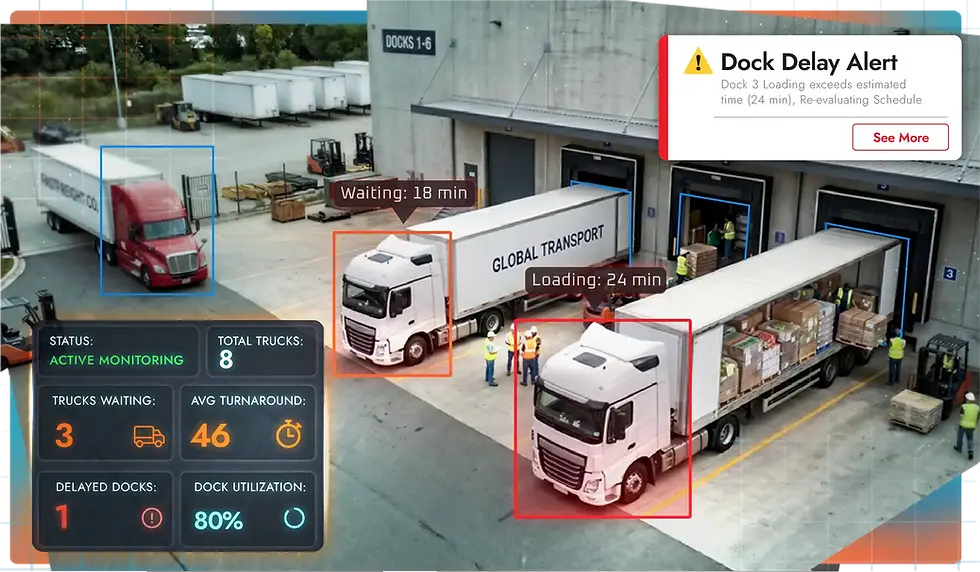
Dock delays are expensive and hard to diagnose from a paper log. Computer vision tracks vehicle arrival, dwell time, and loading activity at each dock bay, giving operations teams a live view of where turnaround is slowing down and why — a truck waiting too long, a bay sitting idle, or loading activity stalled mid-process.
Instead of reconstructing the day's delays from driver logs and gate timestamps after the fact, supervisors get a running view of which bays are underperforming while there's still time to redirect a truck or reassign a crew.

Unstable pallet stacking and improper cargo loading are frequent causes of cargo damage and dock injuries. AI models trained on real loading scenarios detect unsafe stacking, overloaded pallets, and improper truck loading as it happens — catching the problem before the truck leaves the dock rather than after a damage claim is filed. This shifts the check from a spot inspection a supervisor might or might not get to, to a standing rule applied to every single load that passes through the bay.
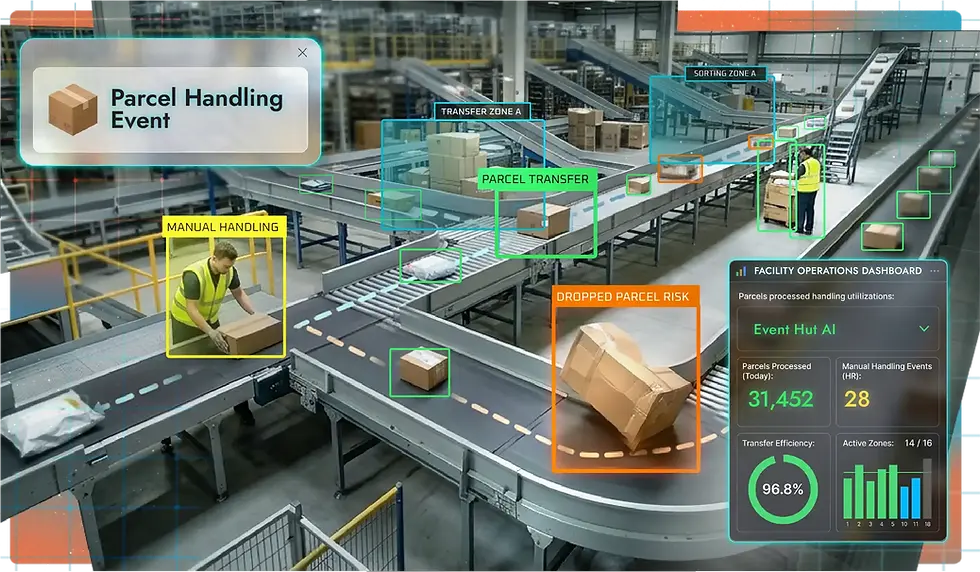
In high-volume handling areas, computer vision tracks how parcels and cargo move through the facility, for example, flagging rough handling, mishandling patterns, and disruptions at transfer points where damage and loss tend to concentrate.
Because the system watches every handoff continuously rather than relying on periodic spot checks, it catches the specific point in the process where a package gets dropped, mishandled, or misrouted, instead of just confirming after the fact that something went wrong somewhere along the chain.

Beyond proximity, forklifts carry their own set of risks — speeding, unsafe reversing, blind-spot exposure, and improper pallet loading during movement. Computer vision flags these patterns as they happen, and edge AI devices like viMAC, installed directly in the vehicle cabin, add a second layer of protection — enforcing speed limits and restricted-zone boundaries even in spots where a fixed camera doesn't have a clear line of sight.
This in-cabin layer matters most in blind corners, narrow aisles, and reversing maneuvers, where a ceiling-mounted camera simply can't get a clean angle but the vehicle's own sensors can.

Aisle congestion, dock traffic, and worker movement patterns are hard to see clearly from the floor. Computer vision maps this activity across zones, showing supervisors exactly where and when bottlenecks form — feeding into a centralized platform like viHUB, which turns those individual zone-level views into one operational picture of the entire site.
Over time, this builds a pattern of when and where congestion tends to recur, so managers can restructure shift timing or traffic flow proactively instead of reacting to the same bottleneck every peak period.
Benefits of Computer Vision in Logistics
These use cases translate into a set of concrete benefits that logistics teams are seeing across their operations.

Real-Time Operational Visibility: A centralized platform like viHUB pulls live feeds from every dock, yard, and zone into a single dashboard, so operations and safety teams see what's happening across the entire network as it happens — not hours later in a shift report.
Cost Savings through Process Automation: Automating detection work that used to rely on manual patrols or after-the-fact review directly reduces labor overhead and claims exposure. Across viAct logistics deployments, organizations have reported operational cost reductions of roughly 30%, saving upwards of $2M annually across warehouse, port, and distribution operations.
Improved Worker Safety & Compliance: Continuous PPE and zone-compliance monitoring, paired with vehicle-proximity alerts, catches everyday lapses such as a missing vest or an unsafe forklift pass before they become incidents. Deployments across logistics networks have recorded incident prevention improving by around 60%.
Enhanced Product Quality & Damage Control: Detecting unsafe loading and rough handling as it happens, rather than discovering damage after delivery, reduces cargo-related claims and gives teams a clear record of exactly where in the process the damage occurred.
Greater Operational Efficiency: Faster dock turnaround, fewer congestion points, and less time spent manually reconciling incidents all compound — some logistics networks have seen throughput improve by as much as 55%.
Scalability Across Multiple Sites: A model trained on one facility's risks can be extended to additional sites with minimal rework, and centralized dashboards give multi-site operators one consistent view across warehouses, ports, and distribution centers rather than a separate system per location.
Better Decision-Making with Data Insights: Every detection becomes structured data — congestion patterns, high-risk zones, recurring violation types — that operations leaders can act on directly, and increasingly query through agentic AI tools like viGent, which can pull live feeds, flag dock risks, and investigate near-misses on request rather than requiring a manual dashboard search.
Quality Documentation & Audit Readiness: Every flagged event is logged automatically with a timestamp and visual record, so compliance reporting and audit prep draw from a verified system log rather than reconstructed notes after the fact.
These benefits aren't unique to any one vendor or facility, but they reflect where the broader logistics industry is already headed. For example, Amazon uses an intelligent robotic system that automatically detects, selects, and handles every product in inventory. This allowed them to reach a record of packaging 13 million items per day. DHL actively uses computer vision and mentions how it would be the standard way of operating in the logistics sector in the future.
The organizations seeing the clearest returns aren't the ones treating this as an experiment, but they're the ones already building it into how they run day-to-day.

Conclusion: Key Takeaways
Computer vision in logistics shifts safety and operations from after-the-fact review to real-time detection and prevention.
Vehicle-worker near misses, forklift risks, dock delays, unsafe loading, parcel handling issues, and warehouse congestion are all now catchable as they happen, not after the fact.
Edge AI hardware like viMAC extends protection into blind spots and low-connectivity zones that fixed cameras and cloud systems alone can't reach.
A centralized platform like viHUB turns scattered camera feeds into one operational view across an entire logistics network, not just a single site.
The measurable impact is real: logistics deployments have reported throughput gains of up to 55%, cost reductions near 30%, and incident prevention improving by around 60%.
Agentic AI tools like viGent are starting to turn that data from something teams review into something they can simply ask questions of.
The logistics networks that treat computer vision as core infrastructure — not an add-on — are the ones that will run safer, leaner, and more resilient operations as complexity in the supply chain only continues to grow.

Quick FAQs
1. What is computer vision in logistics?
Computer vision in logistics is the use of AI-powered cameras and video analytics to detect risks, track activity, and flag safety or compliance issues across warehouses, docks, ports, and distribution centers in real time.
2. How is computer vision different from regular CCTV in a logistics facility?
Regular CCTV and VMS systems record footage for someone to review later. Computer vision analyzes the live feed continuously and sends alerts the moment it detects a risk — catching problems as they happen instead of after they're reported.
3. What are the main use cases of computer vision in logistics?
The most common use cases are vehicle-worker near miss monitoring, forklift speed and handling tracking, dock and bay turnaround monitoring, unsafe loading detection, parcel and cargo handling oversight, and warehouse congestion mapping.
4. What operational benefits does computer vision deliver in logistics?
Reported benefits include real-time visibility across sites, reduced operational costs, fewer safety incidents, better cargo handling and lower damage claims, and audit-ready documentation generated automatically from system logs.
5. Can computer vision scale across multiple warehouses or logistics sites?
Yes. A model trained on one facility's risks can typically be extended to additional sites with minimal rework, and centralized dashboards give multi-site operators a single, consistent view instead of separate systems per location.
Read More:


เมื่อก่อนผมมักติดตามการแข่งขันจากหลายแหล่ง แต่บางครั้งข้อมูลกระจัดกระจายและต้องเปิดหลายหน้า ผมเลยลองดูบริการนี้เพื่อเปรียบเทียบว่าการรวมรายการแข่งขันไว้ในที่เดียวช่วยให้สะดวกขึ้นหรือไม่ จากที่ผมทดลองดู หน้าไลน์มีทั้งการแข่งขันฟุตบอล บาสเกตบอล เทนนิส ฮอกกี้ วอลเลย์บอล และกีฬาอื่น ๆ อีกจำนวนมาก พร้อมเมนูที่ช่วยเลือกประเภทกีฬาได้ง่าย เว็บพนันกีฬาออนไลน์ ผมเริ่มจากฟุตบอลและลองเปิดดูตลาดที่มีในแต่ละคู่ ซึ่งมีทั้งผลการแข่งขัน แฮนดิแคป สกอร์ จำนวนประตู รวมถึงตัวเลือกสำหรับครึ่งแรกและครึ่งหลัง จากนั้นผมลองดูเทนนิสและพบว่ามีตลาดเกี่ยวกับผู้ชนะ คะแนนรวม และแฮนดิแคปของแต่ละเซตเช่นกัน ผมคิดว่าความหลากหลายนี้เหมาะกับคนที่ติดตามกีฬาหลายประเภท เพราะไม่จำเป็นต้องเปลี่ยนแพลตฟอร์มไปมา นอกจากนี้ระบบยังมีส่วนสถิติและรายงานผลที่ช่วยให้ผมตรวจสอบข้อมูลย้อนหลังได้ ผมมองว่าข้อมูลเหล่านี้มีประโยชน์ในฐานะเครื่องมือประกอบการดูการแข่งขัน แต่ไม่ควรนำไปตีความว่าเป็นวิธีรับประกันกำไร เพราะกีฬาไม่สามารถคาดเดาได้ทั้งหมด ผมจึงพยายามตั้งงบประมาณก่อนใช้งานและไม่เพิ่มเงินเพียงเพราะผลก่อนหน้าไม่เป็นไปตามที่ต้องการ สำหรับคนที่สนใจ ผมคิดว่าควรอ่านเงื่อนไขให้ละเอียด ตรวจสอบกฎหมายในประเทศ และใช้งานเฉพาะในขอบเขตที่ควบคุมได้
이동하면서 스포츠 경기 정보를 확인할 일이 많아 모바일 앱을 중심으로 여러 서비스를 비교해 보고 있다. 이번에는 1XBET의 모바일 페이지를 살펴보면서 앱 설치 과정과 주요 기능을 함께 확인했다. 사이트에서는 모바일 앱을 통해 스포츠와 라이브 이벤트를 이용할 수 있으며, 실시간 경기 방송과 게임 통계 확인도 가능하다고 설명한다. 실시간 점수와 배당률이 업데이트되고 계정의 기록을 빠르게 확인할 수 있다는 것도 모바일 기능 중 하나로 소개되어 있었다. 1xbet 앱 설치 정보를 확인하면서 운영체제별 설치 방법도 살펴봤다. Android에서는 APK 파일을 다운로드하고 스마트폰 설정에서 외부 출처의 앱 설치를 허용한 후 설치하는 방식이 안내되어 있으며, iOS에서는 App Store와 국가 및 지역 설정에 관한 절차가 별도로 설명되어 있다. 앱 설치 과정에서 보안 경고가 나타날 수 있으므로 신뢰할 수 있는 공식 출처를 이용하는 것이 중요해 보였다. 모바일 앱의 메뉴를 확인해…
It's wonderful to see blog content that strikes this balance between teaching and storytelling. Nothing here ever feels dry, even when the material gets technical. The examples are well chosen and easy to relate to. I learned more in a short visit than I expected to in an hour. That efficiency is exactly what I look for. I'll be back without question. Genuinely excellent.
This article answered questions I'd been sitting with for a while. Your explanations connected the dots that other posts left scattered. Naturally, I went on to explore the rest of the category. Every piece I read added something useful. Thank you for the clear, helpful writing. It's genuinely appreciated. Keep it up.
Good piece, and I mean that sincerely. I'd add one caveat from my own experience: results vary a lot depending on scale, which might be worth a mention. Still, your core argument holds up well. I subscribe to exactly one online blog on this topic, and after reading this, it's now two. Thanks for raising the bar. Keep it going.