
Malaysia's OSH Master Plan 2026-2030: What It Means for the Future of Workplace Safety


“Quick AI-Powered Insights on the Topic— Freshly Updated!”
|
Malaysia's next five years of workplace safety policy are already mapped out. In February 2026, the Department of Occupational Safety and Health (DOSH), under the Ministry of Human Resources, announced the Occupational Safety and Health Master Plan 2026-2030, known as OSHMP30 — the successor to OSHMP25, which closed out at the end of 2025.
In short, the Malaysia OSH Master Plan 2026-2030 (OSHMP30) is DOSH's national strategy to cut workplace accidents by 15% by 2030, built around six strategic thrusts covering governance, worker wellbeing, technology, high-risk sectors, future-of-work readiness, and OSH education.
For anyone responsible for workplace safety in Malaysia from safety officers, HR leads, plant managers, and HSE consultants- this plan isn't background policy. It's the framework regulators, insurers, and auditors will increasingly measure compliance against over the next five years.
Here's what's actually in it, and what it means in practice.
What is the Malaysia OSH Master Plan 2026-2030?
OSHMP30 is a five-year national roadmap issued by DOSH to guide occupational safety and health policy, enforcement, and industry practice through 2030. It was formally introduced during National OSH Week in mid-2026, positioned as the next chapter after OSHMP25 (2021-2025), which itself focused on three thrusts: strengthening OSH governance, building human capital, and mainstreaming OSH across sectors.
OSHMP30 broadens that scope considerably from three thrusts to six to account for changes in how work itself is done. The plan explicitly names artificial intelligence (AI), automation, the gig economy, hybrid work arrangements, climate-related occupational risk, and psychosocial hazards as new territory this master plan needs to cover, alongside the traditional physical-safety mandate.
The numbers behind it are worth sitting with.
DOSH's own data shows occupational injury cases in Malaysia rose from 34,216 in 2022 to 38,950 in 2023, a 13.8% increase, pushing the injury rate to 2.46 per 1,000 workers. Fatal occupational injuries climbed to 324 cases in 2023. Falls from height remain the single leading cause of fatal workplace accidents nationally, accounting for roughly a third of cases studied by DOSH over the past decade.
That trajectory is a large part of why OSHMP30 exists: OSHMP25 made real progress on awareness and safety culture, but the injury curve didn't bend the way the country needed it to.
Against that backdrop, OSHMP30's headline target is a 15% reduction in occupational accidents by 2030, paired with two structural commitments: revising the Occupational Safety and Health Act 1994 and strengthening how inspections are resourced and conducted.
What are the six pillars of OSHMP30?
OSHMP30 is built around six strategic thrusts. DOSH frames the plan under the theme of building a resilient, inclusive OSH environment for the future workforce and each thrust maps to a specific gap the department has identified.
Strategic Thrust | What It Covers |
1. Strengthening OSH Governance | Tightening enforcement, updating legislation (including the OSH Act 1994), and improving how compliance is monitored and reported |
2. Worker Health and Wellbeing | Expanding beyond physical injury to occupational disease, mental health, and psychosocial risk management at work |
3. Technology and Innovation | Embedding real-time monitoring, predictive risk data, and digital inspection tools into how OSH is practiced, not just policed |
4. Empowerment of SMEs and High-Risk Sectors | Closing the compliance gap in construction, oil and gas, manufacturing, and small-to-medium enterprises where resources and inspector reach are limited |
5. Preparing for the Future of Work | Addressing gig work, hybrid and remote arrangements, automation, and climate-linked occupational hazards |
6. OSH Education, Training, and Competency | Building safety competency across the workforce, from frontline workers to safety professionals and academic institutions |
Two of these — Technology and Innovation, and Empowerment of High-Risk Sectors — are the thrusts most directly relevant to how safety gets implemented day-to-day, and they come up again later in this piece.
What does OSHMP30 mean for workplace safety in Malaysia?
For most organisations, OSHMP30 changes the baseline expectation for what "compliant" looks like. Practically, that means a few shifts are likely over this plan's five-year window:
Inspection frameworks get sharper, with DOSH signaling more resourcing behind enforcement, which raises the cost of non-compliance for employers who've historically treated safety as a periodic checkbox.
Reporting expectations tighten, particularly around near-misses and psychosocial risk, which weren't systematically tracked under earlier plans.
High-risk sectors face more scrutiny, since OSHMP30 names construction, oil and gas, and manufacturing directly as priority areas given their disproportionate share of Malaysia's injury and fatality statistics.
This is the context in which Malaysia’s occupational safety and health practice is heading toward continuous, data-backed monitoring rather than point-in-time compliance — a shift that shows up again in the technology sections below.
Role of AI in the Malaysia OSH Master Plan 2026-2030

AI's role in OSHMP30 is best understood not as a replacement for safety professionals or DOSH inspectors, but as a way to extend the reach, frequency, and quality of workplace safety monitoring.
Under the Technology and Innovation thrust, this can translate into three practical capabilities.
First, AI can turn existing workplace cameras into a continuous source of safety observations. Instead of using CCTV primarily for security or reviewing footage after an incident, computer vision can analyse live video for predefined safety conditions such as PPE compliance, unsafe access, restricted-area entry, or unsafe interactions with machinery. This allows safety teams to identify conditions that may otherwise remain invisible between scheduled inspections.
Second, AI can help prioritise risk rather than simply generate more data. A mature safety system should not treat every observation as an incident. AI can classify recurring unsafe conditions, identify patterns across locations or shifts, and highlight areas where intervention may be needed. Over time, this creates a more useful picture of where, when, and under what conditions safety risks repeatedly emerge.
Third, AI can connect detection with action and accountability. A useful technology layer does more than issue an alert. It can attach visual evidence, record when and where an event occurred, route the observation to the appropriate supervisor, and retain the resulting information for review. This creates a digital trail between hazard detection, corrective action, and safety performance.
That model is particularly relevant to OSHMP30's focus on high-risk sectors.
How Will Technology Support Workplace Safety in Malaysia by 2030?
By 2030, the most meaningful change may not be the number of digital tools used by Malaysian employers, but how safety information moves through an organisation. Technology can make this process more continuous by connecting observation, detection, response, reporting, and analysis into one safety workflow.
For Malaysian workplaces, four technology capabilities are particularly relevant to this transition.
1. Continuous visual monitoring
Computer vision can provide continuous monitoring of safety-critical conditions using existing CCTV infrastructure, drones or IoT sensors rather than requiring safety personnel to physically observe every work zone at all times.

Depending on the workplace, this can include detecting PPE non-compliance, unsafe working-at-height conditions, entry into restricted areas, worker–vehicle proximity, unsafe equipment interactions, or other predefined hazards.
The value is not simply that an AI system can detect these conditions. It is that safety teams can receive consistent observations across time and across multiple locations, helping close the monitoring gap between inspections.
2. Edge AI for remote and difficult-to-monitor environments
Not every Malaysian workplace has reliable connectivity or the infrastructure needed for a fully cloud-dependent monitoring system. Construction projects, remote industrial operations, temporary work areas, tunnels, and confined environments can present particularly difficult monitoring conditions.

Edge AI devices like viMOV can address part of this challenge by processing safety information closer to where it is generated. Portable or on-site systems can support monitoring in environments where connectivity, power availability, or physical access makes conventional infrastructure difficult to deploy.
This is especially relevant to OSHMP30's emphasis on high-risk sectors, where the environments with the greatest need for oversight are not always the easiest to monitor.
3. From isolated alerts to centralized safety intelligence
Another important shift is from individual alerts to organisation-wide safety intelligence.
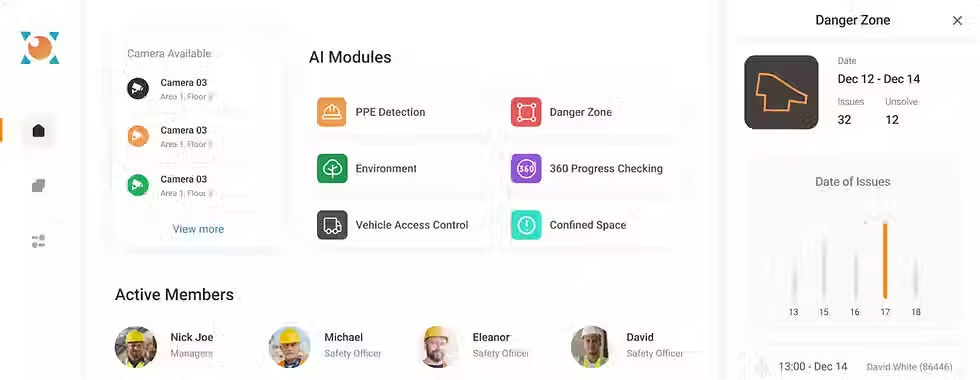
When observations from different sites, cameras, work zones, or safety systems are brought into a central platform like viHUB, organisations can begin to identify recurring patterns.
A leading Singapore construction conglomerate used the platform to centralize AI-generated safety observations from viAct AI monitoring module across multiple projects, giving safety teams a single view of recurring risks instead of managing isolated alerts. This centralized approach supported a 10× improvement in safety scores and saved 7,000+ working hours through more proactive safety management.
4. Evidence-based safety management
Technology can also strengthen the quality of safety records.
Instead of relying entirely on manually written observations or retrospective incident reports, AI-enabled systems can capture the time, location, type of observation, and supporting visual evidence associated with a safety event. When connected to corrective-action workflows, this creates a more complete record of what was detected, what action was taken, and whether the issue recurred.
That evidence, often facilitated by Agentic AI through concise reports, can support internal audits, management reviews, incident investigations, safety trend analysis, and continuous improvement.
Taken together, these technologies point toward a broader change in Malaysia's workplace safety model.

How Can Malaysian Employers Prepare for OSHMP30 and Workplace Safety 2030?
OSHMP30 gives Malaysian employers five years to strengthen how workplace risks are identified, monitored, and managed. Rather than waiting for 2030, organisations can begin by focusing on a few practical priorities:
Assess current OSH gaps: Review where safety monitoring, reporting, and corrective actions still depend heavily on periodic inspections or manual processes.
Prioritise high-risk areas: Start with activities such as working at height, vehicle movement, machinery interaction, and confined spaces where earlier detection can have the greatest impact.
Use technology to extend safety coverage: Existing CCTV, sensors, and digital systems can provide continuous visibility into safety-critical conditions, while AI can help identify recurring hazards and unsafe behaviours between inspections.
Connect detection to action: Safety observations should feed into clear workflows for supervisor review, corrective action, and follow-up rather than remain as isolated alerts.
Build data-driven safety management: Centralising observations and incident data can help employers identify recurring risks across sites, shifts, and activities and focus resources where they are most needed.
Keep people at the centre: AI and digital tools should support safety officers, supervisors, and workers — not replace human judgement, training, or accountability.
The goal is not to have more technology, but to create better visibility of risk and faster opportunities for intervention. Employers that begin building this combination of human expertise, safety data, and technology now will be better positioned for Malaysia's workplace safety expectations by 2030.
Conclusion: Key Takeaways
OSHMP30 sets Malaysia's workplace safety direction through 2030, with stronger emphasis on governance, worker wellbeing, technology, high-risk sectors, future-of-work risks, and OSH competency.
Technology and AI are becoming part of proactive safety management, helping organisations move beyond periodic inspections toward more continuous risk visibility and earlier intervention.
High-risk sectors such as construction, manufacturing, and oil and gas stand to benefit from technologies that can monitor difficult-to-observe environments and identify recurring safety risks.
Digital safety systems can strengthen the full safety cycle — from detecting hazards and capturing evidence to assigning corrective actions and analysing trends across sites and operations.
Successful OSHMP30 readiness is not about replacing people with technology; it is about combining human expertise, better safety data, and technology-enabled monitoring to make workplace safety more proactive and measurable.
By starting now, Malaysian employers can turn OSHMP30 from a regulatory roadmap into an opportunity to build safer, more resilient workplaces by 2030.

Quick FAQs
1. What is Malaysia's OSH Master Plan 2026-2030?
Malaysia's Occupational Safety and Health Master Plan 2026-2030 (OSHMP30) is DOSH's five-year national roadmap for improving workplace safety and health through 2030. It builds on OSHMP25 and focuses on stronger governance, worker wellbeing, technology and innovation, high-risk sectors, future-of-work risks, and OSH education and competency.
2. What is the main goal of OSHMP30 in Malaysia?
OSHMP30 aims to improve Malaysia's workplace safety performance by strengthening prevention, enforcement, risk management, technology adoption, and safety competency through 2030. The blog's source material identifies a 15% reduction in occupational accidents by 2030 as the plan's headline target.
3. Is AI included in Malaysia's OSH Master Plan 2026-2030?
Yes. AI is explicitly recognised within OSHMP30's Technology and Innovation thrust and is also relevant to its Future of Work thrust. The plan positions technologies such as real-time monitoring, predictive risk analytics, and digital inspection tools as ways to strengthen workplace risk management and extend safety oversight.
4. How will technology support workplace safety in Malaysia by 2030?
Technology can help shift workplace safety from periodic inspections toward more continuous, data-driven risk management. AI-enabled monitoring, edge computing, digital inspection tools, sensors, and centralised safety platforms can improve visibility across high-risk and difficult-to-monitor environments while helping safety teams identify and respond to risks earlier.
5. Which industries will be most affected by OSHMP30?
OSHMP30 places particular emphasis on high-risk sectors and SMEs, with construction, oil and gas, and manufacturing identified in the plan's context as areas where stronger safety oversight is particularly important. These industries can benefit from more continuous monitoring because they often involve changing work environments, heavy machinery, working at height, vehicle movement, and other high-risk activities.
Read More:


Thank you for outlining the key changes in the Malaysia OSH Master Plan; it's essential for fostering a tip calculator safer workplace. As someone who's navigated safety regulations, I truly appreciate this comprehensive overview!
Very informative post with clear and useful details. It’s interesting how skill-based games can become more enjoyable when each attempt brings a new challenge. If you enjoy platform games, you can explore Geometry Dash. It offers creative stages, smooth controls, challenging obstacles, and engaging gameplay. Each level gives players a reason to keep practicing and improving their performance.