
Smart Monitoring Systems for Oil & Gas Safety in Saudi Arabia

Updated: 10 hours ago
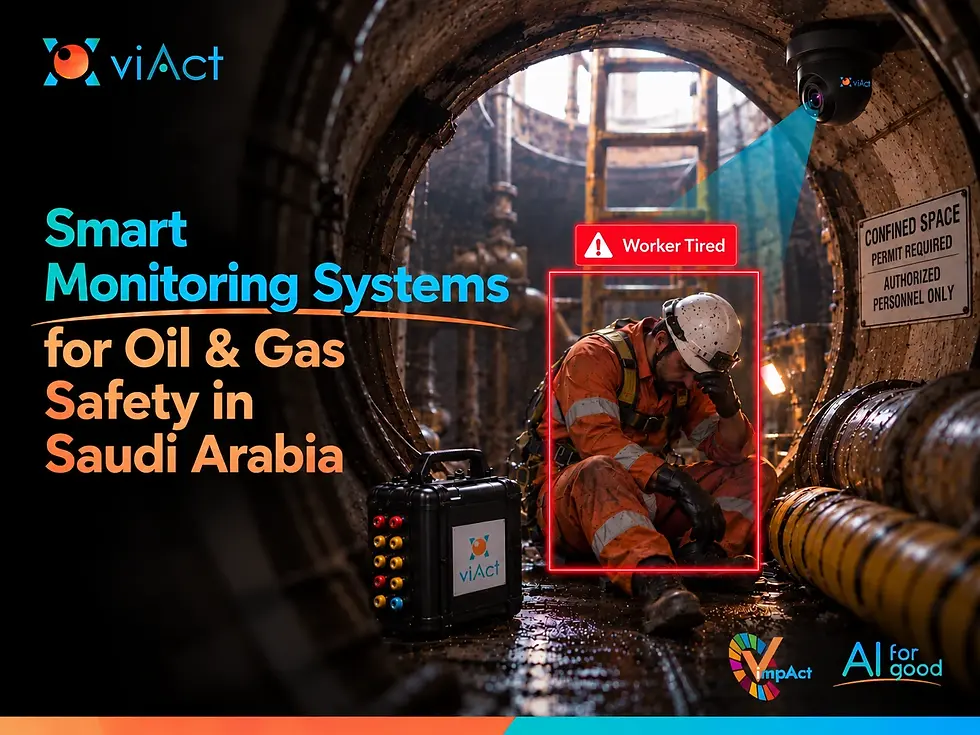
“Quick AI-Powered Insights on the Topic— Freshly Updated!”
|
Saudi Arabia's oil and gas industry operates at a scale where safety monitoring must cover workers, equipment, hazardous areas and process conditions across complex upstream and downstream environments.
In 2025, Aramco reported total hydrocarbon production of 12.9 million barrels of oil equivalent per day, including approximately 10.7 million barrels per day of liquids and 11.4 billion standard cubic feet per day of gas. At this scale, workplace safety is not only about conducting inspections or reviewing incidents after they occur. Operators need continuous visibility into conditions that can change during a shift.
Saudi Arabia's latest national workplace statistics reinforce this need. GASTAT's 2025 Health and Safety at Workplace publication recorded 245 non-fatal occupational injuries and 1.3 fatal occupational injuries per 100,000 workers, excluding road traffic accidents.
AI safety monitoring for oil & gas in Saudi Arabia addresses a different part of this challenge by continuously collecting and analysing information from cameras, sensors, connected devices and safety systems so risks can be detected and acted on closer to when they develop.
What Is a Smart Monitoring System in Oil & Gas?
A smart monitoring system in oil and gas is a connected safety and operational monitoring framework that collects data from cameras, sensors, wearables and other site systems, analyses that information in real time, and alerts personnel when predefined hazardous conditions occur.
Unlike conventional monitoring, where individual CCTV feeds, sensors or inspection records may operate separately, a smart monitoring system brings different sources of information into a connected monitoring process. The purpose is not simply to collect more data. The purpose is to convert site information into detection, alerts, intervention and longer-term safety insight.
Why Is Smart Monitoring Important for Saudi Oil & Gas Operations?
Several factors specific to Saudi Arabia's oil and gas sector make smart monitoring particularly relevant rather than simply a generic technology upgrade:
Scale and complexity of operations
Saudi Arabia operates one of the largest integrated oil and gas value chains globally, spanning upstream drilling and exploration, midstream pipeline and storage infrastructure, and downstream refining and petrochemical processing — each with distinct hazard profiles that are difficult to monitor consistently using manual methods alone.
A documented industry-wide risk pattern
Global data collected by the International Association of Oil & Gas Producers (IOGP) shows that "Line of Fire" incidents such as workers struck by or caught between moving equipment are consistently among the leading causes of fatalities in the oil and gas industry, accounting for more than half of reported fatal incidents in IOGP's 2022 member data. These are precisely the categories of risk that camera-based, sensor-driven monitoring is designed to catch earlier than manual observation can.
National regulatory direction
Saudi Arabia's National Policy on Occupational Safety and Health, approved by the Council of Ministers in 2021 in coordination with the International Labour Organization, places explicit emphasis on hazard prevention, continuous inspection, and safety documentation — objectives that are considerably easier to meet with systems that generate real-time, auditable safety data rather than periodic manual checks.
Active industry-wide digital investment
Saudi Aramco has been expanding its AI and digital infrastructure considerably in recent years — including a 2026 memorandum of understanding with Microsoft focused on industrial AI adoption across its operations, and infrastructure growth. This reflects a broader sector-wide shift toward embedding digital monitoring into core safety and operational workflows, consistent with Saudi Arabia's Vision 2030 push toward technology-enabled industrial operations.
Together, these factors mean smart monitoring is less an optional upgrade for Saudi oil and gas operators and more an increasingly standard expectation, driven by both risk exposure and the direction of national industrial policy.
What Are the Main Functions of Smart Monitoring Systems?
The main functions of a smart monitoring system in oil and gas are continuous observation, hazard detection, worker and equipment monitoring, access control, real-time alerting, event recording and safety trend analysis.
Each function addresses a different gap between a hazardous condition developing and somebody being able to respond.
Smart Monitoring Function | What It Does | Oil & Gas Safety Relevance |
Continuous observation | Monitors selected areas through cameras and connected sensors | Extends visibility beyond periodic inspections |
Hazard detection | Identifies configured unsafe conditions | Supports earlier identification of exposure |
Worker monitoring | Tracks worker location, PPE or selected safety conditions | Helps identify unsafe worker exposure |
Restricted-area monitoring | Detects unauthorized entry into configured zones | Supports red-zone and hazardous-area control |
Equipment monitoring | Observes interactions involving machinery, vehicles or equipment | Helps identify worker–equipment conflicts |
Real-time alerting | Sends notifications when defined conditions occur | Shortens the time between detection and intervention |
Event recording | Retains time, location and event information | Creates a reviewable safety record |
Trend analysis | Compares events across shifts, locations and activities | Helps identify recurring risk patterns |
These functions should not be viewed as separate technologies operating in isolation. The value of a smart monitoring system comes from connecting them. That converts monitoring from passive surveillance into a closed safety feedback loop.
What Are the Main Applications of Smart Monitoring in Saudi Oil & Gas Sector?
The main applications of smart monitoring in Saudi oil and gas include the following key areas:

Red zones are areas where personnel may be exposed to moving equipment, suspended loads, rotating machinery or other hazardous energy. This is particularly relevant around:
drill floors;
cranes and suspended loads;
pipe-handling equipment;
vehicle routes;
heavy machinery; and
temporary exclusion areas.
AI-based monitoring can define safety zones within camera views and identify configured worker entry or unsafe worker-equipment proximity. Alerts can then be sent for verification and intervention, while recorded events can help identify whether exposure repeatedly occurs around particular locations, activities or shifts.

Confined spaces require careful control of entry, authorization, atmospheric conditions, personnel and emergency arrangements.
Smart monitoring can connect cameras, access information, gas detectors and worker-level devices to provide additional visibility into entry and conditions. With a Digital Permit-to-Work (PTW) system integrated, monitoring information can also be compared with authorization status to help identify deviations between approved work and actual site activity.
Gas and Environmental Monitoring

The environmental challenges in Saudi Oil & Gas have been recognised over the time with The General Authority of Meteorology and Environmental Protection (GAMEP) paying special attention to the changing dynamics.
Connected IoT gas detectors and environmental sensors can continuously monitor configured atmospheric and environmental conditions. A smart monitoring system can bring these signals together with location and camera information, helping teams understand what condition has been detected, where it is occurring and what workers or assets may be exposed.
This can support monitoring for gas leakage, air-quality conditions and other site-specific environmental risks alongside conventional environmental and process controls.

Saudi workplace data makes worker condition particularly relevant. GASTAT reported that 16.7% of workers identified fatigue or working beyond one's capacity as a workplace risk in 2025. Further, Saudi Arabia's climate makes worker health monitoring particularly relevant for outdoor and high-temperature oil and gas activities. The Kingdom's 2026 midday outdoor-work restriction specifically emphasizes on prevention of occupational risks associated with high temperatures and heat stress.
AI can add an analytical layer to worker health and fatigue monitoring by combining signals from cameras and IoT-based smart watch to identify patterns that may require attention. Depending on the system and permitted data collection, this can include prolonged activity, unusual inactivity, posture or movement patterns, environmental exposure and selected physiological or wearable-derived indicators.

Oil and gas workers may sometimes perform inspections, maintenance or other tasks in remote or isolated areas where immediate assistance may not be available. Smart monitoring can combine AI-enabled cameras, location information and connected worker IoT wearable devices integrated to provide additional visibility over lone-worker activities.
Depending on the site configuration, the system can identify conditions such as prolonged inactivity, falls, entry into predefined hazardous areas or other configured events that may require attention. Alerts can then be sent to supervisors for faster verification and response, adding an extra layer of protection alongside existing lone-worker communication and emergency procedures.
What Are the Benefits of Smart Monitoring for Oil & Gas Safety?
The main benefits of smart monitoring in oil and gas are earlier hazard detection, faster safety response, continuous visibility, stronger incident documentation and better identification of recurring risks.
Benefit | Practical Safety Value |
Earlier hazard detection | Identifies configured risks closer to when they develop |
Faster intervention | Sends alerts directly to supervisors or EHS teams |
Continuous visibility | Extends monitoring between periodic inspections |
Better documentation | Creates timestamped records of detected events |
Pattern identification | Shows recurring risks by location, activity or shift |
Multi-site visibility | Consolidates safety information across facilities |
The value of smart monitoring is therefore not simply detecting more events. It is shortening the path from hazard detection to corrective action while generating data that can support longer-term prevention.
How Does a Smart Monitoring System Work?
A smart monitoring system generally follows three operational stages:
Integration with existing infrastructure: Rather than requiring a full hardware overhaul, most smart monitoring platforms are designed to work with a site's existing CCTV, sensors, and access control systems, layering AI-driven analysis on top of infrastructure that is often already installed. This significantly reduces both cost and rollout time compared to building a monitoring system from scratch.
Real-time detection and alerting: Once integrated, the system continuously analyzes incoming video and sensor data against a defined set of risk conditions — a worker without a helmet, an unauthorized entry into a restricted zone, an unsafe proximity to moving equipment, or an abnormal gas reading. When a risk condition is detected, the system generates an alert to the relevant personnel, typically through a combination of on-site alarms, dashboard notifications, and mobile alerts to supervisors.
Centralized analysis and reporting: All detected events are logged and aggregated on a central dashboard, giving EHS teams a consolidated view of safety trends across a site or across multiple facilities. Over time, this data can also be used to identify recurring risk patterns — for instance, which shifts, zones, or activities generate the most alerts — supporting more targeted supervision and preventive planning rather than a one-size-fits-all safety approach.
Conclusion: Key Takeaways
Smart monitoring systems combine video analytics, IoT sensors, wearables, and centralized dashboards to move oil and gas safety management from reactive to proactive.
Saudi Arabia's scale of upstream, midstream, and downstream operations, combined with global industry data showing Line of Fire incidents as a leading cause of oil and gas fatalities, makes real-time monitoring particularly relevant to the Kingdom's operating environment.
Saudi Arabia's National Policy on Occupational Safety and Health, along with sector-wide digital investment such as Aramco's expanding AI and IoT infrastructure, reflects a broader national push toward technology-enabled safety management.
Core functions of these systems — hazard detection, permit and access control, environmental monitoring, and centralized alerting — apply consistently across drilling, refining, and pipeline operations.
The main operational benefit is closing the time lag between a hazard emerging and that hazard being addressed, which is where the most significant safety and continuity gains tend to come from.
Quick FAQs
1. What is a smart monitoring system in the oil and gas industry?
A smart monitoring system combines cameras, IoT sensors, wearables, and AI-driven analytics to give oil and gas operators continuous, real-time visibility into safety conditions, detecting hazards and unsafe behavior as they occur rather than relying solely on periodic manual inspection.
2. What is the difference between smart monitoring and conventional CCTV?
Conventional CCTV primarily provides video visibility and recorded footage, whereas a smart monitoring system can analyse incoming information, identify predefined safety conditions, trigger alerts, record events and compare historical patterns.
3. Why is smart monitoring relevant to Saudi Arabia's oil and gas sector?
Saudi Arabia operates one of the world's largest integrated oil and gas value chains, and industry-wide data shows that struck-by and caught-between incidents are among the leading causes of fatalities in the sector. Combined with national regulatory emphasis on hazard prevention and documentation, and significant sector-wide investment in digital and AI infrastructure, smart monitoring aligns closely with both the Kingdom's risk profile and its industrial policy direction.
4. What kinds of hazards can smart monitoring systems detect?
Common detection categories include missing PPE, unauthorized entry into restricted or red zones, unsafe proximity to moving machinery, hazardous gas concentrations, extreme temperature exposure, and signs of worker fatigue or unsafe behavior.
5. How does smart monitoring support regulatory compliance in Saudi Arabia?
By generating continuous, timestamped records of safety conditions and incidents, smart monitoring systems create an auditable data trail that supports the inspection and documentation requirements emphasized in Saudi Arabia's National Policy on Occupational Safety and Health.
Read More:


It’s interesting to see how smart monitoring technology can support safer operations and improve risk awareness across worksites in Saudi Arabia. I often keep safety observations and inspection details in handwritten notes, and an online handwriting reader makes it easier to digitize and organize those records later.
Lab grown diamonds are particularly interesting for shoppers who want to understand exactly what they are purchasing. They are genuine diamonds, but their origin is different from mined stones, which makes education especially important before buying. Toronto has a wide range of jewellery choices, so comparing certification and quality can make the process easier. I also discovered engagement rings winnipeg while exploring modern jewellery ideas, and it provided another interesting reference point for thinking about design, value, and personal style.
A Qué Hora Juega La Lotería es un sitio muy útil para quienes buscan información actualizada. En cuanto a tu publicación, espero que pronto encuentres una distribución corregida para el nuevo currículo de Música de primer grado. Gracias por abrir este espacio donde los docentes pueden compartir materiales y apoyarse mutuamente.
A Driving Directions tool makes navigation simple. Just choose your starting point and destination to receive a suggested route and useful travel details. It's a practical solution for everyday driving and weekend trips.
Interesting look at how smart monitoring systems are improving driving safety in Saudi Arabia. Combining AI, real-time analytics, and proactive risk detection has huge potential for reducing accidents and creating safer roads for everyone. change background of photo online