Top 10 Computer Vision Applications for Construction: Key Technologies & Use Cases

Updated: Oct 7

“Quick AI-Powered Insights on the Topic— Freshly Updated!”
|
The sphere of computer vision has enabled many technical feats in the past few years. We once started as newbies trying to figure out what the machines could do if they were able to ‘look’!
Over the years, computer vision has matured from experimental deployments to enterprise-grade systems powering large-scale industrial operations. Today, we have taken steps from the amateur ladder of computer vision to build some sophisticated Computer Vision Applications for Construction that almost resemble cognitive abilities comparable to the human eye.
In this post, we will talk about the applications of Computer Vision in the field of Construction from the perspective of a proven, production-ready technology which has evolved into a leading AI-powered safety and operations intelligence provider for construction and other heavy industries worldwide.
Why Computer Vision Applications Matter for Construction
Construction sites generate more visual data than almost any other industrial environment — dozens of cameras, drones, constantly shifting crews, equipment moving in and out, and conditions that change daily as a project moves from groundwork to structure to fit-out. Historically, all of that footage existed for one purpose: review after something went wrong.
Computer vision changes what that footage can do. Instead of a passive record, it becomes an active detection layer, watching every frame continuously, flagging risk and progress in real time rather than after the fact.
Top 10 Computer Vision Applications for Construction
Construction remains one of the most hazardous industries globally. The International Labour Organisation estimates it accounts for roughly 30% of all fatal occupational accidents worldwide, despite employing only about 7% of the global workforce. Much of that gap comes down to visibility: hazards that happen in plain sight, on camera, but go unnoticed because no one — or nothing — was watching closely enough, continuously enough.
Here's how the top 10 applications led by vision AI help tackle the main issue across construction sites:
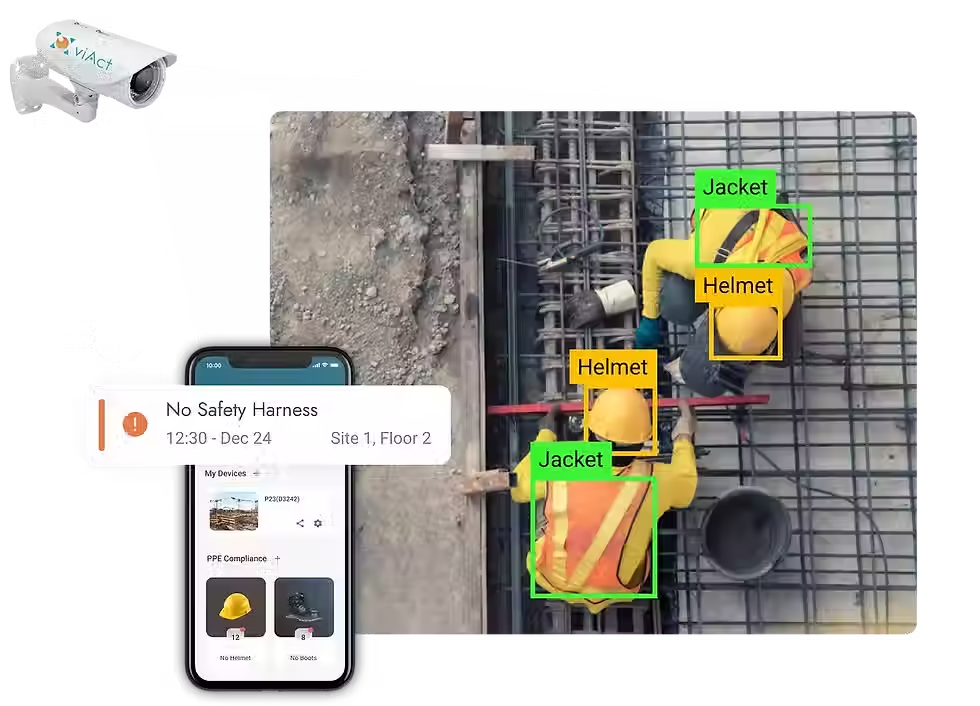
Computer vision automatically identifies missing helmets, vests, gloves, or harnesses across a site, flagging non-compliance the moment it happens rather than during a periodic walk-through. This remains the most widely deployed computer vision application in construction because it's directly measurable and tied to injury prevention.
The impact is already visible in live deployments. On a major healthcare construction project, Alliad deployed viAct computer vision system to continuously monitor PPE compliance across active work areas. Over the first three months of deployment, verified PPE non-compliance events decreased by 41.7% compared with the pre-deployment baseline. The system monitored predefined PPE requirements and recorded deviations with time-stamped visual evidence, allowing recurring non-compliance to be reviewed by location, activity and work period.
As Adam Lalani, Chief Technology Officer at Alliad, explained: “We're always looking for ways to apply technology that delivers real operational value. Through this pilot with viAct, we were able to explore how AI-driven monitoring can enhance visibility and support more proactive decision-making.”

Active lift zones, excavation areas, electrical rooms, and heavy machinery corridors carry outsized risk. Computer vision detects unauthorized entry into these zones in real time, distinguishing between a worker with legitimate reason to be there and a genuine boundary breach.

Falls remain the single most persistent cause of death in construction. Computer vision detects workers operating at height without harnesses, unsafe scaffold access, and edge proximity risk — catching the hazard before the fall, not after.

Blind-spot collisions between workers and excavators, dump trucks, or other heavy equipment are a persistent struck-by risk. Computer vision monitors worker-to-vehicle proximity continuously, flagging unsafe closeness before an operator's field of view would catch it.

Crane swing radius, suspended load movement, and worker proximity to lifting zones are difficult to track manually at the pace lifting operations move. Computer vision tracks load position and worker location together, flagging struck-by and load-related risk in real time.
6. Construction Site Surveillance and Remote Monitoring

Computer vision continuously analyses live construction camera feeds to detect unusual activity, changing site conditions, and events that require attention across multiple work zones. This allows project and safety teams to maintain real-time visibility across large or remote sites without relying on someone to manually watch every CCTV feed.
7. Construction Progress Tracking and Visual Documentation

Computer vision compares site imagery over time to track visible changes in completed work, installed components, and overall project progress. It creates a consistent visual record that can support remote progress reviews, contractor coordination, stakeholder reporting, and comparison between planned and actual site conditions.
8. AI-Assisted Visual Inspection and Defect Detection

Computer vision analyses images from fixed cameras, mobile devices, or drones to identify visible defects, anomalies, or changes that may require further inspection. It can help flag issues such as surface damage, missing components, façade anomalies, or deterioration, allowing engineers and inspectors to focus attention on areas that need closer review.
9. Material, Housekeeping and Site Logistics Monitoring
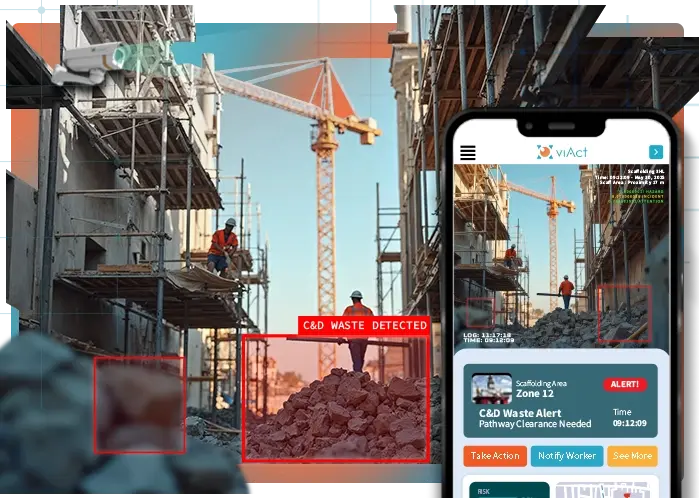
Computer vision detects obstructed walkways, poor material storage, waste accumulation, and objects left in active work or equipment routes. Beyond housekeeping compliance, recurring visual patterns can also reveal inefficient material flow, staging problems, and site logistics issues that affect both safety and productivity.
10. Incident Investigation and Near-Miss Analysis

Computer vision automatically organises visual evidence around incidents and near misses, making it easier to reconstruct event sequences and identify recurring risk patterns. By analysing where, when, and how similar events occur, construction teams can move beyond isolated incident reporting and use visual data to support faster root cause analysis and preventive action.
Computer Vision Applications Across the Construction Lifecycle
Computer vision is often described as a construction safety technology, but its applications span much more of the project lifecycle.
Construction stage | Computer vision applications | Primary value |
Pre-construction | Site surveying, perimeter observation, baseline visual documentation | Better site understanding and planning |
Site preparation | Excavation-zone monitoring, vehicle–worker proximity, access control | Safer movement of people and equipment |
Structural works | PPE detection, work-at-height monitoring, crane safety, scaffold monitoring | Real-time high-risk activity monitoring |
Envelope & façade | Drone inspection, elevated-area monitoring, visual progress documentation | Safer inspection and progress visibility |
MEP & fit-out | PPE compliance, housekeeping, restricted-area monitoring, progress tracking | Better control across dense work areas |
Finishing | Visual inspection, housekeeping, material monitoring, documentation | Improved close-out visibility |
Handover | Visual records, remote inspection, progress verification | Better documentation and stakeholder transparency |
Project-wide | Site surveillance, unsafe-behaviour detection, incident investigation, trend analysis | Continuous safety and operational intelligence |
The key point is that computer vision does not represent a single construction use case. The same visual infrastructure can support different applications as the project changes. A camera monitoring excavation-zone access during early works may later support PPE monitoring, housekeeping or area control when the surrounding construction activity changes.
Technologies Used for Computer Vision Applications in Construction
Computer vision is the intelligence layer, but effective construction monitoring usually involves several technologies working together.
Existing CCTV and IP Cameras
Modern computer vision platforms can often connect with existing IP camera infrastructure rather than requiring a completely new camera network. This makes CCTV one of the most practical starting points for construction computer vision.
Deep Learning and Object Detection
Deep-learning models allow computer vision systems to identify objects and behaviours within video. Depending on the model, the system may identify people, helmets, vehicles, machinery, materials, or predefined activities. Object tracking can then follow those detections across video frames, allowing the system to understand movement and interaction.
Edge AI
Construction sites do not always have stable high-bandwidth connectivity. Edge AI devices like viMAC processes video or sensor data closer to the site rather than sending every raw video stream to a remote cloud environment. This can provide several advantages, such as lower alert latency, reduced bandwidth requirements, greater resilience where connectivity is unstable and more control over how video data is processed and stored.
To learn more about how Edge AI works in a construction environment with its applications and benefits, read the full blog.
Drones
Drones like viAER extend visual intelligence beyond the field of view of fixed cameras. They can support large-area site surveys, façade inspection, roof inspection, scaffolding observation, progress documentation, elevated work-zone monitoring, and inspection of difficult-to-access locations. Computer vision can analyse the imagery captured during these flights to identify relevant conditions or changes.
LiDAR and Spatial Sensing
Computer vision works with pixels. Real-time spatial intelligence systems like viLID provide depth and spatial information. Combining the two can be useful when distance itself is critical to the safety decision. For example, LiDAR can support measurement or monitoring around excavation edges, heavy equipment, cranes, restricted zones and low-visibility environments.
IoT and Smart Wearables
Cameras cannot see everywhere. Confined spaces, underground work areas, temporary structures and moving workers may fall outside fixed-camera coverage. IoT sensors and wearables can supplement visual monitoring with information such as worker location, environmental conditions, gas exposure, fatigue indicators and movement data.
The newest layer is not another camera. It is the intelligence applied after detection is done in a centralised platform like viHUB. Construction sites can generate thousands of alerts and observations. EHS teams therefore need a way to distinguish isolated events from recurring patterns. AI agents like viGENT can help analyse structured safety data, retrieve relevant incidents, summarise trends and generate reports.
The architecture increasingly looks like:

How to Choose the Right Computer Vision Applications for a Construction Site
Choosing the right computer vision application starts with the site risk, not the technology. Contractors should focus on where better visual monitoring can lead to faster and more useful action.
Step 1: Identify the Highest-Risk Activities
Start with activities that create the greatest safety exposure, such as work at height, lifting operations, heavy equipment movement, excavation, or restricted-area access.
Step 2: Check Whether the Risk Can Be Visually Detected
Determine whether cameras can clearly identify the unsafe condition or behaviour. Missing PPE, zone intrusion, worker–vehicle proximity, and unsafe work at height are examples of visually detectable risks.
Step 3: Review Existing Camera Coverage
Assess whether existing CCTV or IP cameras already provide a clear view of the areas you want to monitor. Existing infrastructure can often be used for computer vision without installing an entirely new camera network.
Step 4: Identify Monitoring Blind Spots
Look for locations where fixed cameras cannot provide reliable visibility, such as temporary work zones, elevated structures, basements, or hard-to-reach areas. Drones, sensors, or other monitoring technologies can complement cameras where needed.
Step 5: Prioritize the Most Actionable Use Cases
Choose applications where detecting an event can lead to a clear response. An alert is most useful when the site team knows who should receive it, how quickly they should respond, and what action should follow.
Step 6: Start With a Few High-Impact Applications
Instead of deploying every available detection at once, begin with two or three use cases tied to the site's most important risks. This makes implementation, alert management, and performance measurement easier.
Step 7: Measure Results and Expand
Track whether the selected applications reduce repeated violations, improve response times, or reveal recurring risk patterns. Once they are working effectively, additional computer vision applications can be introduced as the project evolves.
Conclusion: Key Takeaways
Computer vision applications for construction turn everyday site imagery into continuous, actionable intelligence, helping teams detect risks, monitor operations, and understand changing site conditions without depending solely on periodic manual inspections.
The ten key applications extend beyond safety alone, covering site surveillance, worker protection, equipment interaction, progress tracking, visual inspection, material and logistics monitoring, and incident investigation.
Site surveillance, progress tracking, visual inspection, and material monitoring remain important construction applications, but they can now use a broader mix of existing CCTV, IP cameras, drones, and connected visual systems rather than depending on dedicated cameras.
Safety-focused applications address some of construction's highest-risk activities, including PPE non-compliance, restricted-zone intrusion, falls from height, worker–equipment interactions, and crane and hoisting operations.
Computer vision works best as part of a connected construction technology ecosystem. Cameras provide visual coverage, while drones, sensors, LiDAR, wearables, processing infrastructure, safety platforms, and AI analysis can extend visibility or add context where cameras alone are insufficient.
As construction sites become more complex, the value of computer vision will increasingly lie not simply in seeing more of the site, but in understanding what is happening while there is still time to act. Used effectively, it turns visual site data into a continuous source of safety and operational intelligence for better-informed construction decisions.

Quick FAQs
1. What are computer vision applications in construction?
They're AI-powered systems that analyze camera and sensor data on a construction site to detect safety risks, track progress, inspect quality, and monitor equipment and materials in real time.
2. Do computer vision applications require new cameras or hardware?
In most cases, no. Most platforms connect directly to cameras already installed on-site via RTSP. Edge AI devices, LiDAR, drones, and wearables are added separately, mainly to extend coverage into areas fixed cameras can't reach.
3. What is the most common computer vision application in construction?
PPE compliance detection is the most widely deployed application, since it's directly measurable, tied to injury prevention, and typically the fastest to show results after deployment.
4. What technologies work alongside computer vision on a construction site?
Edge AI for real-time on-site processing, LiDAR for 3D spatial monitoring, drones for elevated and hard-to-reach areas, wearables for coverage beyond camera range, and a centralized platform to unify detection from all sources.
5. How much can computer vision reduce construction incidents?
Real deployments in viAct across hundreds of construction sites have recorded up to a 50% reduction in Total Recordable Incident Rate and a 65% reduction in Lost Time Injuries.
Read More: