
5 Major Safety Issues in Oil & Gas Industry that viAct can Mitigate

Updated: Sep 24, 2025
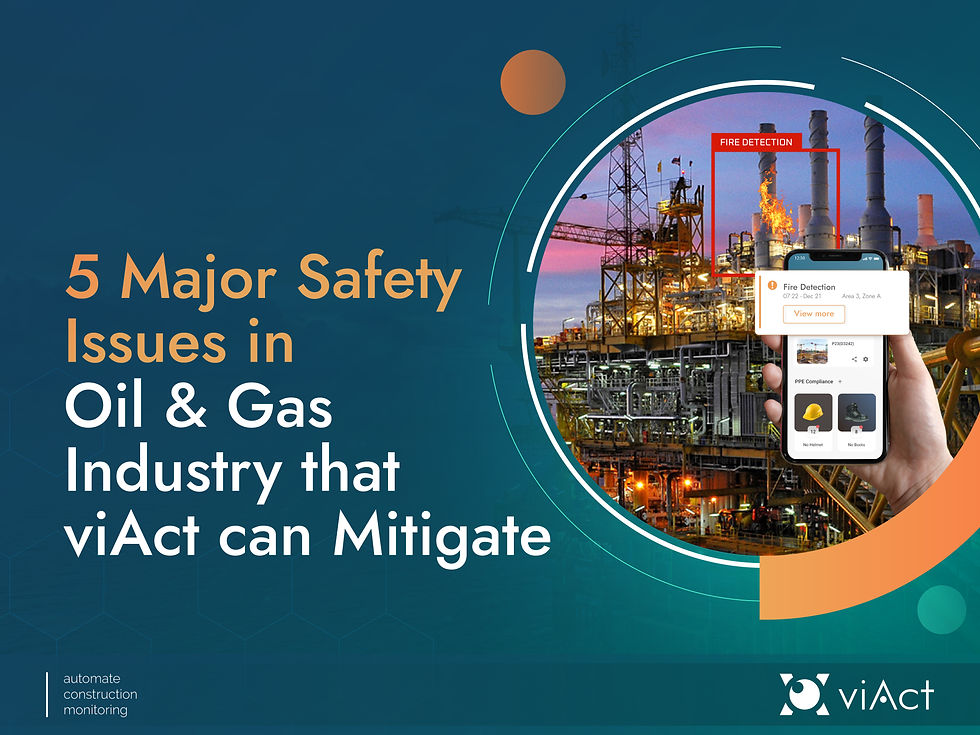
The value and importance of the oil & gas industry is not unknown to any of us. Despite its sheer importance, the processes of exploration, extraction, refining, and transportation of oil & gas – that constitutes the whole of Oil & Gas Industry – poses great risks to both men and materials. In order for the oil & gas companies to ensure safety in the jobsites and reduce the various risks to life, property and the wider environment; it is very crucial for them to follow strict and mandatory safety practice and undergo vigilant safety monitoring round-the clock that too without miss. In this regards, advanced technologies like AI for safety in oil & gas industry has been emerging as a potential solution.
This blog thus attempts at showcasing different safety issues prevailing in the oil & gas industry that viAct can mitigate by leveraging the power of advanced technologies like AI Video Analytics.
5 Major Safety Issues in Oil & Gas Industry
It is known to everyone that workers in the oil & gas industry are vulnerable to dangerous situations in their day-to-day working. Despite strict standards and safety training followed in the industry, many workers end up injuring themselves at work, sometimes injuries being so critical that they lead to their death as well.
The Occupational Safety & Health Administration (OSHA) mentions a number of safety issues prevailing in the Oil & Gas industry with Vehicle Collision, Confined Space Accidents, Fall from Height (FFH), Stuck-by/Caught-in/ Caught-between Machinery/Objects and Ergonomic Hazards; being the top in the list.

However, the list doesn’t end here! There are yet other safety issues like Fires & Explosions, Hazardous Gas Leak and Electrical/Mechanical/Hydraulic Danger Zone Intrusion.
How viAct can Mitigate Safety Issues in Oil & Gas Industry?
viAct’s Automated Monitoring System up-levels from reactive compliance to proactive incident prevention by leveraging the power of its scenario-based AI, thereby reducing risks to both men & materials. The smart AI navigation system offers the following video analytics solutions for the Oil & Gas industry to mitigate its various safety issues:
1. AI-powered Solutions for Vehicle Collision Prevention
According to the Census of Fatal Occupational Injuries (CFOI), workers’ fatality rate by vehicle collisions in oil & gas industry is 8.5 times more than that in all other industries, with pick-up trucks collisions being the most frequent cause of fatal injuries during oil & gas field works.
The AI powered machinery/vehicle monitoring leveraging the power of advanced “viMAC” can help reduce vehicle accidents in the oil & gas industry in the following ways:
On-site human-vehicle-object collision alerts
Real-time on road fleet management to prevent on-road collisions
Real-time vehicle tagging to track vehicles breaking down midways
Fleet management records for preventive maintenance of entire workflow
Operator Distraction Detection
Vehicle/Machinery Productivity Monitoring
2. AI-powered Solutions for Confined Space Work Safety
According to the Bureau of Labour Statistics, 42% of fatal injuries in oil & gas industry are during Confined Space Working, with the major causes of deaths in confined spaces being fire & explosions, asphyxiation and exposure to hazardous conditions.
World’s 1st Mobile AI Safety Monitoring Solution for Confined Space Work – viMOV – can ensure safety in confined spaces by levering the power of Scenario-based vision intelligence in the following ways:
Fire & Smoke Detection in oil storage tanks
PPE Detection while hydraulic fracturing
Extreme Temperature Alert in storages during maintenance task
Danger Zone Intrusion Alerts during drilling activities
3. AI-powered Solutions for Preventing Falling from Height
According to OSHA, falling from height is one of the most fatal scenarios, with 69 workers in U.S. dying due to falls alone, with the primary cause of deaths from falling from height in oil & gas industry being slips while climbing/switching the derrick ladder, swing falls, trips from greasy pipes, and free fall while moving in tight spaces at height.
The industry-leading vision technology offers exclusive AI for work at height safety monitoring solution, which helps prevent deadly accidents in the oil & gas industry caused by fall from heights in the following way:
PPE Detection while equipment maintenance at elevations
Life Safety Ropes Detection while climbing elevated areas
Workers’ Improper Behavior Alert
Detecting Tilting Motion of Climbing Platform
Improper Barrier/No Barrier Detection
4. AI-powered Solutions for Preventing Stuck-by/Caught-in/ Caught-between Machinery/Objects
According to OSHA, 3 out of 5 on-site fatalities in the oil & gas industry are due to struck-by/caught-in/caught-between hazards and the common sites for these hazards involve high pressure gas lines and electrical hazards zone.
The AI-enabled Solution can prevent struck-by/caught-in/caught-between accidents with the power of scenario-based AI and exclusive video analytics system to boost workers’ safety in the following ways:
Intrusion alerts for high-risk area like rotating systems or spinning chains
Real-time work monitoring of high-pressure line repairs
PPE Monitoring while hoisting, lifting & rigging of equipment
5. AI-powered Solutions for Detecting & Preventing Ergonomic Hazards
According to OSHA, ergonomics-related injuries can result in severe injuries developed over time and decreased workforce/labour productivity. However, these risk factors and the resulting injuries can be minimized and/or eliminated through technological interventions, in turn helping in pre-task planning, on-task surveillance by early recognition and reporting of risk factors.
The dynamic AI monitoring solution can leverage the power of video analytics for workplace safety and improving work efficiency in the following ways:
Confined Space Work Monitoring while working in noxious pits
Work at height monitoring to prevent dangerous work position at height
Worker real time monitoring while working in extreme temperature zones
Workers’ Training and Awareness using recoded data
Apart from these, viAct also has several other workplace safety solutions, like PPE Detection, Video Analytics Intrusion Detection, Fire & Smoke Detection, AI solution for Work at Height Safety, and lot more to mitigate other safety issues like Fires & Explosions, Hazardous Gas Leak and Electrical/Mechanical/Hydraulic Danger Zone Intrusion prevailing in the oil & gas industry.
Thus, through viAct’s Automated Monitoring System, the oil & gas industry can extract the following benefits:


Si estás pensando en descargar Film App, conviene revisar también la información sobre compatibilidad. El artículo explica diferentes métodos para dispositivos específicos y señala que el proceso puede cambiar según el equipo. Esta aclaración ayuda a evitar confusiones durante la instalación inicial.
I came across this article while looking for useful educational content, and I found it quite interesting. The author has done a good job of explaining the subject in a straightforward manner, making the information easy for students to follow. I especially liked the practical points because they provide a better understanding of the topic without making it feel complicated. I often explore academic blogs to learn something new and find resources that can support my studies. During one of these searches, I also discovered Assignment Help UK, which students may find useful when exploring additional academic guidance for their coursework. Overall, this was a valuable article with plenty of useful information. I appreciate the effort behind creating student-friendly content…
Para quienes siguen los resultados de Nueva York, disponer de información ordenada puede ahorrar tiempo. El Win 4 de hoy en la noche puede localizarse fácilmente cuando está identificado junto con su fecha. Revisar estos detalles permite comprobar las cifras con mayor precisión y mantener una consulta sencilla.
This was an informative and thoughtfully written post that explained the subject in a clear and easy-to-understand manner. I particularly liked the practical approach, which makes the information more useful for readers looking to learn beyond the basics. Health-related topics are especially valuable when presented in a simple and accessible way. While exploring reliable information about cancer care, I also came across the importance of choosing the best oncologist in vadodara. Content like this can help readers become more aware, informed, and confident when making important healthcare decisions.
A very informative and well-explained post! I really enjoyed how the author presented the topic in such a simple and practical manner. Content like this is especially valuable for students and young professionals who want to expand their knowledge and develop better decision-making skills. I believe financial awareness is equally important, as understanding savings, investments, and long-term financial planning can make a meaningful difference. For those looking to learn more about investment planning, a Financial Advisor in Vadodara can provide valuable guidance based on individual financial goals.