
How AI Video Analytics Improve Construction Safety and Productivity


“Quick AI-Powered Insights on the Topic— Freshly Updated!”
|
A crane operator hoists a load over an active walkway. Forty meters away, a worker steps toward an open edge to check a measurement, attention elsewhere. Neither event shows up in an incident report, because nothing happens.
But on a site without eyes on both spots at once, both are one missed second from becoming one.
This is the gap in AI video analytics construction that is built to close. It turns the cameras already mounted on-site into a live risk-detection system — reading PPE compliance, proximity, restricted-zone entry, and worker behavior in real time, and triggering an alert before a near-miss becomes a recordable incident.
The category has grown accordingly. As per Grand View Research, global video analytics is projected to reach a $37.84 billion market by 2030, and construction is one of the sectors adopting it fastest, largely because the risk profile justifies it.
The U.S. Bureau of Labor Statistics recorded 173,200 non-fatal work injuries and illnesses in construction in a single year, and falls, slips, and trips alone accounted for over 46% of fatal accidents in the industry in 2021.
Those aren't abstract numbers to a site EHS team; they're the reason real-time detection has moved from "nice to have" to standard practice on well-run sites.
Now, the short answer to how it improves safety and productivity is that it replaces after-the-fact footage review with instant, automated detection, cutting reaction time from hours to seconds while giving site managers the operational data to fix bottlenecks, not just accidents.
The rest of this blog breaks down how the technology works, what it delivers on both fronts, and how to evaluate a solution for your own sites.
What is AI Video Analytics in Construction?
AI video analytics is the use of computer vision and machine learning to interpret live video feeds from different sources such as CCTVs, drones, IoT devices or sensors and extract meaningful information from them automatically — detecting objects, classifying what they're doing, and tracking their movement over time.
On a construction site, that means the system can tell the difference between a worker walking past scaffolding and a worker climbing it without a harness, and can flag the second case in real time.
This is a meaningful departure from traditional CCTV. A standard camera system records; a human has to watch it, either live or after the fact, to catch anything useful. AI video analytics processes the same feed continuously and automatically, converting it from a passive recording tool into an active monitoring layer that never blinks, never gets fatigued on a night shift, and never misses a blind-spot check because it was reviewing paperwork instead.
How AI Video Analytics Works on Construction Sites
The underlying process runs on three core functions:
Detection — identifying objects of interest in a video frame: a person, a vehicle, a piece of equipment, a harness (or the absence of one).
Classification — determining what that object is doing: standing under a suspended load, entering a restricted zone, working without a hard hat.
Tracking — following that object's movement across frames to understand patterns, like how close a worker is drifting toward an open edge or a moving forklift.
In practice, deployment is simpler than the underlying AI suggests. Most modern platforms connect directly to existing IP cameras or NVR/VMS systems via RTSP, so there's no need to rip out and replace CCTV infrastructure.
Once connected, the AI models run either in the cloud, on-premise, or at the edge — with edge processing (via on-site hardware) becoming the preferred option for sites with limited connectivity, since it keeps latency low and doesn't depend on a stable internet link to catch a risk in the moment an alert is triggered, it's routed to the right person by dashboard, SMS, WhatsApp, or on-site speaker, tagged with a timestamp and visual snapshot for the audit trail.
For sites with blind spots outside camera range — confined spaces, remote zones, workers on the move — edge AI wearables and mobile units extend the same detection logic beyond what a fixed lens can see, closing the gap cameras alone can't cover.
Here’s the system architecture underlying a Construction AI Safety Solution.

Safety Benefits of AI Video Analytics in Construction
These are the outcomes site teams actually feel once real-time detection is running — not just what the system does, but what changes for the people on the ground.
Faster Response to Safety Risks
The biggest shift is speed. What used to mean a supervisor spotting a problem on a walk-through, or catching it days later in footage review, now happens the moment it occurs: a missing helmet, a worker drifting into a hazardous zone, an unsafe crowding pattern. Reaction time drops from 3 hours to 3 seconds, and because alerts can be tuned by zone or severity, the right person hears about the right risk instead of getting buried in notifications.
Fewer Falls and Height-Related Injuries
Falls, slips, and trips are still the leading cause of death on construction sites, so this is where the safety case is strongest. Workers get a warning the moment they drift too close to an open edge, an unguarded ledge, or an unsafe point of scaffold access — early enough for someone to step back before it becomes a fall, not just a report afterwards.
Protection from Falling and Suspended Loads
Struck-by incidents from falling objects are one of OSHA's "Fatal Four" construction hazards. When a worker moves under a suspended load or into a crane's swing radius, the system catches it and triggers an alert to clear the area — closing a gap that's historically depended on someone happening to notice in time.
Reduced Worker-Vehicle Collisions
Heavy equipment and moving vehicles are a constant risk in busy site zones. Continuous proximity monitoring between workers and vehicles catches unsafe distances the moment they form, rather than after a near-miss is reported after the fact — cutting the seconds between a risk forming and someone being warned about it, which is often the only difference between a close call and a collision.
Tighter Control Over Restricted and High-Risk Areas
Keeping unauthorized workers out of active lift zones, electrical rooms, or concrete pours has traditionally meant posting someone at the entrance. Now every entry into a controlled zone is tracked automatically, with an immediate response triggered on a breach — freeing up the person who used to be doing that job manually.
Measurable Drop in Serious Injuries and Fatalities (SIFs) Over Time
The real payoff shows up in the numbers a safety team reports up the chain. As detection stays consistent shift after shift, incident metrics like TRIR and LTI move down and stay down — not a short-term dip. Across 400+ construction sites, viAct's own deployment data shows a 50% reduction in TRIR and a 65% reduction in LTI, covering more than 32,000 protected workers.
Simpler, More Defensible Audits
Every flagged event — a violation, a near-miss, a corrective action taken — is captured automatically with a timestamp and visual proof, rather than relying on someone to write it down before it's forgotten. viGent, the Agentic AI layer over the platform, helps draft concise summaries of incidents that can be forwarded to supervisors for instant decision-making. That turns ISO, OSHA, or internal safety reviews into a matter of pulling a report instead of reconstructing what happened from memory and incomplete logs.
None of this comes at the cost of speed or output — in fact, the same system driving these safety gains tends to improve productivity at the same time.
Productivity Benefits of AI Video Analytics in Construction
The same AI detection layer that prevents incidents also generates operational data that helps teams work faster and coordinate better.
Fewer Manual Inspections
Automated detection reduces how often EHS managers need to physically walk a site to catch what a camera can already flag remotely. Field visits become targeted instead of routine, cutting inspection time without reducing safety coverage.
Centralized Multi-Site Monitoring
With a single dashboard, viHUB can track safety scores — TRIR, DART, LTIs, near-misses — across 20 or more sites at once. A regional manager overseeing multiple projects across a country or region no longer needs a separate system, or a separate trip, for each one.
Fast Deployment on Existing Infrastructure
Because most AI platforms plug into cameras already installed, there's no lengthy hardware rollout. Sites can move from install to live surveillance in a fraction of the time a full camera replacement would take, a timeline that matters when teams are juggling deadlines across multiple sites and geographies.
Better Coordination in High-Traffic Zones
AI-driven proximity alerts around crane decks, forklift paths, and shared lanes between subcontractors reduce delays and near-misses during peak activity, keeping equipment and people moving without the informal radio-relay coordination many sites still rely on.
Workforce Heat Maps and Resource Optimization
Beyond incident prevention, video analytics generates data on worker movement, idle zones, and material bottlenecks. Managers can use that to adjust work schedules, re-route material delivery, and reduce delays — directly relevant given that improving construction labor productivity has the potential to add over $1.6 trillion in value to the sector annually, as per McKinsey & Company.
Predictive Scheduling and Risk Modelling
With a few months of accumulated data, AI systems can flag patterns — like a spike in fatigue-related incidents on night shifts and inform proactive schedule or zone adjustments. Rather than reacting to an incident after it happens, teams can use these trends to plan shifts, staffing, and zone assignments around the conditions most likely to produce risk.
Faster ROI on Safety Investment
Reduced downtime, fewer compliance fines, and streamlined inspections mean many teams recover their initial investment within a single project cycle — turning safety spend into a measurable operational return rather than a fixed cost.
Together, these safety and productivity gains show up in a wide range of deployment scenarios — the section below breaks down where each one applies on an active site.
AI Video Analytics Safety and Productivity Use Cases Across Construction Projects
Real deployments show the range of what a single platform can cover across a site — each use case runs off the same core detection engine, applied to a different risk category.
Here are the top use cases that facilitate safety and productivity benefits across construction projects.

The AI system continuously scans for missing helmets, vests, gloves, or harnesses across multi-contractor crews, a persistent challenge on sites where different subcontractors bring different safety cultures and enforcement habits. On the safety side, every worker in camera range is checked on every frame instead of during occasional spot checks; on the productivity side, that removes the need for a supervisor to physically walk the site for compliance rounds, freeing that time for higher-value work.

Given that falls remain the single largest cause of construction fatalities, this is often the first module sites deploy. It flags unsafe positioning near ledges, roof edges, or incomplete guardrails in real time, cutting fall risk before it becomes an incident — and because the alert goes straight to the worker or supervisor, it avoids the schedule disruption and investigation time a fall report would otherwise trigger.
In fact, a Singapore Construction Giant deploying AI video analytics prevented more than 150 near misses from open edge in a single year, leading to a 76% reduction overall and recorded zero fall from height incidents.

An AI-powered platform tracks swing radius, suspended load movement, hook alignment, and worker proximity to active lifting zones, the exact conditions behind struck-by incidents involving lifted loads. Beyond preventing those incidents, continuous lift-zone visibility lets crews run lifts with more confidence and fewer precautionary pauses than manual spotting requires, keeping lift schedules, often the tightest bottleneck on a site, closer to plan.

Blind-spot risk between workers and excavators, dump trucks, or forklifts is monitored continuously, with alerts issued within seconds of an unsafe proximity event. The safety upside is fewer struck-by incidents; the productivity upside is fewer stop-start delays across the site, since near-misses and manual spotting routines are what typically bring vehicle movement to a halt.
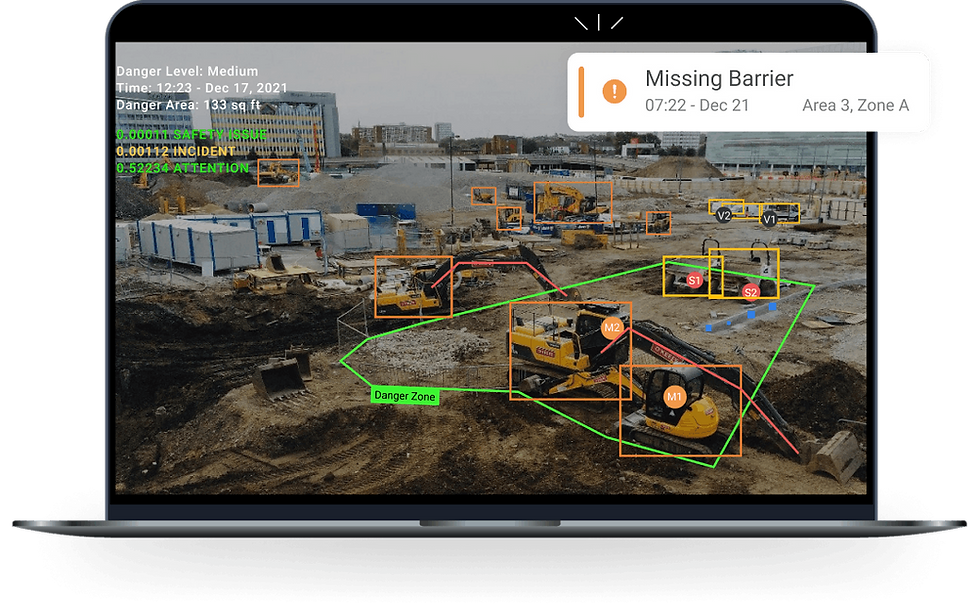
Electrical rooms, active pours, and other high-risk areas need controlled access, and video analytics tracks every entry against that access list automatically. That cuts unauthorized-access incidents in high-risk zones, and it also removes the need to staff a physical guard at every controlled entry point, redeploying that headcount to work that actually moves the project forward.

The AI system identifies unsafe climbing behavior, overloading risk, and early signs of structural instability in temporary work platforms, hazards that are easy to miss during a routine walk-through but show up clearly in continuous video analysis over time. Catching them early prevents both the safety incident and the costlier fix and schedule delay that come from addressing structural issues after the fact.

Beyond static hazards, the system can flag behavioral risk indicators, for example fatigue signs during long or night shifts, unsafe postures, or erratic movement patterns. On the safety side, this catches risk before it turns into an incident; on the productivity side, it feeds directly into the kind of predictive scheduling covered above, so shift and staffing decisions are based on real patterns instead of guesswork.

Blocked pathways, clutter, spills, and improper material storage are flagged before they escalate into trip hazards or access issues. Keeping the site clear reduces injury risk, and it also keeps material movement and crew access unobstructed — without adding a manual housekeeping audit to someone's daily checklist.
On sites in high-heat regions, video analytics can be paired with environmental sensors and IoT-enabled smart watches to flag workforce exposure risk before symptoms escalate, shifting heat safety from a reactive response to something teams can act on earlier in the shift.
A Saudi-based construction firm employing more than 15,000 employees, after applying the viAct AI module across its site, reported a 63% reduction in on-site medical emergencies while preventing 4,800 lost work hours — a case that shows heat monitoring paying off on both the safety side (fewer emergencies) and the productivity side (fewer hours lost to preventable incidents).
Table 1: Traditional Site Monitoring vs AI Video Analytics in Construction: A Comparative Summary
With the benefits and use cases laid out, it's worth putting the two approaches side by side directly in the table below.
Factor | Traditional CCTV / Manual Monitoring | AI Video Analytics |
Detection speed | Reviewed after the fact, or only if someone is watching live | Real-time, automatic, 24/7 |
Coverage | Limited by how many screens a person can watch at once | Every connected camera, continuously |
Consistency | Varies with fatigue, shift changes, attention | Consistent detection accuracy regardless of time or shift |
Multi-site visibility | Separate systems or manual reporting per site | Centralized dashboard across all sites |
Compliance documentation | Manual logs, often incomplete | Automatic, timestamped, audit-ready |
Response time | Minutes to hours | Seconds |
Setup | New hardware often required | Plugs into existing CCTV via RTSP |
Value over time | Static — same capability year one and year three | Improves with data — predictive risk modeling develops over months |
Choosing the Right AI Video Analytics Solution for Your Construction Site
Not every platform is built the same way, and the differences matter once you're comparing vendors rather than the concept in general. A few questions worth asking before committing:
Does it work with your existing cameras? A solution requiring full CCTV replacement adds cost and timeline that plug-and-play, RTSP-based platforms avoid.
Can it run at the edge, not just the cloud? Sites with limited or unreliable connectivity need on-site processing to keep detection real-time rather than dependent on bandwidth.
How many use cases does it actually cover? A platform limited to one or two detection types (say, PPE only) will need to be supplemented later. Broader module libraries — spanning PPE, proximity, zone control, housekeeping, and more — reduce that need.
What's the false-positive rate? Alert fatigue from inaccurate detections undermines adoption fast. Ask vendors for accuracy benchmarks, not just feature lists.
Does it scale across multiple sites from one dashboard? Centralized visibility matters more as a portfolio grows past a single project.
Is compliance and audit documentation built in, or bolted on? Automatic, timestamped logging should be a core function, not an add-on.
How fast is real deployment, not just the sales pitch? Ask for deployment timelines from existing customers in your region and site types.
Conclusion: Key Takeaways
AI video analytics uses computer vision to detect, classify, and track events on video feeds in real time — unlike traditional CCTV, which only records for later review.
Falls, slips, and trips account for over 46% of construction fatalities, making real-time open-edge and fall detection one of the highest-impact use cases.
Most platforms integrate with existing CCTV via RTSP, meaning deployment can go live in as little as a week without new hardware.
The same system driving safety gains also generates workforce heat maps and bottleneck data that support the estimated $1.6 trillion productivity opportunity in the construction sector.
Centralized dashboards allow one team to monitor 20+ sites simultaneously, turning multi-site oversight into a single view instead of a per-site chore.
When evaluating a solution, prioritize existing-camera compatibility, edge processing, use-case breadth, and built-in audit documentation over feature lists alone.
The construction sites seeing the strongest results in 2026 treat it as infrastructure, not an add-on: connected to existing cameras, covering multiple risk types at once, and feeding one dashboard that safety and operations teams both actually use.

Quick FAQs
1. What is AI video analytics in construction?
AI video analytics in construction is the use of computer vision and machine learning to interpret live video feeds from site cameras automatically — detecting risks like PPE non-compliance, restricted-zone entry, or unsafe proximity to equipment in real time, rather than relying on someone to review footage after the fact.
2. How does AI video analytics improve construction safety?
It shortens the gap between a risk forming and someone acting on it. Instead of a supervisor spotting a hazard on a walk-through or reviewing footage later, the system flags it — a missing harness, an open-edge risk, an unauthorized zone entry — the moment it happens, and routes an alert to the right person immediately.
3. Can AI video analytics work with existing CCTV cameras?
Yes. Most platforms connect to existing IP cameras or NVR/VMS systems via RTSP, so sites don't need to replace their camera infrastructure to get started. New hardware is only needed for areas outside existing camera coverage, such as confined spaces or remote zones.
4. How long does it take to deploy AI video analytics on a construction site?
Deployment speed depends on site complexity, but plug-and-play integration with existing cameras means it's typically fast. A single site running on existing CCTV can go live in a matter of days to a couple of weeks; larger, multi-zone or multi-site rollouts generally take several weeks, phased by zone.
5. Does AI video analytics also improve productivity, not just safety?
Yes. The same detection layer that flags safety risks also generates operational data — worker movement patterns, idle zones, material bottlenecks — that managers use to adjust schedules, reduce inspection time, and coordinate high-traffic areas more efficiently.
Read More:
Scaffolding Safety in Hong Kong: CIC and OSHC Leading the Path
Top 5 Video Analytics Use Cases in Hong Kong Construction Industry

Cuando una página presenta la información de manera sencilla, la consulta resulta mucho más cómoda. Anguila 8 es una búsqueda concreta que puede realizarse rápidamente. Tener los datos reunidos ayuda a localizar lo importante y permite revisar la información con mayor tranquilidad, especialmente cuando se consulta con frecuencia.
Great, informative read! This article does a fantastic job explaining how AI video analytics transforms construction sites — not only preventing serious safety incidents but also unlocking measurable operational productivity. The case data and side‑by‑side comparison table make complex technical concepts easy to understand for site leaders. Really useful content for the construction industry! --Multiples
Lottery enthusiasts often look for current draw information in one convenient place. Well-structured pages make it easier to check numbers, review previous outcomes, and follow daily updates, especially when searching for quiniela real results online.
Sprunki Phase 3 is one of the most popular fan-made rhythm games inspired by the legendary music game Incredibox. Combining creepy horror elements, creative sound mixing, and interactive gameplay, sprunki phase 3 delivers a unique musical experience that keeps players entertained for hours.
Really nice article with useful ideas for anyone who enjoys online entertainment. I like games that are easy to understand but still give you something interesting to do. If that sounds good, explore cps game options. They offer fun gameplay, simple challenges, and an enjoyable browser experience for casual players.