
Edge AI vs Cloud AI for Industrial Safety: Which Architecture Is Right for Your Site?


“Quick AI-Powered Insights on the Topic— Freshly Updated!”
|
If your site loses connectivity for even a few minutes, does your safety monitoring stop working too?
For most industrial teams still running cloud-only AI, the answer is yes — and that gap costs more time than it looks like on paper. According to the U.S. Bureau of Labor Statistics most recent Census of Fatal Occupational Injuries, a worker died from a work-related injury every 104 minutes in 2024.
That's the real question behind Edge AI vs Cloud AI: when a hazard develops in seconds, does your detection system respond in seconds too, or does it wait on a network round-trip first?
The short answer: Edge AI for industrial safety wins when a hazard has to be caught in the moment it happens, on-site, regardless of signal. Cloud AI wins when you need to see patterns across many sites at once.
This guide compares both architectures from an industrial safety perspective, explains where each performs best, and explores why many organisations are moving towards hybrid AI deployments that combine the strengths of both.
What is Edge AI and How Does it Work in Industrial Safety?
Edge AI refers to artificial intelligence that performs inference directly on the device where data is collected rather than transmitting it to a remote server for processing. Cameras, sensors, or dedicated AI devices equipped with GPUs, NPUs, or specialised processors analyse information locally and make decisions in real time.
That local-first design is what makes edge AI for industrial safety the right fit for monitoring, predictive maintenance, and machine vision on industrial sites — the response doesn't wait on a network connection, and raw footage doesn't need to leave the site just to get evaluated. When a hazard must be caught in milliseconds rather than seconds, this is the architecture that delivers.
What is Cloud AI and What Does it Offer Industrial Safety Teams?
Cloud AI for industrial safety is the opposite setup: data travels to centralized, off-site infrastructure where it is processed, stored, and analyzed at scale. Instead of one device handling one location, cloud AI can pull together data from every connected site a company runs.
That scale is exactly its strength — training and refining models, running analytics across a whole portfolio of facilities, and giving safety leadership one unified view instead of dozens of disconnected local ones. It trades response speed for breadth, which makes it the stronger fit for organization-wide visibility rather than the split-second call a single hazard demands.
Table 1: Edge AI vs Cloud AI: Head-to-Head Comparison for Industrial Safety
Table 1 below breaks down how Edge AI and Cloud AI compare across the factors that matter for an industrial safety deployment, and where each delivers the most value.
Factor | Edge AI | Cloud AI |
Latency | Milliseconds — processed on-device | Seconds to minutes — depends on network round-trip |
Connectivity dependency | None required for detection to run | Requires stable connectivity to sync and analyze |
Best for | Real-time hazard detection, immediate alerts | Cross-site trend analysis, fleet-wide reporting |
Data handling | Processed locally; only alerts/events need to sync | Aggregates data from every connected site |
Typical safety use case | Red zone breach, confined space monitoring | Multi-site incident trend analysis, compliance reporting |
Scalability | Deployed per site/device | Centrally managed across unlimited sites |
Resilience in low connectivity | Fully operational offline | Degraded or unavailable without signal |
Why Industrial Safety Teams Are Rethinking Cloud-First Monitoring
Cloud-based monitoring has earned its place in industrial safety programs for good reason. It's where dashboards live, where incident history gets analyzed over months and years, and where a safety team can compare performance across every site a company runs instead of relying on one manager's notes from one facility.
None of that goes away, and none of it should — it's the layer that turns individual incidents into organizational learning.
What cloud-first monitoring alone can't do is answer for the seconds between a hazard forming and a hazard becoming an incident. A cloud round-trip, even a fast one, still involves sending data out and waiting for a response — and for a worker stepping into a rig floor red zone or a crane swinging over an occupied area, that round-trip is often the exact window where the outcome gets decided.
The scale of the underlying problem is why closing that gap matters. The International Labour Organization estimates roughly 2.93 million work-related deaths occur globally each year, alongside hundreds of millions of non-fatal occupational injuries. In the U.S. alone, manufacturing carries a Total Recordable Incident Rate (TRIR) of around 3.4, as per BLS and construction fatalities remain concentrated in OSHA's "Fatal Four" (falls, struck-by, caught-in/between, and electrocutions), which account for close to 59% of all construction worker deaths.
These are exactly the categories of incident where a faster local response, feeding into a system that keeps learning centrally through a platform like viHUB, outperforms either layer working alone.
Bandwidth economics reinforce the same point rather than a competing one. High-resolution safety cameras generate far more data than most industrial networks can continuously stream to the cloud without cost or lag — which is why edge processing (analyzing on-device, syncing only what matters to the cloud) has become the practical way to keep cloud-side analytics fed with meaningful data instead of overwhelmed by raw footage.
When Edge AI Is the Right Choice in Industrial Safety
Edge AI for industrial safety is the right call when a workload meets any of the following:
Hazards Require Immediate Intervention – Industrial hazards often develop within seconds. Whether it's a worker entering a crane lift zone, a forklift approaching a pedestrian, or personnel entering a rig-floor red zone, delayed alerts increase risk. Processing data locally in a fixed vehicle-mounted edge device like viMAC enables the system to detect hazards and notify operators in real time, allowing intervention before an unsafe condition escalates into an incident.
Connectivity Cannot Be Guaranteed - Many industrial environments, including offshore platforms, underground mines, remote construction sites, and confined spaces, operate with unreliable connectivity. Edge AI mobile devices like viMOV perform inference locally; safety monitoring continues regardless of connectivity.

Bandwidth is Limited - Continuous video streaming is expensive and bandwidth-intensive. Edge AI analyses footage locally and transmits only relevant alerts, event clips, and metadata, reducing network usage while ensuring critical safety information is retained.
Data Privacy and Sovereignty Matter - Many organisations must comply with strict data governance requirements. By processing information on-site, edge AI works on privacy-first processing for EHS data and keeps sensitive operational footage within the facility while sharing only essential events for centralised reporting, improving both cybersecurity and regulatory compliance.
How Different Industries Benefit from Edge AI and Cloud AI
Although the architectural principles remain the same, the operational challenges vary considerably between industries. Understanding those differences helps explain why AI deployments are rarely identical across sectors.

Construction sites change constantly. Temporary infrastructure, evolving site layouts, moving equipment, and inconsistent connectivity create an environment where hazards develop quickly, and operating conditions change daily.
Edge AI supports applications such as:
Crane anti-collision monitoring
Equipment blind-spot detection
Restricted-area monitoring
Worker-down detection
Because these decisions occur directly on-site, supervisors receive alerts immediately without depending on site-wide connectivity.
Cloud AI complements this by providing:
Project-wide safety reporting
Contractor performance benchmarking
Compliance documentation
Trend analysis across multiple projects
A major Singapore construction contractor deploying AI-powered safety monitoring achieved a 10× improvement in overall safety scores while recovering more than 7,000 productive work hours through fewer operational interruptions—demonstrating the value of combining real-time intervention with long-term operational analysis.

Mining presents perhaps the strongest argument for Edge AI. Underground operations frequently experience little or no network connectivity, making continuous cloud processing impractical.
Edge AI enables:
Vehicle proximity monitoring
Dynamic exclusion zones
Worker localisation
Gas detection
Tunnel hazard monitoring
Cloud platforms remain valuable for analysing production trends, maintenance performance, and organisation-wide safety metrics once operational data is synchronised.
A Chilean mining operation deploying AI-assisted dynamic safety zoning reduced proximity risks by 70%, lowered restricted-area intrusions by 65%, and improved incident response times by 55%.
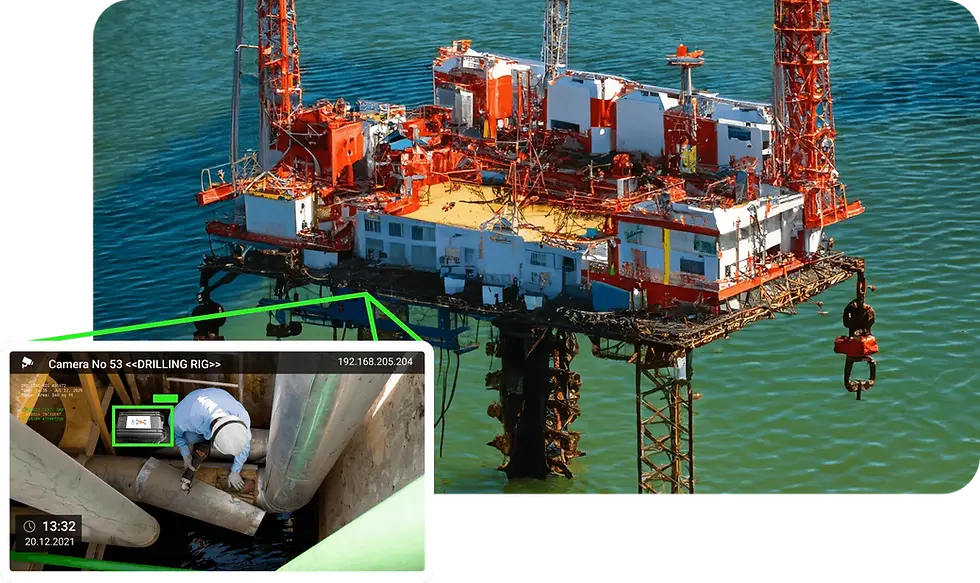
Few industries combine high operational risk with connectivity constraints as frequently as offshore oil and gas. Rig floors, drillships, FPSOs, and offshore production platforms require continuous monitoring despite satellite latency and changing weather conditions.
Edge AI supports:
Red-zone monitoring
Fire and smoke monitoring
Confined-space supervision
Cloud AI enables operators to consolidate operational intelligence across multiple offshore assets, supporting incident investigations, regulatory reporting, and enterprise-wide safety governance.
One offshore operator in Abu Dhabi reduced red-zone violations by more than 80% while increasing operational productivity by 50% through fewer incident-related interruptions.

Manufacturing environments prioritise consistency, speed, and repeatability. Production lines operate continuously, meaning hazards and quality deviations often emerge with little warning.
Edge AI enables:
Machine hazard detection
Forklift-pedestrian collision prevention
Worker safety around automated equipment
Fire and smoke detection
Cloud AI provides longer-term visibility by identifying recurring operational trends across multiple production facilities, helping manufacturers optimise safety performance, investigate recurring incidents, and improve standard operating procedures.
During a facility relocation, a Dubai power generation equipment manufacturer deployed AI-assisted safety monitoring, reducing forklift-related incidents by 65%, while maintaining operational continuity throughout the transition.

Unlike other industries, logistics derives much of its value from understanding patterns across distributed facilities rather than focusing solely on one location.
Edge AI detects hazards such as:
Crane lift-zone intrusions
Forklift collisions
Cargo reversing in loading/unloading areas
However, cloud AI in this industry delivers the greater operational advantage by correlating incidents across facilities, identifying recurring safety risks, benchmarking site performance, and uncovering systemic inefficiencies. This organisation-wide visibility enables logistics operators to standardise safety practices, optimise resource allocation, and continuously improve operations across the entire supply chain.
For many organisations, the decision is rarely an either-or choice. High-risk operational workloads benefit from local inference, while enterprise management, reporting, and continuous improvement are most effective when supported by cloud-based platforms.
As industrial AI deployments mature, organisations are increasingly assigning workloads based on operational requirements rather than processing everything in a single environment.
Why Leading Industrial Operators Are Adopting Hybrid AI Architectures
The discussion around Edge AI versus Cloud AI often assumes organisations must choose one architecture over the other.
In practice, the opposite is happening.
Across construction, manufacturing, mining, logistics, and energy, organisations are increasingly distributing AI workloads according to operational requirements rather than processing everything in one location.
This reflects a broader architectural shift.
Instead of asking "Where can AI run?", industrial organisations are asking "Where should each decision be made?"
The answer usually follows a simple principle:
Immediate operational decisions belong at the edge.
Enterprise-wide intelligence belongs in the cloud.
This separation allows each architecture to perform the function it is best suited for.
The edge layer continuously analyses operational conditions, detects hazards, and initiates immediate interventions where latency cannot be tolerated. The cloud layer aggregates events from multiple facilities, identifies recurring patterns, supports investigations, improves AI models, and enables strategic decision-making across the organisation.
Building on this foundation, AI agents such as viGENT act as the intelligence layer that converts data into action. Rather than detecting hazards directly, agentic AI interprets insights from both Edge AI and Cloud AI to automatically summarise incidents, correlate related events, identify emerging risk patterns, and deliver context-aware recommendations.
It also streamlines communication by generating investigation summaries, sharing relevant information with supervisors and HSE teams, and helping coordinate corrective actions across multiple sites—reducing the time between hazard detection and operational decision-making.
Rather than duplicating capabilities, the two layers complement one another.

How to Choose the Right Architecture for Your Site
Selecting between Edge AI and Cloud AI is not simply a technology decision—it is an operational one. The right architecture depends on the nature of the workload, the environment in which it operates, and the consequences of delayed decision-making.
Rather than asking which architecture is better overall, industrial organisations should evaluate where each AI workload delivers the greatest value.
The following framework can help guide deployment decisions.

Conclusion: Key Takeaways
Choosing between Edge AI and Cloud AI is a workload-placement decision, not a competition, as each is built for a different job.
Edge AI devices (viMAC for vehicle anti-collision, viMOV for portable monitoring in confined and off-grid spaces) win whenever a hazard needs to be caught in the same moment it develops, especially where connectivity can't be guaranteed.
Cloud AI, through viHUB, wins when the goal is cross-site pattern detection and site-wide reporting that no single device could produce alone.
Mining and offshore oil & gas are the clearest cases where edge isn't optional; connectivity gaps there are frequent and, in mining's case, sometimes total.
Logistics is the one industry here where centralized intelligence carries more of the value, since the win is pattern-matching across many distributed sites rather than any single site's response speed.
As a result, most industrial operations end up running both layers together — not as a hedge, but because that's the architecture that actually matches how real sites operate.
Ultimately, the future of industrial safety does not belong to Edge AI or Cloud AI alone. It belongs to organisations that combine both architectures into a single, intelligent ecosystem capable of protecting workers today while continuously improving operations for tomorrow.

Quick FAQs
1. What is the difference between Edge AI and Cloud AI?
Edge AI processes data locally on devices located near cameras or sensors, enabling real-time decision-making with minimal latency. Cloud AI processes data in centralised infrastructure, making it better suited for enterprise analytics, reporting, and cross-site intelligence.
2. Can Edge AI work without an internet connection?
Yes. Edge AI performs data processing directly on-site, allowing safety monitoring to continue even during network outages. Events can be synchronised with cloud platforms once connectivity is restored.
3. Which industries benefit most from Edge AI?
Edge AI delivers significant benefits across construction, mining, oil & gas, logistics, and other high-risk industries where rapid hazard detection and operational continuity are critical.
4. Does Cloud AI still have a role in industrial safety?
Absolutely. Cloud AI supports functions such as enterprise-wide reporting, incident investigations, regulatory compliance, predictive analytics, AI model management, and identifying trends across multiple facilities.
5. Should industries choose Edge AI, Cloud AI or a hybrid architecture?
For most industrial operations, a hybrid architecture offers the greatest value. Edge AI enables immediate on-site hazard detection, while Cloud AI provides enterprise visibility, long-term analytics, and continuous optimisation. Combining both allows organisations to balance operational responsiveness with strategic decision-making.
Read More:


Slope 2 is a good example of how simple design can still create an engaging experience, much like the way Edge AI focuses on efficient decisions right where they are needed.
i like how checking important information can become part of a simple routine. sassa status check is useful when reviewing updates, while srd status check makes it easier to keep an eye on recent information.
I think a hybrid setup makes the most sense-Edge AI for instant on-site alerts and Cloud AI for long-term analysis across multiple spider solitaire free locations.
It's always nice when someone shares a useful website that doesn't make things complicated. I recently tried this cps test, and I liked how quickly I could get started. The whole process is simple, the results appear right away, and it works smoothly on my browser. I'll probably keep using it from time to time just to see how my clicking speed changes.