
Contractor Safety Management in Construction: How AI-Powered EHS Software Closes the Safety Gap


Express Overview🚀 Managing contractor safety on a busy construction site is one of the most complex EHS challenges a safety team faces. Contractors and subcontractors bring different safety cultures, follow different protocols, and move between sites and shifts, creating monitoring gaps that manual inspection cannot consistently close.
viAct AI-powered EHS software addresses these challenges across four key stages of contractor safety management in construction:
🚀 The result? 70% faster permits, 90% fewer safety violations, and 50% fewer incidents. Smarter safety starts here!
Let’s explore in detail! |
Contractor Safety Management in Construction: A Shared Responsibility
Construction is one of the highest-risk industries for contractor safety failures. According to the US Bureau of Labor Statistics, construction and extraction workers – sectors where the majority of on-site workers are contractors or subcontractors operating under multi-employer conditions – experienced 1,032 fatalities in 2024.
Construction sites are classified as "multiemployer" environments, meaning the host employer is responsible not only for their own workforce but also for ensuring Contractor Safety Management as per safety protocols.
However, contractors often operate outside the company’s established safety culture, increasing the risk of miscommunication, inconsistent training, and safety lapses.
Did you know, according to World Commerce and Contracting, poor contract management costs organisations an average of 9.2% of their annual revenue through missed deadlines, unfavourable renewals, and overlooked terms, a figure that is even higher in complex construction projects were contractor coordination failures compound across multiple subcontractors. |
Bridging the Gaps in Construction Contractor Safety Management with AI
Contractor safety reporting remains a major challenge due to limited supervision, fear of repercussions, unclear reporting processes, and lack of confidence in safety management. These gaps lead to underreported hazards and delayed safety interventions, increasing risks on worksites.
Take David, a contract scaffolder on a high-rise project in Hong Kong. When he spotted a loose plank, a major fall hazard, he hesitated to report it, fearing delays and unsure of the proper procedure. His team’s safety protocols also differed from the host company’s, adding to the confusion. By the time the issue was discovered during an inspection, workers had already been exposed to danger for days.

Now, imagine an AI-powered EHS Software handling contractor safety management in place.
Hazards are reported instantly through voice commands, real-time alerts prevent delays, and AI-driven analytics predict risks before they escalate. Standardized safety protocols eliminate confusion, while digital micro-training keeps contractors informed on site-specific hazards.
With AI-driven automation and real-time visibility, contractor safety reporting becomes proactive, efficient, and standardized, ensuring every hazard is addressed before it turns into an accident.
Let’s dig into the details!
AI-powered EHS software such as by viAct is transforming how companies manage contractor safety by automating safety processes, improving real-time monitoring, and maintaining the compliance trail that regulators require.
By integrating AI-driven tools at every stage of a contractor’s time on-site, organizations can significantly improve safety outcomes while streamlining operations.

The 4 Stages of Contractor Safety Management in Construction that EHS Software Can Enhance
AI-powered EHS software manages contractor safety across four critical stages: from the moment a contractor arrives on site through to the post-task compliance record that protects the organisation during regulatory inspections. Each stage addresses a specific gap that manual contractor safety management consistently fails to close on construction sites.
Here are the 4 key stages of Contractor Safety Management aided by AI-powered EHS software:
1. Contractor Onboarding and Safety Training
On large construction projects, contractor onboarding is one of the most time-sensitive and compliance-critical processes a safety team manages. A subcontractor crew arriving on a Monday morning needs to be verified, briefed on site-specific hazards, and cleared to work before they touch a single tool. When this process is manual, it relies on paper-based document checks, generic safety briefings, and supervisors who may or may not be available at the right time. The result is either a bottleneck that delays work or shortcuts that leave contractors on site without proper safety clearance.
AI-powered EHS software removes this bottleneck by automating the entire onboarding workflow. Before a contractor is cleared for site access, the system automatically verifies their certifications, trade licences, and safety induction records against site requirements. Expired documents are flagged immediately, preventing unqualified workers from entering safety-critical zones without the relevant clearances.
Site-specific safety training becomes more targeted and evidence-based through viAct AI monitoring data. The trends and patterns captured in the centralised dashboard, like, which zones generate the most PPE violations, which task types produce the highest near-miss frequency, which contractor crews show repeated behavioural deviations, give safety managers the specific evidence they need to direct training where it will have the most impact. Instead of generic induction briefings, training sessions can be built around what the data is actually showing on that specific site.
The system also automates document verification and compliance checks to ensure contractors meet safety requirements before beginning work, eliminating the manual paperwork burden that typically falls on site safety officers during busy morning mobilisation periods.
2. Understanding Contractor Task Risks with Job Hazard Analysis (JHA)
Once onboarded, contractors on construction sites move into some of the most hazardous task categories in any industry: work at height on scaffolding and tower cranes, confined space entry in tanks and pits, excavation work around live services, hot work in proximity to flammable materials, and others. Each of these task types carries a specific risk profile that a generic safety briefing cannot adequately cover.

AI-driven Job Hazard Analysis (JHA) software addresses this by generating task-specific hazard assessments automatically before work begins. When a contractor is assigned a confined space entry task, the system identifies the specific risks associated with that space based on its dimensions, ventilation status, gas monitoring history, and the contractor's previous experience with similar entries. It assigns risk levels based on severity and probability, and communicates these to both the contractor and the supervising safety officer before the permit is issued.
Critically, the system accommodates last-minute risk changes on construction sites. If ground conditions change before an excavation begins, if weather deteriorates before a work-at-height task, or if adjacent hot work creates a new ignition risk near a confined space, the AI-powered JHA can be updated in real time, flagging the changed risk level and triggering a revised safety brief before work proceeds. This is a capability that paper-based JHA processes simply cannot match on a dynamic construction site.
The result is that safety communication between contractors and safety officers becomes evidence-based rather than experience-based. Rather than relying on a supervisor's familiarity with a particular risk, every contractor receives the same structured hazard analysis for their specific task, consistently applied across every shift and every crew.
3. Dynamic Risk Assessment During Contractor Work Execution
Contractors on active construction sites face risks that change by the hour. A crane lift that was safe at 8am becomes dangerous when wind speed increases at 10am. An excavation that was stable in dry conditions becomes unstable after afternoon rain. Static risk assessment cannot capture these changes. What is needed is continuous monitoring that adapts to site conditions in real-time.

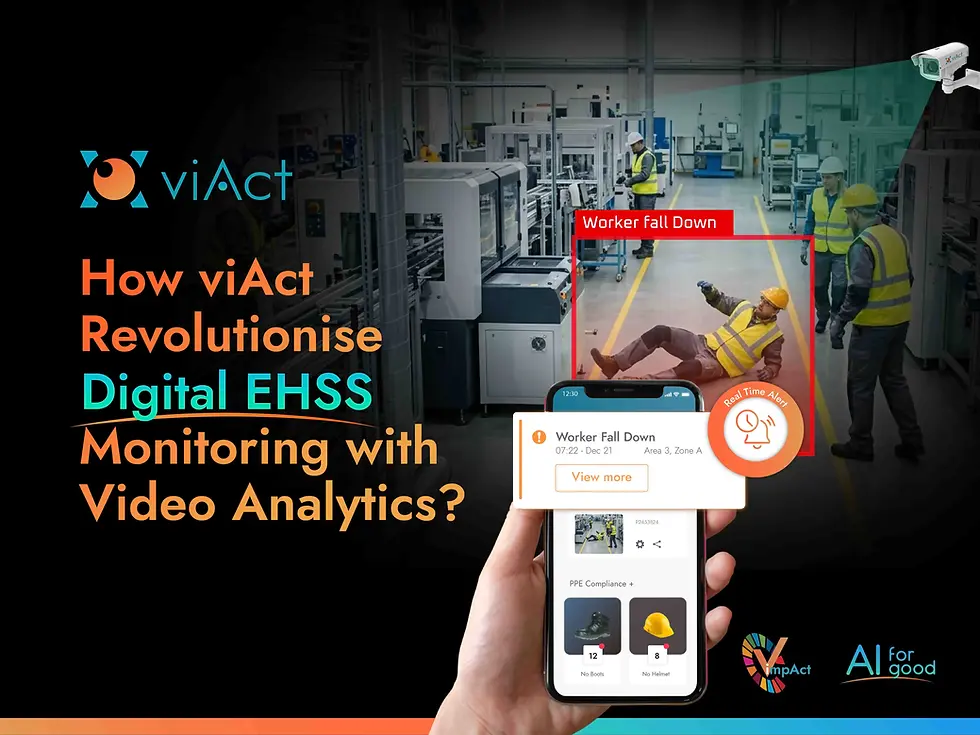
viAct AI-powered Dynamic Risk Assessment tools provide this by monitoring worker behaviour and site conditions simultaneously across every camera feed on site. The system uses computer vision to detect safety non-compliance the moment it occurs. When a deviation is detected, an instant alert is sent to the supervising safety officer, enabling intervention before the deviation becomes an incident.
The digital permit to work system connects directly to this real-time monitoring layer. When a contractor begins a high-risk task, the permit conditions are active in the system. If the AI detects that the work is proceeding outside those conditions, like wrong zone, wrong PPE, or wrong personnel, the system flags it immediately rather than waiting for the next manual inspection round.
Beyond individual incidents, the monitoring data accumulates into a pattern that manual supervision can never build. For example, which zones generate the most violations, which shift times see compliance drop, which contractor crews are consistently flagging alerts across weeks of data. This evidence gives construction safety managers the specific, site-based intelligence to intervene on systemic problems before the next incident.
Real World Case Study: Singapore Construction Giant Achieves 10× Safety Score Improvement with viAct
A top construction company in Singapore managing multiple high-rise and infrastructure projects with over 12,000 workers deployed viAct's multi-module AI-powered EHS platform across their sites.
The challenge they were facing included: inconsistent PPE compliance across contractor teams, recurring near misses around heavy machinery, and manual inspection gaps that left hazards undetected until near misses occurred. Hence, they deployed viAct at their site on existing CCTV infrastructure that gave EHS managers a real-time visibility across all sites simultaneously while also providing a live safety score dashboard.
Results:
10× improvement in safety score across multiple project sites
7,000+ working hours saved by shifting from reactive to proactive safety management
On-time project delivery with full MOM WSH compliance
Instant, audit-ready reporting replacing weeks of manual documentation
The Project Safety Manager said: "With viAct dashboards automatically updating our safety score, compliance with MOM inspections has become far smoother. What used to mean weeks of paperwork is now instant, audit-ready reporting. It also helped us avoid costly penalties by proving our safety measures in real time."
Read the full case study here: https://www.viact.ai/case-studies/singapore-construction-giant
4. Post-Task Evaluation and Compliance Forecasting
Every contractor task that completes on a construction site generates safety data: what was complied with, what was violated, how quickly deviations were corrected, and whether permit conditions were followed throughout. In a manual system, this data either goes unrecorded or ends up in reports that no one has time to analyse before the next crew begins work. The result is that the contractor makes the same safety errors across multiple visits because no one has connected the patterns.
viAct post-task evaluation system records safety performance data automatically for every contractor and every task completed on site. Each contractor builds a compliance score over time based on their PPE adherence, permit compliance, behaviour monitoring outcomes, and response to safety alerts. This score is visible to site safety managers and gives them an evidence-based basis for decisions like which contractors need targeted retraining, which subcontractors are consistently high-risk, and which task types generate the most compliance failures across the project.
Predictive risk forecasting uses this accumulated performance data to identify patterns before they cause incidents. If a particular subcontractor's crew consistently shows declining PPE compliance during Friday afternoon shifts, or if confined space entries on a specific floor generate repeated near-miss alerts, the system flags these patterns proactively. Safety managers can address the systemic condition before the next incident rather than after it.
For construction companies operating in Singapore, Hong Kong, and the GCC, the compliance documentation generated has direct regulatory value. As the Singapore Construction Giant case study demonstrates, what previously required weeks of manual paperwork preparation before a Ministry of Manpower inspection is now available instantly as an audit-ready record through viAct's centralised management platform. This is not just an administrative benefit. It is what enables construction companies to demonstrate the continuous safety management that regulators increasingly require rather than point-in-time compliance during inspections.
For a complete overview of how AI for EHS monitoring works across construction sites, including contractor-heavy environments, see: https://www.viact.ai/post/ai-for-ehs-monitoring-a-new-era-of-construction-safety
Conclusion and Key Takeaways
Contractor safety gaps on construction sites are rarely the result of negligence. They stem from structural problems, such as, inconsistent protocols across subcontractors, unclear reporting processes, and monitoring systems that cannot keep pace with active construction.
AI-powered EHS software closes this gap across all four stages of a contractor's time on a construction site. It verifies and trains contractors before they start, identifies the specific hazards of their task before they begin, monitors their behaviour and site conditions continuously during execution, and builds the compliance record that protects the organisation after they finish.
Key Takeaways
Contractor safety management in construction requires a system that works consistently across every subcontractor, every shift, and every zone simultaneously. Manual supervision cannot achieve this. AI-powered EHS software can.
AI automates the contractor clearance and onboarding process, ensuring no contractor enters a construction site without verified credentials and site-specific safety awareness, eliminating the gaps that paper-based induction processes leave.
AI-driven Job Hazard Analysis adapts to changing site conditions in real time, giving contractors and safety officers an updated risk picture before every high-risk task, not just at the start of the day.
Continuous AI monitoring converts weeks of site activity into patterns, revealing which zones, shifts, and contractor crews generate the highest risk concentration so safety resources are directed where they are needed most.
AI-generated compliance records give construction companies instant, audit-ready documentation for regulatory inspections, replacing weeks of manual preparation that traditional contractor safety management requires before every MOM or GCC safety audit.

Quick FAQs
1. How does AI-powered EHS software improve contractor safety management in construction?
AI-powered EHS software automates safety compliance, monitors contractor activities in real-time, and provides proactive risk alerts. Modules like Behavior Based Safety software and Job Hazard Analysis (JHA) software help identify unsafe actions and mitigate risks before incidents occur.
2. Why is Job Hazard Analysis software essential for contractor safety management?
JHA software automates hazard identification for contractor tasks, ensuring that risks are assessed before work begins. It enhances safety planning, reduces manual errors, and integrates with AI-driven monitoring systems for continuous risk assessment.
3. How does viAct’s AI-powered EHS software support real-time contractor safety monitoring in construction?
AI-powered EHS software continuously tracks contractor activities using computer vision and IoT sensors. It detects unsafe behaviors, enforces compliance, and integrates with Incident management software to provide instant alerts and corrective actions in workplace safety.
viAct is a leading Impact AI company focused on improving safety and efficiency in high-risk industries. Since 2016, we've implemented innovative “Scenario-based Vision Intelligence” solutions across hundreds of organizations. Recognized by Forbes and the World Economic Forum, we aim for a sustainable future through responsible technology.
Read More:


Khi truy cập vào live casino và game bài, mình thấy tốc độ phản hồi khá đều. Trong quá trình đọc thêm thông tin về kèo nhà cái mình nhận thấy hệ thống còn tích hợp thêm slot, esport và thể thao nên tạo cảm giác đầy đủ hơn. Các danh mục được phân chia rõ nên không mất nhiều thời gian làm quen. Cá nhân mình cảm thấy tổng thể được tổ chức khá hợp lý.
Lúc đầu mình chỉ định vào lướt qua thôi, không nghĩ sẽ tìm hiểu nhiều. Nhưng khi thử thao tác giữa slot và esport thì thấy tốc độ xử lý khá mượt, không có cảm giác bị gián đoạn. Các danh mục được sắp xếp rõ nên nhìn tổng thể khá gọn. Khi mình mở Nhà cái Cwin xem thêm thì thấy còn có slot, thể thao và mini game tích hợp chung khá thuận tiện. Theo mình, nếu duy trì được sự liền mạch này thì sân chơi sẽ tạo được sự ổn định khi sử dụng lâu.
Trong quá trình tham khảo một số website giải trí trực tuyến, mình tình cờ bắt gặp go8 qua một nội dung được chia sẻ trên mạng. Vì chưa biết nhiều về trang này nên mình truy cập thử, chủ yếu quan sát giao diện và cách sắp xếp các chuyên mục game bài, xóc đĩa, tài xỉu... Ấn tượng đầu tiên là phần trình bày khá đơn giản, từng khu vực được bố trí tương đối rõ nên khi lướt nhanh vẫn dễ nhận biết nội dung. Mình cũng thử chuyển qua vài mục khác nhau và thấy trang phản hồi khá nhanh, các thao tác cơ bản thực hiện tương đối thuận tiện. Nhìn chung trải nghiệm ban đầu…
Khi truy cập vào live casino và game bài, mình thấy tốc độ phản hồi khá đều. Trong quá trình đọc thêm thông tin về Sunwin mình nhận thấy hệ thống còn tích hợp thêm slot, esport và thể thao nên tạo cảm giác đầy đủ hơn. Các danh mục được phân chia rõ nên không mất nhiều thời gian làm quen. Cá nhân mình cảm thấy tổng thể được tổ chức khá hợp lý.
Sunwin mình có thử truy cập vào trang này sau khi thấy nó được nhắc đến ở một số nơi trên mạng, mục đích chủ yếu là xem cách họ thiết kế giao diện và sắp xếp nội dung. Do chỉ xem lướt nhanh nên chưa tìm hiểu sâu, nhưng có thể thấy bố cục khá hợp lý, tổng thể không bị rối mắt. Các phần thông tin hiển thị rõ ràng, được sắp xếp khoa học nên khá dễ theo dõi. Khi mở trên điện thoại, trang vẫn hoạt động ổn định và thao tác tương đối mượt. Nhìn chung mang lại cảm giác đơn giản và dễ dùng.