What Causes Data Centre Fires, and How Can They Be Detected Early?

“Quick AI-Powered Insights on the Topic— Freshly Updated!”
|
Data centre fires often originate in the electrical and power systems that keep facilities running. The Energy Incident Register, an independent public database, recorded 180 data centre power-infrastructure incidents worldwide since 2010, including 59 fires or thermal events, as of 10 November 2026. These incidents highlight the need to monitor UPS batteries, generators, switchgear and other critical equipment before faults escalate.
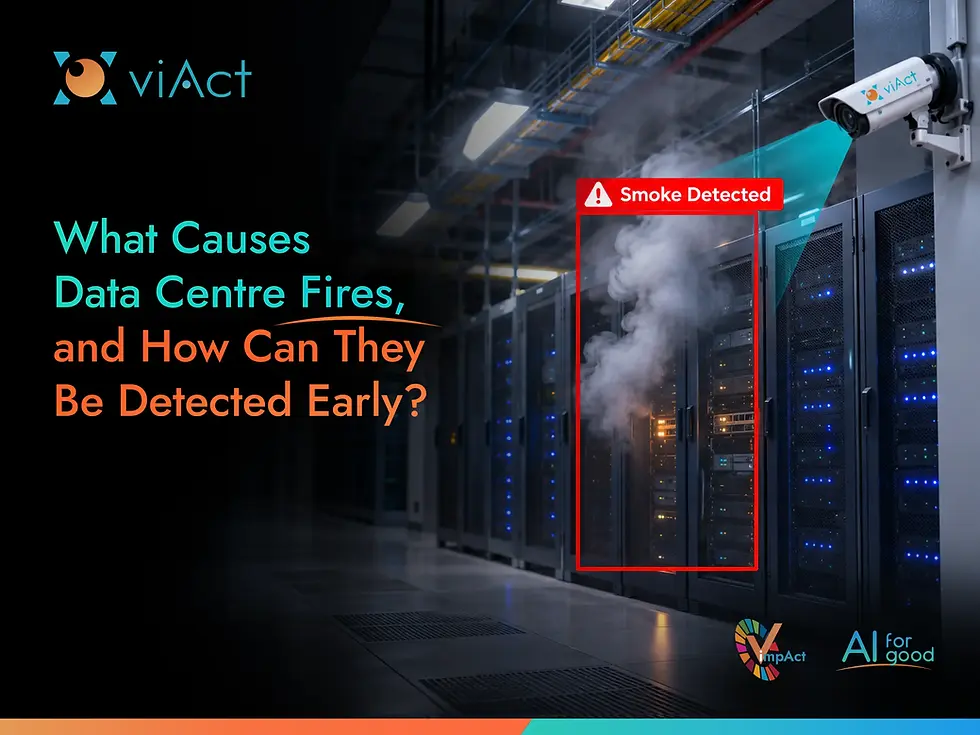
As data centre capacity expands, operators need more than a single detection method. This blog explains the main data centre fire causes, the technologies used to identify early warning signs and why construction and commissioning require particular attention. AI video analytics for data centres can complement existing fire protection systems by using CCTV to monitor visible smoke, flames and selected unsafe activities.
What Causes Data Centre Fires?
The main data centre fire causes include battery failures, electrical faults, equipment overheating, fuel-related incidents and ignition during maintenance or hot work. UPS and battery rooms, backup generators and switchgear frequently appear in reported power-infrastructure incidents, although not every incident involves a fire.
The Energy Incident Register provides a breakdown of equipment mentioned in its incident records.
Equipment or area | Reported incidents |
UPS systems and battery rooms | 74 |
Backup generators | 57 |
Switchgear and electrical rooms | 31 |
Transformers and substations | 19 |
Fuel systems | 6 |
Equipment not stated | 55 |
Source: Energy Incident Register, 10 November 2026. The 180 records include power failures and thermal events as well as fires. Equipment categories overlap because one incident may involve multiple systems.
These figures indicate where power-related incidents have been reported, not which equipment has the highest fire failure rate. The register is also expanding its historical records, so changes in its totals should not automatically be interpreted as increases in actual incident frequency.
The principal fire risks differ by equipment type.
UPS and Battery Systems

UPS batteries can develop hazardous conditions through internal faults, overheating, overcharging or physical damage. Lithium-ion systems present a particular concern because thermal runaway can release substantial heat and flammable gases.
Lead-acid batteries have different risks, including electrical faults, overheating and hydrogen accumulation under certain charging conditions.
Backup Generators and Fuel Systems

Backup generators introduce risks involving fuel leaks, hot exhaust surfaces, electrical faults and equipment overheating.
These hazards may emerge during routine operation, maintenance or emergency power testing, particularly where fuel storage and electrical systems are located close together.
Switchgear and Electrical Rooms

Loose electrical connections, insulation deterioration, overloading and equipment faults can produce overheating or electrical arcing.
Because some faults develop inside enclosed equipment, visual inspection alone may not identify the earliest warning signs. Electrical protection systems and equipment condition monitoring are therefore essential.
Maintenance and Hot Work

Welding, cutting, grinding and temporary electrical work can introduce ignition sources near cables, insulation and combustible construction materials.
These risks become particularly important during facility expansion, equipment replacement and commissioning, when multiple contractors may work around energised systems.
Do Lithium-Ion UPS Batteries Cause Data Centre Fires?
Lithium-ion UPS batteries are a clear contributing factor, according to Uptime Institute's 2026 outage analysis, which found that major data centre fires have increased gradually in recent years. Uptime cautions that part of the rise reflects the build-out of new facilities rather than higher inherent risk. The main hazard is thermal runaway, a self-heating reaction that can rapidly escalate and become difficult to control once initiated, making early detection particularly important.
Lead-acid batteries burn too. Recent registered entries include a January 2026 lead-acid battery fire at a London data centre tower and an October 2026 smouldering fire in a battery system at a Berlin data centre.
These incidents demonstrate why battery safety depends on the technology installed, its operating conditions and the procedures used during maintenance.
Does Human Error Cause Data Centre Fires?
Human error is a recognised ignition pathway, though public reports rarely record it as the stated cause. Maintenance, testing and hot work put people and ignition sources next to live electrical equipment, and Allianz Commercial's commissioning guidance describes human and interface risk as dominant when a data centre first goes live.
Reported cases show the pattern. In the 2025 fire at South Korea's national data centre in Daejeon, officials suspected a lithium-ion battery exploded during maintenance work to move backup battery modules. The register also lists a September 2026 fire in a UPS room at a Seoul data centre during electrical testing. On hot work, the Fire Industry Association says oversight is often lacking, and permits are often generic, treated as paperwork by both client and contractor.
How Do Construction and Commissioning Raise Data Centre Fire Risk?
Construction and commissioning raise fire risk because systems are energised and tested close to their limits for the first time while many contractors work on site at once. Allianz Commercial's 2026 claims analysis found that fire accounts for well over half of about €700 million in analysed data centre losses, and it flags testing and commissioning as a high-risk phase. The EU aims to at least triple its data centre capacity within five to seven years, so more facilities will pass through that phase.
Hot work is a recurring ignition source. Allianz cites a hot-works fire at a hyperscale facility among claims in the US$50 million to US$100 million range. UK analysis of fire service data counted 182 hot work fires in English non-domestic buildings in 2024 to 2025, with welding and cutting behind more than four in five.
How Can Data Centre Fires Be Detected Early?
Early detection works best in layers. Aspirating smoke detection gives very early warning of smoke in high-airflow halls, off-gas monitoring covers lithium-ion battery rooms, thermal imaging watches for abnormal heat at electrical panels and UPS cabinets, conventional alarms provide the code baseline, and camera-based detection covers what sensors cannot see.
Each layer catches a different stage, from battery venting and rising heat to visible smoke or flame.
Method | What it senses | Where it fits | Main limit |
Aspirating smoke detection | Smoke particles drawn through sampling tubes | Data halls and other high-airflow spaces | Smoke-based, so it can trail battery off-gassing |
Lithium-ion off-gas monitoring | Vapours released before thermal runaway | Lithium-ion UPS and battery rooms | Covers battery rooms only |
Conventional point detectors and alarm panels | Smoke or heat reaching the device | Whole building, code compliance | Passive, since smoke must reach the sensor |
Computer vision on CCTV | Visible smoke, flame, water ingress, unsafe or unpermitted work | Rooms and aisles already covered by cameras | Needs line of sight to the camera |
Thermal imaging | Abnormal heat in electrical panels, UPS cabinets and server aisles | Switchgear, UPS rooms and server halls | Senses heat, not smoke, flame or the activity behind it |
Where Does Computer Vision Fit in Data Centre Fire Detection?
Computer vision provides an additional visual monitoring layer around equipment and activities that conventional fire detectors do not directly observe. It can help identify visible smoke or flames while also monitoring selected contractor behaviours, restricted-area access and unsafe work conditions.
It does not replace aspirating smoke detection, battery monitoring or certified fire alarm systems.
Consider three practical examples.
Smoke near a generator yard: A fixed camera identifies visible smoke in a monitored area and generates an alert for the designated response team.
Unauthorised access to an electrical room: Video analytics identifies a person entering a restricted area. When connected to an appropriate authorisation system, the event can be checked against access permissions or permit status.
Unsafe activity during commissioning: A camera identifies a configured safety violation, such as missing PPE or entry into a designated exclusion zone, allowing supervisors to investigate before work continues.
The benefit is not that cameras detect every developing fire. Rather, they provide information about visible conditions and human activities that other sensors may not capture.
What Fire-Related Warning Signs Can AI Identify in Data Centres?
Traditional fire detection systems monitor smoke, heat and other physical indicators, but they do not always provide visual context about what is happening around critical equipment. AI-powered fire and smoke detection adds visual monitoring through existing CCTV cameras, helping operators identify visible smoke, flames and potential fire hazards across data centre environments.
In data centres, visual monitoring can help identify:
Thin smoke plumes emerging from generator yards, electrical equipment or other monitored areas.
Small visible flames developing near equipment or combustible materials.
Smoke during electrical testing in UPS rooms, switchgear areas or commissioning zones.
Unsafe hot work activities near cables, equipment or combustible materials.
Unauthorised entry into high-risk areas where electrical maintenance or testing is underway.
Obstructed emergency exits or access routes that could delay evacuation or emergency response.
Unlike smoke and heat detectors, vision AI can also provide visual evidence of the surrounding conditions, helping operators identify the affected location and review what occurred.
However, camera-based detection requires a clear view of the hazard and does not replace aspirating smoke detection, battery monitoring or certified fire alarm systems.
What Does an Alert Workflow for Data Centre Fire Detection Look Like?
A camera-based fire alert should move from detection to notification, investigation and documented resolution. The objective is to ensure that an identified hazard reaches the responsible team and leads to appropriate action without delaying established emergency procedures.
A typical workflow can follow six stages.
1. Detect: A camera identifies visible smoke near a generator yard or another monitored area.
2. Record: The centralized monitoring platform creates an event with the location, timestamp and relevant visual evidence.
3. Notify: The alert reaches designated personnel through configured communication channels.
4. Respond: The responsible team follows the facility's emergency procedures, including evacuation and emergency-service notification where required.
5. Investigate: Once conditions are safe, authorised personnel review the incident and determine necessary corrective actions.
6. Verify and close: The team documents the action taken and verifies that the issue has been resolved.
In the viAct workflow, cameras connect over RTSP, so no new cameras are needed with a single site with existing CCTV can be live in 3 to 7 days. Alerts can go to an on-site speaker, SMS, WhatsApp or email, and each event is tagged with a timestamp and a visual snapshot for later review. The alert supplements the fire alarm system and does not replace it.
In FY2025-26, viAct reported a 50% reduction in human-error-related downtime across data centre deployments. The reductions were associated with monitoring unsafe activities around switchgear, battery systems and cooling infrastructure.
These functions support operational awareness and incident documentation. They do not replace certified fire alarm systems, suppression equipment or mandatory emergency response procedures.
Conclusion: Key Takeaways
Power infrastructure deserves close attention. UPS batteries, generators and switchgear frequently appear in reported data centre power incidents, although not all involve fires.
Battery monitoring must go beyond visible smoke. Electrical, thermal and off-gas monitoring can identify selected abnormal conditions before a visible fire develops.
Construction and commissioning require additional controls. Hot work, electrical testing and contractor coordination are important sources of preventable risk.
Early detection is most effective when layered. Aspirating smoke detection, battery monitoring, conventional fire systems and computer vision identify different warning signs.
Alerts must lead to action. Clear notification, emergency response, investigation and corrective-action procedures help ensure hazards are addressed.
As data centre capacity expands, fire safety will depend on more than installing additional detectors. Operators need to understand where hazards originate, recognise early warning signs and ensure that every relevant alert leads to an appropriate response.

Quick FAQs
1. Are data centre fires common?
Data centre fires are relatively infrequent but can cause substantial damage and service disruption. Allianz's 2026 claims analysis found that fire accounted for well over half the value of analysed data centre insurance losses, despite water damage being a more frequent cause of claims.
2. What is the most common cause of fire in data centres?
Electrical and power infrastructure is a major source of reported data centre fire incidents, particularly UPS batteries, generators and switchgear. Common ignition mechanisms include electrical faults, overheating, battery failures and maintenance-related activities. However, available incident records do not establish a single most common cause across all data centres.
3. Can computer vision replace aspirating smoke detection?
No. Aspirating smoke detection samples airborne particles, while computer vision identifies visible conditions within camera coverage. They serve different purposes and can complement each other.
4. Can existing CCTV cameras detect smoke and fire in data centres?
Yes. Existing CCTV cameras can support viAct AI-based smoke and flame detection when camera placement, lighting and image quality are suitable. Video analytics can also identify selected unsafe activities, but it cannot detect concealed electrical faults or replace certified fire alarm systems.
5. How can data centres prevent fires caused by UPS batteries?
Operators can reduce battery fire risks through appropriate battery selection, battery management systems, temperature monitoring, ventilation, routine inspections and safe maintenance procedures. Lithium-ion installations may also benefit from suitable off-gas detection and measures designed to limit thermal runaway propagation.
Read More: