Haul Truck Safety in South African Mines: Key Risks and Controls


“Quick AI-Powered Insights on the Topic— Freshly Updated!”
|
Haul truck safety is a critical part of mining operations in South Africa, where large mobile equipment operates alongside smaller vehicles, maintenance teams and pedestrians. Poor visibility, operator fatigue, unsafe haul roads, dust exposure and mechanical failures can turn routine transportation activities into serious accidents.
For South African mining operators, improving haul truck safety requires more than driver training or periodic vehicle inspections. It involves a combination of traffic management, engineered controls, proximity detection systems, equipment maintenance and continuous monitoring of high-risk activities.
This guide explains the major haul truck hazards, South Africa's requirements for trackless mobile machinery (TMM), the technologies used to reduce collision risks and how artificial intelligence (AI) can support safer mining operations.
What Is Haul Truck Safety in Mining?
Haul truck safety refers to the operational procedures, engineering controls and monitoring technologies used to prevent collisions, rollovers, equipment failures and worker injuries involving large mining haul trucks.
Unlike conventional road vehicles, mining haul trucks have large blind zones, substantial stopping distances and limited manoeuvrability. Their operating environments can also change frequently as excavation progresses, haul roads are relocated and traffic patterns evolve.
The objective is to prevent dangerous interactions before they result in incidents, rather than relying only on investigations after an accident.
Why Is Haul Truck Safety Important in South African Mines?
Haul truck safety is particularly important in South African mines because trackless mobile machinery (TMM) operates in environments where vehicle size, limited visibility, changing road conditions and mixed traffic can create serious collision and rollover risks.
Several conditions make haul truck safety management especially challenging.
Large equipment and restricted visibility
Mining haul trucks can be several times larger than light vehicles operating on the same site. Operators may have difficulty seeing vehicles, workers or obstacles immediately around the truck, particularly when reversing or turning.
Changing haul routes and traffic patterns
As mining progresses, haul roads, loading areas, intersections and dumping locations may change. Traffic management plans must therefore be updated to reflect actual operating conditions.
Dust and reduced visibility
Dry haul roads, blasting activities and vehicle movements can generate airborne dust. Dust clouds may obscure approaching vehicles, road edges, intersections and pedestrian movements.
Extended operating hours
Many mines operate across multiple shifts. Night operations, repetitive driving and long periods of concentration increase the importance of fatigue monitoring, lighting and shift management.
High-consequence incidents
A collision involving a loaded haul truck can result in serious injuries, fatalities, equipment damage and prolonged operational disruption.
For mine operators, haul truck safety is therefore both an occupational safety requirement and an important part of maintaining reliable production.
What Do South African Regulations Require for Haul Truck and TMM Safety?
South Africa's Mine Health and Safety Act (MHSA) regulations expect trackless mobile machinery to detect pedestrians and other machines, warn the people involved, and intervene automatically if no one acts. These are the collision-avoidance clauses in Chapter 8 of the MHSA Regulations, gazetted in December 2022 and covering TMM at surface and underground mines. TMM includes applicable haul trucks, loaders and other mobile mining equipment.
As reported, Regulation 8.10 includes the following requirements:
Pedestrian detection (8.10.1.2(b)). The machine must automatically detect nearby pedestrians and warn both the operator and the pedestrian.
Machine-to-machine detection (8.10.2.1(b)). Machines must detect one another and warn both operators.
Automatic intervention. If no action prevents a potential collision, the machine must slow to a safe speed and then apply its brakes automatically.
Fail to safe. The system must fail to a safe state without human intervention.
This means a system that only records video, or only alerts after an event, does not by itself meet the intent of these clauses. What matters is the detect → warn → intervene sequence.
South Africa’s mining fatalities fell from 74 in 2021 to a then-record-low 49 in 2022, rose to 55 in 2023, and then dropped to 42 in 2024 and 41 in 2025.
In January 2023, when the 2022 results were released, the Minister of Mineral Resources urged all stakeholders to implement the collision avoidance systems introduced by the new TMM regulations.
Weeks later the Minerals Council named trackless mobile machinery as the industry’s next big safety challenge, citing 16 TMM fatalities in 2021 and 17 in 2022. The Minister repeated the call in January 2025.
Are proximity detection systems mandatory in South African mines?
Proximity detection systems (PDS) and collision avoidance systems (CAS) are important elements of South Africa's TMM regulatory framework. The applicable obligations depend on factors such as the machinery category, relevant collision risks, regulatory provisions and implementation requirements.
Mines should assess whether their systems must provide operator warnings, automatic speed reduction or machine stoppage under the relevant regulatory requirements. For current compliance requirements, mine operators should consult the official MHSA regulations, applicable Department of Mineral and Petroleum Resources notices and relevant technical standards.
What Are the Main Haul Truck Safety Risks?
The six major haul truck safety risks in mining are operator fatigue, blind zones, unsafe haul road conditions, dust and environmental factors, vehicle–pedestrian interactions, and braking or mechanical failures.
Each risk has different causes and requires specific preventive controls.
1. Operator Fatigue

Operator fatigue is a reduction in alertness, concentration and reaction time that can affect a haul truck driver's ability to operate equipment safely.
Fatigue can develop during long shifts, repetitive driving, night operations or periods of insufficient rest. A fatigued operator may respond slowly to obstacles, miss warning signs or fail to notice changes in traffic conditions.
Common indicators include:
Repeated yawning, prolonged eye closure or head nodding.
Delayed responses to road conditions or warning signals.
Lane deviations and inconsistent driving behaviour.
Reduced awareness of nearby vehicles and workers.
Recommended controls: Fatigue risk management programmes, suitable shift schedules, rest breaks, operator training and appropriate fatigue detection systems. Camera-based driver monitoring systems may identify observable indicators such as eye closure and head position. They should support, rather than replace, fatigue management policies.
2. Haul Truck Blind Zones

Haul truck blind zones are areas around a vehicle that the operator cannot see adequately through direct vision, mirrors or installed cameras.
Blind zones vary according to vehicle design, cab position, load configuration and operating conditions. High-risk areas often include the space immediately in front of the vehicle, areas alongside the truck and the rear reversing path. A smaller service vehicle or worker may remain outside the operator's direct line of sight, particularly during turning, reversing or manoeuvring near loading equipment.
Recommended controls: Blind-zone assessments, vehicle separation, mirrors, cameras, proximity detection, controlled reversing and restricted access around operating equipment. A camera improves visibility only within its coverage area. It does not necessarily provide reliable proximity measurement or prevent a collision.
3. Haul Road Conditions

Unsafe haul road conditions increase the likelihood of haul truck collisions, loss of control, rollovers and braking-related incidents.
Haul road design and maintenance directly affect vehicle stability, stopping performance and driver visibility. Common hazards include excessive gradients, sharp bends, inadequate road width, uneven surfaces, poor drainage, potholes and insufficient edge protection. Poorly designed intersections may also bring loaded haul trucks and smaller vehicles into conflict.
Recommended controls: Road design standards, suitable berms, gradient management, drainage, speed restrictions, routine inspections and traffic route assessments. Technology can detect certain unsafe vehicle movements, but it cannot substitute for physically correcting a defective haul road.
4. Environmental and Dust Conditions

Dust creates a haul truck safety risk by reducing visibility and making it more difficult for operators to identify vehicles, workers, road edges and obstacles.
Dust is common on dry surface haul roads and around loading or dumping areas. Visibility may deteriorate rapidly when several vehicles travel through the same section. Other environmental factors include rainfall, fog, poor lighting, glare and slippery road surfaces. Dust can also affect the performance of optical sensors and camera-based monitoring systems if lenses become obstructed.
Recommended controls: Dust suppression, road watering, speed management, suitable lighting, sensor cleaning and appropriate detection technologies for reduced-visibility conditions. Mines should test monitoring equipment under representative dust conditions rather than assuming performance observed in clear weather will remain unchanged.
5. Vehicle–Pedestrian Incidents

Vehicle–pedestrian incidents occur when workers enter or remain within the operating path or hazardous proximity of a moving haul truck.
Such interactions may occur near workshops, loading areas, inspection points, maintenance zones and access roads. Common causes include inadequate pedestrian segregation, unexpected worker movement, poor communication and blind-zone exposure.
A pedestrian may also enter a vehicle operating area while a truck is stationary, without recognising that it is about to move.
Recommended controls: Physical segregation, designated crossings, access restrictions, exclusion zones, proximity alerts and clearly defined communication procedures. The safest approach is to eliminate unnecessary pedestrian exposure to haul truck operating areas wherever practicable.
6. Braking and Mechanical Failure

Braking and mechanical failures can cause haul truck incidents when critical components are unable to maintain vehicle control, particularly on gradients or during loaded operations.
Potential failures include service brake defects, retarder problems, steering faults, tyre damage and hydraulic system failures. The consequences can be especially serious when a loaded haul truck travels downhill or approaches an intersection.
Recommended controls: Pre-start inspections, planned maintenance, brake testing, defect reporting, condition monitoring and suitable emergency procedures.
AI-based visual monitoring can identify some observable signs of abnormal operation, but it cannot independently verify internal brake condition without appropriate diagnostic data or sensors.
What Technologies Are Used for Haul Truck Safety in Mining?
The main technologies used for haul truck safety include proximity detection systems (PDS), collision avoidance systems (CAS), radar, cameras, GPS fleet tracking, fatigue monitoring, telematics and AI video analytics for mining operations.
Edge AI processing on mining haul trucks further enables real-time hazard detection directly at the vehicle, reducing dependence on cloud connectivity and allowing safety monitoring to continue even when haul trucks operate in remote mining locations with limited or no internet access.
These systems address different risks. Some provide vehicle operators with warnings, while others monitor behaviour, track equipment movement or support automatic intervention.
Detect nearby workers, vehicles or objects using technologies such as radio-frequency identification, radar or other sensing methods. Depending on the system, PDS can warn operators before a hazardous interaction develops.
Identify potential collisions and may support machine intervention through integration with approved vehicle control systems. CAS capability varies by equipment and installation; warning-only systems should not be confused with automatic collision prevention.
Camera and 360° Visibility Systems
Provide operators with additional views around large equipment, particularly during reversing and manoeuvring. Camera coverage depends on positioning, lighting, lens cleanliness and display configuration.
Monitor vehicle location, speed, travel routes, idle time and operating patterns. Telematics can help mine operators identify speeding, route deviations and recurring traffic risks.
Use in-cab sensors or cameras to monitor observable fatigue and distraction indicators. Some systems generate immediate alerts, while others support supervisor reviews and fatigue trend analysis.
AI Video Analytics and Dynamic Safety Zoning
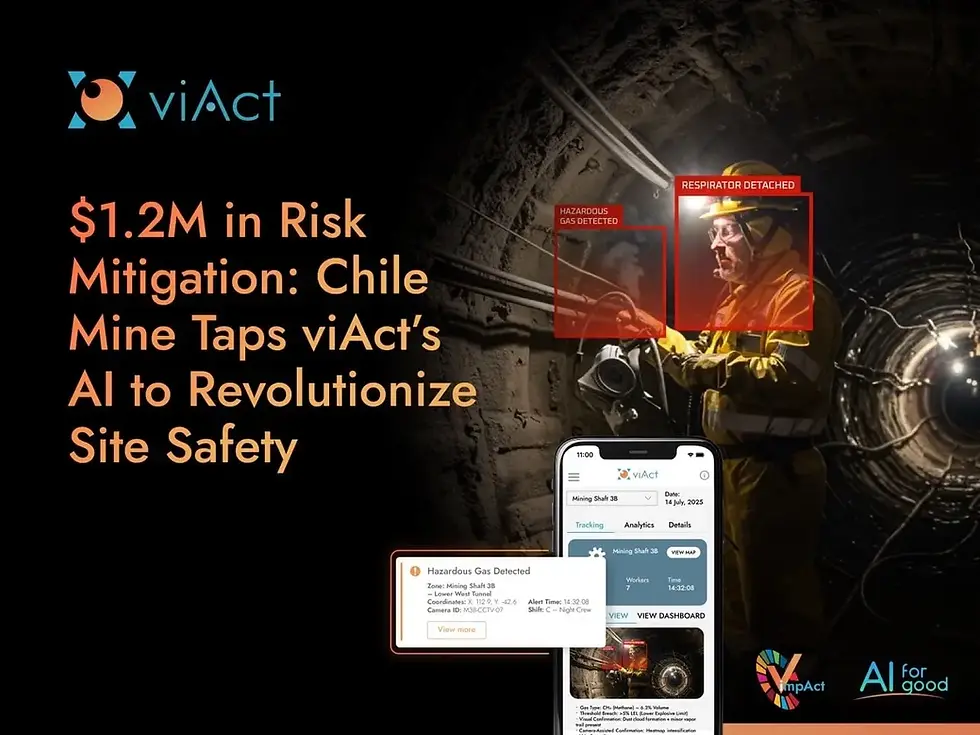
Analyse camera feeds to identify unsafe vehicle–worker interactions, restricted-area entry and other visually detectable hazards. These systems can provide incident evidence and support corrective-action tracking. At a mining operation in Chile, 70 fewer worker–vehicle proximity risk events at a mining operation following the deployment of viAct AI-powered dynamic safety zoning for mining. The deployment also reported 65% fewer restricted-zone intrusions and 55% faster incident response.
These technologies can complement one another, but they are not interchangeable. For example, an AI camera positioned at a haul road intersection may detect recurring unsafe vehicle interactions. However, that camera alone does not necessarily provide the certified machine-control functionality required of an applicable collision prevention system.
In FY 2024-25, 200 fewer haul-truck collision events across 50+ open-pit mining sites worldwide were reported from viAct AI-powered safety monitoring. The appropriate technology depends on the specific hazard, the required safety function and the operating environment.

How Can Mines Choose the Right Haul Truck Safety Technology?
South African mines should select haul truck safety technology based on site-specific collision risks, regulatory requirements, environmental conditions, vehicle compatibility, connectivity and the system's verified safety functions.
A technology suitable for a warehouse or controlled industrial facility may not perform equally well on a dusty, high-vibration mine haul road.
The following criteria can support technology evaluations and procurement discussions.
Selection criterion | Questions mines should ask vendors |
Dust and environmental tolerance | Has the system been tested in dust, rain, glare and low-light conditions? |
Vibration and durability | Can sensors, cameras and mounting hardware withstand mining equipment vibration? |
Detection capability | Does it detect people, vehicles or both? What are its documented limitations? |
Edge processing | Can critical detection functions operate without external internet connectivity? |
Fleet compatibility | Can the system work with existing haul trucks and mixed equipment brands? |
TMM regulatory alignment | Which specific Regulation 8.10 requirements does the proposed configuration address? |
Machine intervention | Is the system warning-only, or can it perform validated automatic intervention? |
System integration | Can it connect with existing telematics, cameras, control rooms and safety platforms? |
Maintenance | How are sensors calibrated, cleaned, inspected and tested? |
Event evidence | Can safety teams review alerts, incident records and corrective actions? |
Conclusion: Key Takeaways
Haul truck safety requires multiple controls. Operator training, traffic separation, road maintenance, equipment inspections and detection technologies must work together.
Blind zones and vehicle–pedestrian interactions remain critical hazards. Physical segregation and appropriate proximity detection can reduce exposure to these risks.
South African TMM regulations establish specific safety obligations. Mines must assess applicable Regulation 8.10 requirements, including collision prevention, braking and restricted operator visibility.
Different technologies perform different functions. PDS, CAS, radar, telematics and AI video analytics should be selected according to the hazards they are designed to address.
AI can improve hazard visibility and incident investigation. Continuous monitoring can help safety teams identify recurring unsafe interactions and evaluate corrective actions.
Mining conditions must guide technology selection. Dust, vibration, lighting, connectivity and equipment compatibility can affect detection performance.
Safety improvements should be measured using verified evidence. Mines should assess recurring events, corrective-action completion and risk exposure rather than relying only on the number of alerts generated.
The goal of haul truck safety technology is not simply to detect more hazards. It is to help mining operations identify dangerous conditions, implement appropriate controls and verify whether those controls are reducing risk.

Quick FAQs
1. What is a haul truck safety solution?
It is an AI-based solution that watches around haul trucks and warns operators and supervisors of danger. A combination of AI cameras, video analytics and sensors, the system watches haul trucks and the people and vehicles around them, warns operators of danger and records events.
2. What can an AI haul truck safety system detect in mining?
viAct uses AI video analytics to analyse camera footage and identify supported hazards, including worker–vehicle proximity risks, restricted-zone intrusions and unsafe interactions around mining equipment. When a defined hazard is detected, the system can generate alerts and record visual evidence for safety teams to review. Detection performance depends on camera coverage, visibility and site conditions.
3. Can viAct AI solution stop a haul truck automatically?
It can detect supported collision risks and generate warnings for operators or supervisors. Automatic speed reduction or braking requires integration with compatible vehicle control systems and appropriate safety validation. Such intervention is not an inherent capability of standalone AI video analytics and must be confirmed for the specific haul truck configuration.
4. Can the AI monitoring work without internet connectivity?
Yes. A haul truck system with edge AI works without internet or electricity connectivity because detection runs on the vehicle itself. A network is needed only to send events to the central platform for review.
5. Is driver and video data private in a haul truck monitoring system?
viAct AI follows data-protection guidelines such as GDPR and PDPL, with options to blur driver faces and enable anonymisation. Mines still decide what is recorded, who can see it and how long it is kept.
Read More: