
Advancing Manufacturing EHS: How AI Agents Are Shaping Manufacturing Operations


“Quick AI-Powered Insights on the Topic— Freshly Updated!”
|
Manufacturing firms have always placed great emphasis on worker safety and operational reliability. Innovation in this space has been driven by an aim to prevent accidents, reduce downtime, and ensure machines and processes function smoothly. AI agents in manufacturing operations are the latest step in that effort, moving beyond systems that just monitor or predict to ones that connect EHS data across the plant and act on it directly.
This blog explores how AI agents are shaping manufacturing EHS and operations, and what that shift actually looks like on the floor.
The Role of AI Agents in Manufacturing EHS Operations

AI agents in manufacturing operations work by connecting data across the plant, equipment condition, environmental sensors, worker activity, and safety logs, and acting on what they find rather than just surfacing a report. That shift from passive monitoring to direct action is what sets agents apart from earlier automation tools. AI agents play several roles that contribute to manufacturing EHS and operations, such as:
Predictive Maintenance: Predictive maintenance powered by AI agents helps companies avoid expensive breakdowns, reduce downtime, and support worker safety by flagging potential issues before they worsen, then routing that finding to the right team automatically instead of leaving it in a dashboard.
Optimization of the Process: Workflows in manufacturing can often be highly complex. AI agents simplify these processes by continuously analysing streams of data for potential improvements, then adjusting or alerting the right team directly, reducing the human error that often leads to accidents.
AI-Driven Risk Evaluation: AI agents provide an effective risk evaluation layer, taking into account equipment condition, environmental conditions, and worker behaviour to evaluate safety hazards in real-time and trigger precautionary measures early, rather than waiting for a scheduled review.
Training and Simulations for Workers: AI-generated training modules and simulations give workers a safe environment to practice safety procedures. This increases awareness of safety protocols and can lower the chance of accidents.
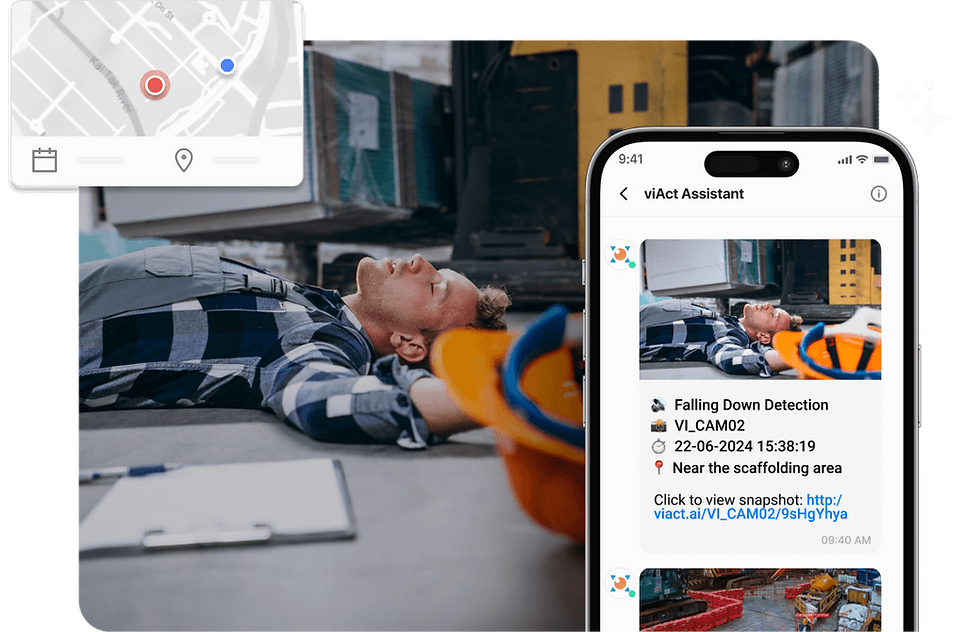
Safety Monitoring: AI agents use sensors and cameras to continuously monitor the plant floor for safety violations or dangers, and instead of only sending an alert, can log the event, notify the right person, and update the safety record automatically.
The Advantages of AI Agents in Manufacturing EHS Operations
Enhanced Predictability: Manufacturers using AI agents are better able to predict when safety problems, equipment breakdowns, or process bottlenecks will arise, reducing risk while increasing operational efficiency.
Better Safety for Workers: AI agents support worker safety by tracking potential threats in real-time and acting on predictive analytics, helping create a safer workplace and decreasing the chances of accidents.
Downtime Reduction: AI agents can reduce unexpected downtime by optimizing workflows for safety and equipment repair, helping manufacturers save both time and money on unscheduled downtime.
Increased Productivity: With AI agents driving continuous process improvement, manufacturers can work more efficiently, with fewer interruptions caused by equipment failure or safety concerns, leading to an overall boost in productivity.
Cost Savings: Businesses typically save significant sums when accidents become less likely, downtime decreases, and efficiency improves, it usually doesn't take long for AI agent technology to pay for itself.
Emergency Response Optimization: AI agents play an essential role in emergency response at plants. By connecting historical and live data, they can identify emergency situations as they arise, for example a chemical spill or equipment malfunction, and coordinate the response directly instead of just flagging it for someone to act on.
Tailored Safety Solutions: Every manufacturing plant faces its own set of safety concerns based on its setup, methods, and people. AI agents can tailor safety responses to these specifics, gathering real-time data to adjust rules on the fly and keeping workers safe as conditions change.
Are you looking to explore or deploy AI agents for your manufacturing site? Don't hesitate to reach viAct. Our skilled professionals are ready to support you in adopting the optimal solution for your manufacturing site.
Considerations Before Deploying AI Agents in Manufacturing EHS
AI agents hold immense potential for manufacturing EHS and operations, yet before adoption, a few things should be carefully evaluated:
Data Privacy: AI agent systems must gather a large amount of information. Manufacturers need to consider data privacy when gathering this data and should make intelligent use of worker information while protecting anonymity to protect workers' rights.
Ethical Considerations: Any biases present in training data can be reinforced by AI systems, creating real considerations for manufacturers who supervise workers and set safety precautions. AI agents should be deployed ethically and responsibly, with clear rules and control systems in place for how they monitor employees and handle sensitive tasks.
Implementation Costs: Implementation costs for AI agent systems may require an initial investment in hardware and personnel training, which should be weighed against the long-term benefits.
Maintenance And Training: For AI agent systems to stay effective, they require regular updates and maintenance. Companies should plan for ongoing training alongside upkeep to get the most from their technology investment.
Technological Challenges: Implementing AI agent systems can be complex from a technology standpoint. Manufacturers need to invest in the right tools and expertise for a smooth rollout.
Workforce Adoption: Workers may take time to adjust to AI agent systems in the workplace. Training and communication about their purpose and benefits should help ease any concerns and ensure a seamless integration.
Where AI Agents in Manufacturing EHS Are Headed Next?
AI agents in manufacturing EHS are an exciting development, with real potential for worker protection and improved operations, and this is still early. There are more developments ahead.
Autonomous Safety Measures: AI agents are moving toward running safety routines and responses on their own, without needing manual input for every step, leading to faster responses and higher worker safety.
Collaborative Robotics: AI agents and collaborative robots (co-bots) are working together more closely. Co-bots interact directly with people; while AI agents help ensure they complete their jobs safely, reducing risk.
Seamless Integration: AI agents can integrate into manufacturing systems seamlessly, becoming part of everyday safety and operations processes without drawing too much attention to themselves, working alongside workers to help keep the workplace as safe as possible.
Conclusion and Key Takeaways
AI agents are changing how manufacturers approach EHS and operations, not by replacing the judgment of safety teams, but by closing the gap between spotting a problem and doing something about it. From predictive maintenance and real-time risk evaluation to emergency response, the shift is the same throughout: data that used to sit in a report or a dashboard now feeds directly into action: faster alerts, automatic documentation, and coordinated responses, that don't wait on someone to notice.

That shift is still early. Manufacturers adopting AI agents will need to work through real considerations around data privacy, ethics, cost, and workforce adoption along the way, but the direction is clear. As agents take on more of the day-to-day work of connecting plant data and acting on it, manufacturing EHS and operations become more proactive and not just safer on paper, but faster to respond when it counts.
Key Takeaways
AI agents in manufacturing operations connect EHS data, equipment condition, environmental sensors, worker activity, and safety logs, and act on it directly instead of just producing a report.
The shift from Generative AI to AI agents is a shift from generating insights to acting on them, across predictive maintenance, risk evaluation, safety monitoring, and emergency response.
Considerations like data privacy, ethics, implementation cost, and workforce adoption still apply and should be planned for before deployment.
viAct's approach combines connected data, computer vision, and AI agents to help manufacturers move safety and operations from passive monitoring to direct action.

FAQs
1. What are AI agents in manufacturing EHS operations?
AI agents in manufacturing EHS operations connect data across the plant, equipment condition, safety logs, environmental sensors, and worker activity, and act on what they find rather than just generating a report or alert. viAct's platform is built around this connected, action-taking approach.
2. How does viAct apply AI agents to manufacturing EHS operations?
viAct connects safety monitoring, risk evaluation, and predictive maintenance data into one layer, then uses AI agents to flag issues, notify the right people, and update records automatically instead of leaving that work to a human reviewing a dashboard.
3. Do viAct AI agents replace the need for human safety oversight?
No. viAct EHS AI agents handle detection, monitoring, and initial response, but human oversight remains part of the process, especially for judgment calls and final decision-making.
4. What kind of manufacturing data can viAct AI agents work with?
Common sources include equipment sensors, environmental monitors, safety and incident logs, maintenance schedules, and camera and drone-based safety monitoring feeds.
5. Why does real-time response matter more than prediction alone?
Predicting an issue is only useful if something acts on it quickly. viAct AI agents close that gap by connecting the prediction directly to a response, an alert, a work order, or an emergency protocol, instead of leaving it for someone to notice and act on later
Also Read:


Gracias por compartir estos detalles sobre Magis TV descargar. El contenido me parece útil para quienes están comenzando a investigar sobre esta opción y quieren conocer mejor sus características. Una buena recomendación para cualquier usuario es revisar siempre la fuente de descarga, los permisos y la compatibilidad antes de instalar.
I like how AI agents help prevent accidents in manufacturing. Sometimes the info they give is like a secret code. By the way, if you need to decode Wingdings or other symbols, try wd gaster translator (https://www.wingdingstranslatoron.online/). It's free, quick, and no sign-up needed.
This article makes a lot of sense. AI can really help keep workers safe and machines running well. It reminds me that in any industry, testing is key. For online ads, we often use a video ad tag tester (https://www.vast-tag-tester.online/) to check that everything plays correctly before going live.
Comprobar los numeros ganadores después de un sorteo resulta más sencillo cuando la información está bien estructurada. Me pareció práctico encontrar también datos complementarios, porque permiten revisar otros aspectos de la jornada. Además, una presentación clara ayuda a ahorrar tiempo durante la comprobación.
I found this content interesting because the explanation feels smooth and natural. I explored Slope Game and liked its simple controls. The fast movement, sharp turns, and open edges make each run a real challenge. It is easy to start playing, but reaching a high score takes practice and good control.