
Why EHS Teams Are Shifting Toward Proactive Safety Software for Faster Risk Response


“Quick AI-Powered Insights on the Topic— Freshly Updated!”
|
Introduction — From Reactive to Proactive Safety
For decades, workplace safety has operated on an uncomfortable truth: most systems are designed to respond to incidents, not prevent them. A worker gets hurt, a report is filed, and a corrective action plan is drafted. The cycle repeats.
But the numbers are too costly to ignore. According to the latest safety report by the U.S. Bureau of Labor Statistics, there were 5,070 fatal work injuries in the United States alone against 2,488,400 cases of injuries and illnesses. This pointed towards a total workplace injury cost of $181.4 billion. These aren't just statistics but are preventable outcomes that proactive safety software is designed to stop.
Today, leading EHS teams are abandoning the reactive model entirely. They are deploying proactive safety AI culture and proactive workplace safety AI tools that monitor, predict, and act before injuries occur.
This guide covers everything EHS managers need to know about making the switch: what proactive safety software is, how it works, its core benefits, real-world examples, implementation steps, challenges, and how to choose the right proactive safety solution for your organization.
Section 1 — What is Proactive Safety AI?
Proactive Safety vs. Reactive Safety: Key Differences
Reactive safety is the traditional model of site monitoring. It relies on lagging indicators like incident rates, lost-time injuries (LTIs), and Total Recordable Incident Rate (TRIR) to measure performance. The problem? These metrics only tell you what already went wrong.
Proactive safety software transitions this model. Instead of counting incidents after they happen, it uses leading indicators such as near-miss frequency, unsafe behavior rates, and hazard density, to predict and prevent accidents before they occur.
Key differences at a glance:
Reactive safety | Proactive safety AI |
Incident reporting, root-cause analysis, lagging KPIs | Real-time hazard detection, predictive analytics, leading KPIs |
Responds to events after they happen | Identifies risk conditions before they escalate |
Relies on manual observation and periodic audits | Runs 24/7 continuous monitoring across all camera feeds |
What is Proactive Safety Software?
Proactive safety software is an AI-powered platform that continuously monitors workplace environments using computer vision, predictive analytics, and real-time data processing. It identifies hazards, unsafe behaviors, and high-risk conditions the moment they appear and triggers automated alerts, workflows, and corrective actions before an incident can occur.
Modern proactive safety solutions connect to a facility's existing CCTV infrastructure, eliminating the need for costly hardware overhauls. The AI engine runs on-premises, processing live video feeds in real time to detect a set of common safety breaches on sites.
Unlike traditional safety software, which primarily stores incident records and manages compliance checklists, a proactive safety solution is an active, always-on sentinel working in parallel with your EHS team.
The Role of Computer Vision and Real-Time Monitoring
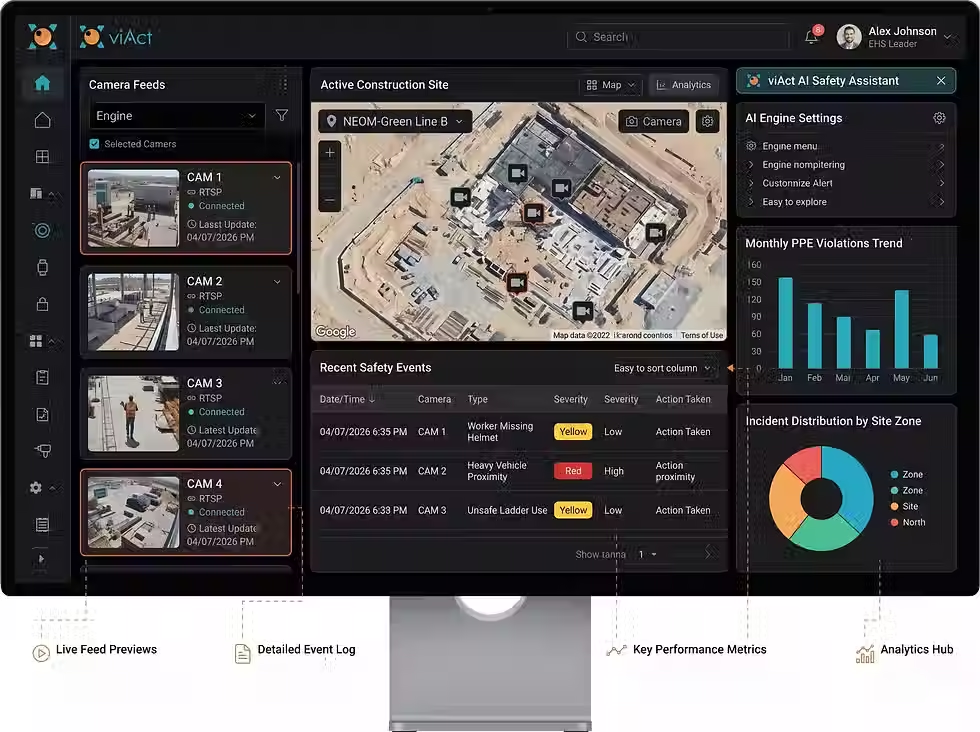
At the heart of proactive workplace safety AI is computer vision, which includes the ability of machines to interpret and analyze visual data from the real world. Using deep learning and convolutional neural networks (CNNs), these systems are trained on millions of images to recognize objects, behaviors, and environmental conditions with extraordinary precision.
Once deployed, the system analyzes every camera frame continuously, something no human safety officer could do across a large facility without fatigue or distraction. When a defined safety rule is breached (for example, a worker entering a hazardous zone without the correct PPE), the system:
Detects the violation in real time
Assigns a risk score to the event
Triggers an automated alert to the relevant supervisor or EHS team member
Logs the event with video evidence for review
Launches a predefined corrective action workflow
This entire process happens within seconds, turning what would have been a post-incident investigation into a pre-incident intervention.
Section 2 — Core Technologies Behind a Proactive Safety System
Understanding how a proactive safety solution works under the hood helps EHS teams make better deployment decisions and build stronger business cases for executive buy-in. Here are the four core technologies powering modern proactive safety AI.
1. Predictive Analytics and Leading Indicators
Predictive analytics uses historical safety data, real-time behavioral patterns, and environmental variables to forecast where and when incidents are most likely to occur. Rather than waiting for TRIR to spike, EHS managers receive early warnings, sometimes hours or days in advance.
For example, if a particular work zone consistently records a high frequency of near-miss events during the third shift, the system flags this as an elevated-risk pattern and recommends targeted interventions like additional safety briefings, zone reconfiguration, or enhanced monitoring.
2. Real-Time Video Analysis
Real-time video analysis is the engine of proactive workplace safety AI. Connected to existing CCTV networks, the system processes multiple simultaneous video streams across an entire facility without delay. Unlike recorded-footage reviews (which are reactive by nature), real-time analysis enables immediate intervention.
A Dubai-based energy manufacturer, for instance, deployed real-time video analytics across its facility during relocation due to multiple safety challenges around heavy equipment. The system continuously detected machine-vehicle–pedestrian interactions in real time, contributing towards 65% reduction in pedestrian collisions and 54% decline in overall safety violations.
3. AI-Powered Hazard Detection
AI-powered hazard detection goes beyond simple rule-based alerts. Modern proactive safety software uses deep learning models trained on industry-specific datasets to identify a wide spectrum of hazards, including:
PPE non-compliance (missing hard hats, high-vis vests, gloves, safety footwear)
Ergonomic risk postures (improper lifting, repetitive strain positions)
Restricted zone and exclusion area breaches
Vehicle control violations (speeding forklifts, wrong-way traffic)
Housekeeping hazards (spills, blocked emergency exits, cluttered walkways)
Behavioral safety violations (distraction, horseplay, fatigue indicators)
Crucially, these models improve over time. As the system processes more data from your specific environment, detection accuracy increases, making the proactive safety solution smarter and more tailored to your operation with every passing week.
4. Risk Scoring and Early Warning Alerts

Not all safety violations carry the same weight. A missing glove in a low-risk area is different from an unprotected worker near moving machinery. Proactive safety AI assigns dynamic risk scores to every detected event, enabling EHS teams to prioritize their response based on potential severity.
Risk scores are updated in real time. When a score crosses a defined threshold, the system escalates the alert, notifying senior safety managers, triggering automated lockout procedures, or dispatching a safety officer to the scene. This tiered response framework prevents alert fatigue while ensuring that critical risks never go unaddressed.
For a more detailed understanding of how a proactive safety solution updates safety scores in real time, read our e-book.
Section 3 — 7 Benefits of Proactive Safety Software
The business case for proactive safety software is compelling across every dimension — human, financial, operational, and regulatory. Here are the seven most impactful benefits EHS teams report after deployment.
1. Prevents Incidents Before They Happen
This is the defining benefit of proactive safety software, and it is also the most difficult to quantify, because you are measuring what did not happen. But the evidence is consistent: facilities using proactive workplace safety AI report significant reductions in TRIR, near misses, and serious injuries and fatalities (SIFs).
A metro extension project in Doha recorded a 80% safety accuracy in its first year on a proactive safety AI platform, alongside measurable ROI in productivity savings.
2. Reduces Human Error
Human safety officers are essential, but they are also human. They experience fatigue, distraction, and cognitive overload, especially in large, high-activity environments. A single safety officer cannot simultaneously monitor 50 camera feeds, track 200 workers, and maintain perfect situational awareness across a 300,000-square-foot warehouse.
Proactive safety AI does not tire, does miss a frame. It facilitates removing human error from the monitoring loop, ensuring consistent, objective, and exhaustive hazard detection around the clock.
3. Delivers Leading Safety Metrics, Not Lagging Ones
Traditional EHS dashboards are rear-view mirrors. They show TRIR, Lost Day Rate, and incident counts, all of which reflect events that have already occurred. Proactive safety software equips EHS managers with forward-looking metrics: hazard density scores, behavioral risk indices, PPE compliance rates, and zone-level risk heat maps.
These leading indicators give safety leaders the data they need to intervene before a metric becomes a statistic, shifting safety culture from reactive compliance to proactive risk governance.
4. Improves EHS Decision-Making
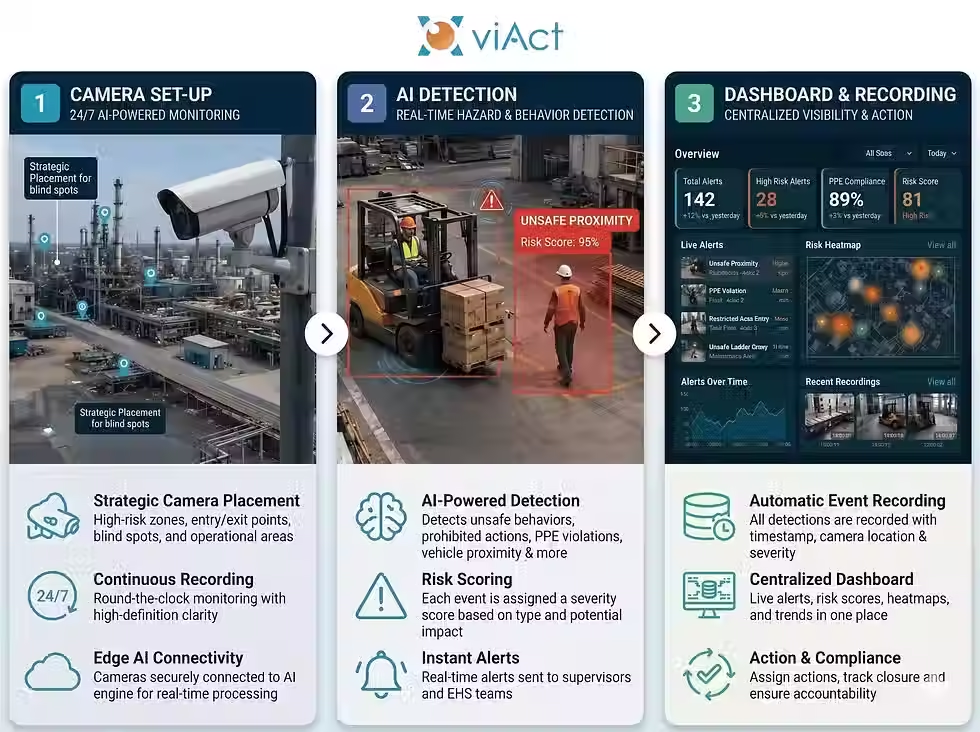
When every safety event is automatically logged, tagged, timestamped, and enriched with video evidence, EHS managers gain an unprecedented level of operational insight. They can identify which areas, shifts, or task types carry the highest risk; track the effectiveness of safety interventions over time; and build evidence-based business cases for resource allocation.
One dairy and beverage facility used its proactive safety solution's analytics dashboard to identify that hygiene issues were three times more likely during the second hour of a shift on its third packaging line. A targeted real-time intervention pointed out workers in the blind spots often skipping PPE like hair nets, masks and gloves. This reduced hygiene violations by 40% within six months.
5. Ensures 24/7 Coverage Without Fatigue
Many of the most serious workplace incidents, including equipment failures, unauthorized access, and after-hours hazards, occur outside of standard business hours, when human oversight is minimal. Proactive workplace safety AI operates continuously, providing the same level of vigilance at 3 a.m. on a Sunday as it does at 9 a.m. on a Monday.
OSHA reports that the rate of accidents and injuries are 18% greater in the evening shifts and 30% during night shifts as compared to day periods when traditional safety oversight is at its lowest.
6. Supports SIF Prevention
Serious Injuries and Fatalities (SIFs) are the highest-stakes events in workplace safety. They are also, in many cases, predictable, preceded by a pattern of high-energy near misses and unsafe conditions that go undetected under reactive safety systems.
Proactive safety AI is specifically designed to detect the precursors to SIF events. By combining object velocity, proximity data, and behavioral risk indicators, it generates a real-time SIF risk score that updates every few seconds. When that score spikes, safety teams receive immediate escalation alerts, enabling intervention before a life-altering event occurs.
7. Measurable ROI and TRIR Reduction
Safety investments have historically been difficult to quantify in financial terms. Proactive safety software changes this. By tracking incident rates, insurance claims, productivity losses, and compliance costs before and after deployment, EHS teams can build a direct, measurable ROI case.
Reductions in TRIR (Total Recordable Incident Rate) reported across deployments
Significant decreases in Lost Day Rate (LDR) as fewer injuries result in time away from work
Lower insurance premiums as carriers respond to documented safety performance improvements
Reduced cost per recordable event as intervention speed improves
Section 4 — How to Implement a Proactive Safety System
Implementing a proactive safety solution does not require ripping out your existing infrastructure. In fact, one of the most compelling advantages of modern proactive safety AI platforms is their ability to layer on top of what you already have.
Here's how a typical deployment unfolds.
Step 1: Integrating with Existing CCTV Infrastructure
The first step is connecting your proactive safety software to your existing CCTV network. Most enterprise-grade platforms support plug-and-play integration with standard IP camera systems with no hardware replacement required. A video processing unit is installed on-premises, ensuring that all data processing happens within your facility's network boundary.
This on-premises architecture is critical for data privacy and security. Raw video footage never leaves your facility, addressing one of the most common concerns EHS leaders raise about AI-powered monitoring.
Audit existing camera coverage and identify blind spots
Connect the AI processing unit to your CCTV network
Configure camera angles and zones for optimal detection coverage
Conduct an initial system calibration and baseline safety assessment
Step 2: Defining Safety Rules and Thresholds
Every facility has unique risks, layouts, and operational patterns. Proactive safety AI platforms allow EHS teams to define custom safety rules specifying exactly which behaviors, zones, and conditions should trigger alerts.
Examples of configurable safety rules:
PPE compliance: alert when any worker in Zone A is detected without a hard hat
Vehicle control: alert when forklift speed exceeds 8 km/h in pedestrian zones
Area control: alert when any person enters a restricted zone outside of authorized hours
Ergonomics: flag repetitive lifting postures that exceed biomechanical risk thresholds
Risk thresholds can also be tiered, for instance, setting lower alert thresholds for high-risk areas (near heavy machinery) and higher thresholds for lower-risk zones, helping EHS teams prioritize their response queue effectively.
Step 3: Setting Up Automated Alerts and Workflows
Once safety rules are defined, the platform configures automated alert workflows. When a rule breach is detected, the system triggers a predefined response sequence:
Instant notification to the relevant supervisor via mobile app, SMS, or email
Automatic event logging with video evidence and risk score
Assignment of a corrective action owner and deadline
Escalation to senior EHS management if the action is not completed within the defined timeframe
Case closure and performance reporting once the corrective action is verified
This end-to-end workflow ensures that no safety event falls through the cracks and that every intervention is documented, auditable, and reportable to regulators or insurers.
Implementation tip: Start with your top three highest-risk zones or hazard categories. Phased rollout builds team confidence, generates early wins, and allows you to refine alert thresholds before full-scale deployment.
Section 5 — Challenges and Risks to Consider
Adopting proactive workplace safety AI brings significant advantages, but EHS leaders should approach implementation with a clear-eyed view of the challenges involved. Here are the three most important areas to address.
1. Data Privacy and Ethical Use
Video monitoring of employees raises legitimate privacy concerns. Workers may feel surveilled in ways that undermine trust, particularly in jurisdictions with strong labor protections like the EU (GDPR), GCC and Asia (PDPL or SDAIA) or California (CCPA).
Best-practice guidance for responsible deployment:
Implement privacy-by-design principles: process only what is necessary for safety purposes
Use on-premises edge processing to ensure raw video never leaves the facility network
Be transparent with employees: communicate clearly what is being monitored and why
Apply data minimization: retain only the evidence needed for safety review and compliance
Conduct a Data Protection Impact Assessment (DPIA) before deployment
Leading proactive safety software vendors embed these privacy safeguards into their platforms by default, including anonymization features and strict data retention policies that help organizations meet regulatory requirements without compromising safety performance.
To explore how an AI-powered proactive solution adheres to GDPR compliance with only 0.68% drop in accuracy, read our exclusive report.
2. Avoiding Alert Fatigue
One of the fastest ways to undermine a proactive safety solution deployment is to generate too many alerts. When safety officers receive hundreds of notifications per day, many of them low-priority or false positives, they begin to ignore them, defeating the purpose of the entire system.
Strategies to prevent alert fatigue:
Start with conservative, high-confidence detection thresholds and adjust over time
Use risk scoring to filter and prioritize alerts by severity
Configure tiered escalation: minor violations go to line supervisors; critical events escalate to EHS management
Regularly review and refine safety rules to reduce false positives as the AI model learns your environment
Monitor alert volume and response rates as a key performance indicator
3. Getting Leadership Buy-In
Proactive safety software represents a meaningful organizational investment in technology, training, and change management. Securing executive support requires translating safety outcomes into business language.
Key arguments for the C-suite:
Direct financial ROI: reduced incident costs, insurance premiums, and regulatory penalties
Productivity gains: fewer work stoppages, lower absenteeism, and improved operational continuity
Reputational protection: demonstrated commitment to worker welfare supports employer branding and talent retention
Regulatory compliance: documented safety performance reduces exposure to OSHA citations and legal liability
Section 6 — Choosing the Right Proactive Safety Software
The proactive safety software market is growing rapidly, and not all platforms are created equal. Here is what EHS leaders should evaluate when selecting a proactive safety solution.
Key Features to Look For
CCTV integration: plug-and-play compatibility with your existing camera infrastructure
On-premises processing: ensures data privacy and reduces latency
Configurable safety rules: customizable to your specific hazards, zones, and risk thresholds
Real-time alerting: sub-second detection-to-notification pipeline
Risk scoring: dynamic, severity-weighted event prioritization
Automated workflows: end-to-end corrective action management from detection to closure
Analytics dashboard: leading indicator metrics, trend analysis, and performance benchmarking
EHS platform integration: API connectivity with your existing EHSQ management systems
SIF prevention capability: specific detection models for high-energy, life-threatening events
Audit-ready reporting: automated safety reports with video evidence for regulatory compliance
Questions to Ask Vendors
How does your system integrate with our existing CCTV infrastructure?
Where is video data processed — on-premises, in the cloud or hybrid mode?
How do you handle data privacy and GDPR / CCPA compliance?
What is the typical false-positive rate, and how is it reduced over time?
How configurable are the safety rules, and how quickly can new rules be deployed?
What integrations do you support with EHS management platforms?
Can you share validated case study data from deployments in our industry?
What does onboarding, training, and ongoing support look like?
How Proactive Safety Systems Integrate with EHS Platforms
The most effective proactive safety solutions do not operate in isolation. They integrate bi-directionally with your existing EHS management systems by automatically pushing safety event data, corrective action records, and compliance metrics into your EHSQ platform, while pulling contextual data (permit-to-work records, HAZMAT logs, shift schedules) to enrich AI decision-making.
API-based integrations also connect proactive safety AI to BI platforms (Power BI, Tableau) for executive-level safety dashboards, and to HR and operations systems for holistic workforce risk management. This interoperability is what transforms a standalone monitoring tool into a true proactive safety solution embedded in your safety management ecosystem.
Conclusion — Building a Proactive Safety Culture
The shift from reactive to proactive safety is not simply a technology upgrade. It is a cultural transformation — a declaration that your organization will no longer wait for something to go wrong before taking action.

Proactive safety software gives EHS teams the tools to make that declaration real. Real-time hazard detection. Predictive analytics. Automated workflows. 24/7 coverage without fatigue. And above all, the ability to protect workers before they are hurt, not after.
The statistics are clear. The technology is proven. The ROI is measurable. What remains is the decision: to lead with prevention, or to continue managing the consequences.
EHS teams that adopt proactive workplace safety AI today are not just reducing incident rates. They are building a safety culture where every worker, on every shift, in every zone, goes home safe. That is not just a compliance outcome. It is the entire point.
Key Takeaways
Proactive safety software uses AI and computer vision to prevent incidents before they occur, replacing reactive monitoring with real-time, predictive risk management.
Core technologies include predictive analytics, real-time video analysis, AI-powered hazard detection, and dynamic risk scoring.
The seven key benefits range from SIF prevention and 24/7 coverage to measurable TRIR reduction and improved EHS decision-making.
Successful implementation starts with CCTV integration, configurable safety rules, and automated corrective action workflows.
Key challenges include privacy concerns, alert fatigue, and leadership buy-in, which are all manageable with the right platform, governance framework, and change management approach.
When evaluating vendors, prioritize on-premises processing, EHS platform integration, and validated case study data from your industry.
The future belongs to workplaces where risks are interrupted before workers are exposed to them. And the companies adopting proactive workplace safety AI today are quietly building that future already.

Quick FAQs
1. How does proactive safety with AI actually work?
The system connects to existing CCTV infrastructure and continuously analyzes live video streams using AI models trained to detect unsafe conditions.
When a violation occurs, the platform:
Detects the risk
Assigns a severity score
Sends instant alerts
Logs video evidence
Triggers corrective action workflows
This entire process typically happens within seconds.
2. Which heavy industries benefit most from proactive safety deployment?
Proactive safety solutions like viAct are especially effective in high-risk industries such as:
Construction
Manufacturing
Oil & Gas
Mining
Logistics and Warehousing
Energy and Utilities
Transportation
Aviation
Chemicals and Petrochemicals
Food & Beverage
Infrastructure and Smart Cities
These industries often deal with heavy equipment, high worker density, hazardous environments, and operational complexity.
3. How much does proactive safety software typically cost?
Costs vary depending on:
Number of cameras
Facility size
AI modules required
Number of sites
Deployment model
Integration complexity
Most vendors offer:
Subscription-based SaaS pricing
Annual enterprise licensing
Camera-based pricing models
Multi-site enterprise packages
Typical deployments like viAct start from 1000 USD per camera per month per module with extra charges for customisation.
4. What ROI can companies expect from AI proactive safety software?
The return on investment extends far beyond reducing incident counts. Organizations often see measurable improvements across operational continuity, insurance exposure, productivity, and regulatory compliance within the first phases of deployment. Since the system identifies risks before they escalate, companies experience fewer disruptions caused by accidents, equipment damage, investigations, shutdowns, and worker absenteeism.
Many organizations also report reductions in Total Recordable Incident Rate (TRIR), Lost Time Injuries (LTIs), and near-miss frequency after implementing proactive workplace safety AI. These improvements can contribute to lower insurance premiums, stronger audit performance, and reduced financial exposure from serious incidents or regulatory penalties. On large industrial projects, even preventing one major SIF event or operational shutdown can offset the entire investment in the platform.
5. How can I book a demo for installing an AI software for proactive monitoring at my site?
Booking a demo with viAct is very straightforward. You can place a demo request through the website by sharing basic project details such as industry type, site location, operational challenges, and approximate camera infrastructure.
Once the request is submitted, a viAct representative typically reaches out to understand the site's specific safety concerns, operational risks, and deployment requirements in more detail. This consultation stage helps the team evaluate factors like:
Existing CCTV coverage
High-risk operational zones
Common safety violations
Workforce size
Regulatory requirements
Multi-site monitoring needs
Based on these discussions, the viAct team prepares a tailored demonstration focused on the organization's actual operational scenarios rather than a generic software walkthrough.
viAct is a leading Impact AI company focused on improving safety and efficiency in high-risk industries. Since 2016, we've implemented innovative “Scenario-based Vision Intelligence” solutions across hundreds of organizations. Recognized by Forbes and the World Economic Forum, we aim for a sustainable future through responsible technology.
Read More:


Helpful content with a simple explanation. Finding an enjoyable game with challenging levels can make free time more interesting. You can check out gd. Each stage brings different obstacles and timing challenges, creating an engaging experience for players who enjoy skill-based gameplay.
Mình thường kiểm tra tốc độ tải trang ở nhiều thời điểm khác nhau. Khi chuyển từ Slot sang Game bài rồi qua Bắn cá, mình thấy phản hồi tương đối nhanh. Giao diện thiết kế tối giản nên dù có nhiều danh mục vẫn không bị rối. Lúc mình vào Link vào Hitclub xem tổng thể thì thấy họ giới thiệu thêm khá nhiều tựa game mới. Theo mình, nếu vẫn giữ được sự liền mạch này thì nền tảng sẽ phù hợp để sử dụng thường xuyên
Gần đây khi tìm kiếm thông tin về các website giải trí trực tuyến, mình nhận thấy Link vào Hitclub xuất hiện với tần suất khá cao trong các cuộc thảo luận của người dùng. Điều đó khiến mình tò mò và quyết định truy cập thử để tham khảo. Sau khi trải nghiệm sơ bộ, mình thấy giao diện của trang được thiết kế đơn giản nhưng vẫn đảm bảo tính trực quan.
Khi đọc các bài giới thiệu nền tảng giải trí, tôi thường thích những bài viết ngắn gọn để có thể xem nhanh trên điện thoại. Bài viết này có bố cục khá dễ theo dõi khi phần nhắc đến Link vào Hitclub được đặt ở giữa nội dung. Điều đó giúp mạch bài trở nên tự nhiên hơn và không tạo cảm giác quảng cáo quá sớm. Nội dung tập trung vào trải nghiệm chung của người dùng với giao diện dễ sử dụng và nhiều danh mục quen thuộc như slot, game bài hay mini game. Nhìn chung cách diễn đạt khá nhẹ nhàng và dễ hiểu.
Lúc đầu mình chỉ định vào lướt qua thôi, không nghĩ sẽ tìm hiểu nhiều. Nhưng khi thử thao tác giữa slot và game bài thì thấy tốc độ xử lý khá mượt, không có cảm giác bị gián đoạn. Các danh mục được sắp xếp rõ nên nhìn tổng thể khá gọn. Khi mình mở Link vào Hitclub xem thêm thì thấy còn có slot, thể thao và mini game tích hợp chung khá thuận tiện. Theo mình, nếu duy trì được sự liền mạch này thì sân chơi sẽ tạo được sự ổn định khi sử dụng lâu.